08/07/2026
Best electric SUVs in the UK: Top picks for 2026
Written By Mark Nichol

Electric SUVs combine the practicality and higher driving position that buyers love with the smooth performance, low running costs and refinement that make EVs enjoyable to live with.
Right now there's never been more choice, with SUV-shaped EVs to suit almost every budget. Many of them are more affordable than you might expect, with prices coming down and running costs much lower than similarly sized petrol and diesel alternatives. With zero tailpipe emissions and attractive Benefit-in-Kind (BiK) taxation rates, they’re also a superb choice for company car drivers.
The best also offer impressive real-world range, making long journeys far less daunting than they once were. At the same time, the UK’s charging network is expanding, getting both more reliable and faster.
There are different electric SUVs available to suit your needs, from small agile ones that are easy to park to large electric SUVs that'll carry all the family and more thanks to their seven-seater flexibility.
So, if you can make an electric car fit your lifestyle – more on how to figure that out here – these are the SUVs we’d recommend looking at first.
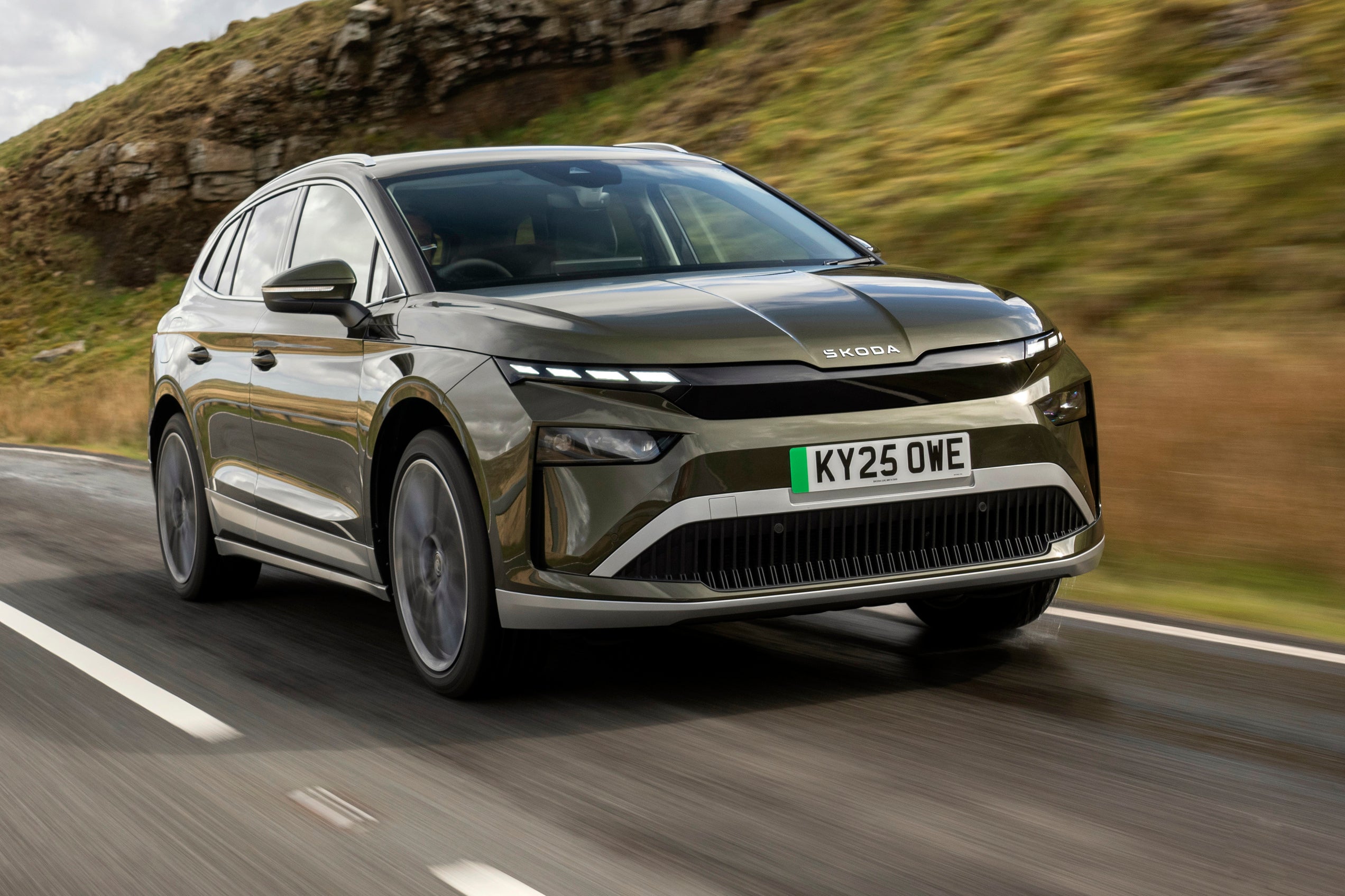
1. Skoda Elroq
Year launched: 2024

The Skoda Elroq gets the balance of size, space, price and equipment spot on. It’s a really useful size – big enough to be a practical family car, but without feeling so large as to make it difficult to park. It’s also lovely to drive, with a smooth ride quality, great visibility and a driving position that’s adjustable for all shapes and sizes.
All versions get a large central multimedia touchscreen with wireless phone mirroring, while higher specification versions add a head-up display, upgraded seats and a Canton sound system.
Thankfully, Skoda has stucks with some physical buttons on the dashboard, making the infotainment system less frustrating to use than cars with giant screens but poor software – there are plenty of those around. The boot features the sort of practical hooks, nets and dividers that make everyday family life that little bit easier. Official driving range figures go up to 370 miles for the models with the largest 84kWh battery.
The Elroq’s main strength is value. It offers much of the appeal of cars including the Volkswagen ID.4 and Cupra Tavascan for less money. But it does arguably feel like it’s had most of its personality buffed out – even the sporty Skoda Elroq vRS version feels quick rather than engaging. Other cars on this list have more character, but in all other regards, the Skoda Elroq's the electric SUV to have.
2. Kia EV3
Year launched: 2024

The Kia EV3 is the Korean firm's attempt to shrink the big EV styling, technology and feel of the brilliant Kia EV9 down into a smaller, cost-effective package. Yet this process hasn't made it feel at all like a budget car. Interior quality is superb, the dashboard design is genuinely interesting and space is excellent for a compact SUV. Proper rear-seat room and a flexible boot make the EV3 brilliant for family life.
On the road it’s easy-going rather than sporty, with light steering and a focus on comfort – the kind of qualities that make commuting feel effortless. Battery options are between 58.3kWh and 81.4kWh, with long range versions boasting up to 375 miles of official driving potential before needing plugging in. Recharging speeds of up to 128kW make quick work of replenishing the batteries on longer trips.
Kia’s infotainment system remains one of the more user-friendly setups around while its Blind-Spot View Monitor warning displays, integrated into the driver's display screen of EV3 GT-Line S versions, are an especially useful piece of safety technology.
Costing from around £31,500 after the Electric Car Grant (ECG) discount has been applied, the Kia EV3 feels like a properly modern electric SUV without creeping into premium pricing. Lots of car for the money, with striking, but not overbearing, styling.
3. BYD Sealion 7
Year launched: 2024

The BYD Sealion 7 is big, quiet and very polished to drive, with a cabin that feels genuinely upmarket in a way you wouldn’t have associate with a brand that was new to UK buyers just a few years ago. There's plenty of room for five people inside which has a real sense of space – and the boot is a huge 520 litres with the rear seats in place.
It’s very clearly set up for comfort rather than driving fun and while that makes it comfy most of the time – especially on the motorway – at low speeds the ride can feel over-soft. It occasionally bobs up and down like… a sea lion shuffling towards the sea, for instance.
Those gripes aside, the BYD Sealion 7 feels like so much car for the money. The giant multimedia touchscreen is standard, which rotates between portrait and landscape modes – a neat party trick, if nothing else. Straight-line performance is impressive: 0-62mph in 4.5 seconds for the Excellence AWD version is impressive in a car this big and soft, yet its claimed driving range is a very handy 312 miles – While that range-topping version costs £59,000, the entry-level Sealion 7 Comfort can still cover 300 miles on a charge, yet it costs £47k.
4. Tesla Model Y
Year launched: 2021

The best compliment you can give the Tesla Model Y is that it still feels fresh and cutting edge. It was updated in 2025 with a much more modern look but the same basic appeal: epic speed and an overall sense that it was built by tech people for tech people.
It’s a great car with a spacious cabin, a massive boot space and a multimedia touchscreen that – once you get used to it – becomes second nature to use. And it's actually good fun to use, too. How many car touchscreens can you say that about?
The ride is a little on the firm side and the quality of the interior materials can feel second-rate compared to similarly priced SUVs, but what makes the Tesla so appealing is the the brands Supercharger infrastructure. It's still the Model Y's big real-world advantage – plug into it and you can stick 200 miles into the battery in just 15 minutes.
Combine that effortless long-distance capability with its ironclad residual values and it’s easy to see why the Tesla Model Y remains such a popular choice among buyers who want an electric SUV.
5. Hyundai Kona Electric
Year launched: 2023
.jpg)
It’s may not be especially glamorous, but the Hyundai Kona Electric is one of those cars that quietly gets on with being good – literally and metaphorically. From the driver’s seat it feels genuinely compact, making it an easy-to-drive car in town, but it still has space enough for four adults plus a 466-litre boot – usefully big enough for large shops or weekends away.
Inside, it’s improved massively over its predecessor. The twin-screen setup feels modern plus there are physical controls where you need them, which is refreshing in 2026.
It drives in a very relaxed, slightly soft way. That’s great for comfort, but not so much if you’re expecting any kind of engagement. While the driving range is decent, it doesn’t quite have the long-legged range of newer EVs of this type. You’re looking at about 250 miles in real life from a battery that Hyundai quotes up to 319 miles for.
Prices start at £35,000 which means the Hyundai Kona Electric doesn’t look inexpensive compared with some newer electric SUVs these days. The line-up comprises Advance, N Line, Ultimate specifications but we think you’re best off with the entry-level Advance version which comes with a heat pump, LED headlights, adaptive cruise control and rear parking sensors as standard.
6. Cupra Tavascan
Year launched: 2024

The Cupra Tavascan is a genuinely interesting SUV. It looks dramatic, with its sharp angles and low side profile that help it stand out compared to most of the boxy alternatives you see on the road.
Inside, it leans into that sporty feeling again, with a driver-focused layout where the multimedia touchscreen is angled towards the driver a little. The Tavascan's cabin certainly feels more ‘styled’ than the closely related Volkswagen ID.4's or Skoda Enyaq's do, with so many surfaces, textures and lights to take in.
Choose a Tavascan and you’ll enjoy one of the most entertaining-to-drive SUVs on the market as it’s a little sharper to steer and firmer over the road than most. The trade-off is practicality, not being quite as comfortable or big as others. As you’d expect from a Cupra, every Tavascan is quick – as little as 5.5 seconds for the 0-62mph benchmark with the fastest – plus the battery range is decent with up to 345 miles claimed for the most efficient 77kWh battery version.
Priced from a smidgen under £40,000 means the less expensive Cupra Tavascan derivatives are strong value for money. If you fancy an electric car that's been injected with some genuine visual and driving theatre, this is the one to go for.
7. MG IM6
Year launched: 2025

A newcomer to the UK, the IM sub-brand is an upmarket offshoot of MG aimed at the Tesla Model Y. But despite Tesla's head stat, the MG IM6 is a strong proposition. In fact, we'd go as far as to say that in some aspects, it's better. Its interior is plusher – including outstandingly comfy front seats – and the screen controls are easy to fathom.
It’s also comfortable while being blessed with blistering pace; the IM6 Performance model has more power than a Lamborghini Huracan. It’s far from riveting to drive, but that kind of straight-line performance – 751PS and 0-62mph in 3.5 seconds – cannot be ignored.
The premium positioning means the MG IM6 costs from £48,500, but for that you get the Long Range version with up 388 miles of claimed driving range, with kit list so long that your only option is paint colour. In a world full of Tesla Model Ys, the IM6 feels like a left-field alternative but one that's not a compromise.
8. Volkswagen ID.4
Year launched: 2021
.jpg)
The Volkswagen ID.4 is still one of the easiest electric cars to live with. It’s spacious, comfortable, has great battery range and fathomable on-board technology. Visibility is great and the seating position has a wide range of adjustability and comfort. In short, it's the sort of car that you can do the school run in but still melts motorway miles away without any drama.
Across the range you get a choice of battery sizes (52kWh, 77kWh and 79kWh), with real-world range sitting roughly between 235 and 340 miles depending on the version chosen. Power outputs run from around 190PS in the entry-level cars up to 299PS, while the VW ID.4 GTX cranks that up to 340PS and knocks the 0-62mph time down to 5.4 seconds.
Charging tops out at 165kW on most of the newest ID.4s, meaning a 10-80% top-up typically takes 29 minutes. Specifications-wise, you’re looking at a choice of Essential, Match and Black Edition, with GTX Edition sitting at the sporty end. The higher you go, the more you get things such as bigger multimedia touchscreens, upgraded driver assistance and nicer interior finishes.
In the cabin, the absence of a transmission tunnel means there is lots of storage space up front, while the flat floor in the back means three adults can sit across the rear bench without knocking knees. This clever use of space extends to the cavernous 533-litre boot, making it as adept at swallowing a week's worth of holiday luggage as it is at handling the weekly shop.
9. BMW iX3
Year launched: 2025

The latest BMW iX3 is a ground-breaking car for the brand. Unlike the previous-generation BMW iX3, which was based on the combustion-engined X3 of the time, this generation is built from the ground-up on BMW's new, EV-dedicated Neue Klasse platform. It represents a complete reset on how BMW designs, powers and builds its electric cars
That means you get more usable space inside without the car getting bigger, including better storage where it actually matters in daily use. It also means the battery sits more naturally along the floor, which helps stability and makes the iX3 feel calmer and more settled on the road. And the range is fantastic – up to 500 miles on the best models.
Charging is equally impressive: a 10-80% top-up can be done in roughly 20 minutes if you find the right charger. You get a choice of rear-wheel drive iX3 40 or dual-motor iX3 50 xDrive, with power ranging from roughly 320PS up to around 469PS – so even the less gutsy one one feels quick.
None of this is cheap, though, with BMW iX3 prices starting at £53,250 and rising to £64,645, before climbing well over the £70k mark when you add extras. This is a fancy-feeling car with a fancy price.
10. Volvo EX90
Year launched: 2024

Everything you know about this Swedish brand – calm, safety, comfort – hits its apex in the Volvo EX90. It’s a truly luxurious experience but it's also a proper seven-seater. Unlike some rivals, the third row isn’t just for show.
Inside, it’s very minimalist: the clean lines, neat design and huge multimedia touchscreen mean there's a real focus on making it uncluttered. It’s a lovely place to spend time, especially on long journeys. On the road it’s all about soft and quiet refinement, which is enhanced by electric power that’s quick and virtually silent. The downside is its weight and size. You feel it when parking as it's not exactly nimble in tight spaces.
Three levels of power are available ranging from 333PS to 680PS, with a 92kWh battery for the least powerful and all other EX90s supported by a 106kWh alternative. Despite a 14kWh capacity difference, official driving range figures only vary between 346 and 380 miles, depending on specification.
This may not seem that impressive on paper, but remember the Volvo EX90 is a huge SUV that can seat seven adults – even the lightest model weighs over 2.5 tonnes. Some of Volvo’s most advanced safety features are also available, including a roof-mounted lidar system designed to read the road far ahead and prepare for hazards before you’d realistically be able to react.
As of 2026, and according to the WLTP battery range test, the longest range electric SUV is the Volvo EX60, at 503 miles, closely followed by the BMW iX3, with 500.
They’re both expensive, though, so if you want something more reasonably priced, cars like the Tesla Model Y Long Range, the Skoda Enyaq 85 and the Hyundai Ioniq 5 Long Range all offer battery ranges exceeding 300 miles of claimed range.
Real-world range depends on all kinds of factors, including how you drive and the outside temperature.
In most cases, yes. And by a significant amount. Electricity is generally cheaper than petrol or diesel on a cost-per-mile basis, especially if you charge at home overnight. This can be made cheaper still by switching to an EV-specific tariff.
Electric vehicles also require less routine maintenance because they have fewer moving parts.
The Skoda Enyaq remains one of the strongest family-focused electric SUVs thanks to its spacious cabin, large boot and comfortable ride. Larger families should also consider the seven-seat Kia EV9.
Charging times depend on the battery size, the car's on-board charger and the energy flow from the electrical source. In the most modern EVs, a rapid public charger can add a couple of hundred miles in less than half an hour. A home wall box will typically recharge most electric SUVs in 10-12 hours.
Modern electric SUVs are far better suited to motorway journeys than many people expect. Models such as the Tesla Model Y, Skoda Elroq, VW ID.4 and BMW iX3 combine strong range with rapid charging capability, making long-distance travel straightforward.