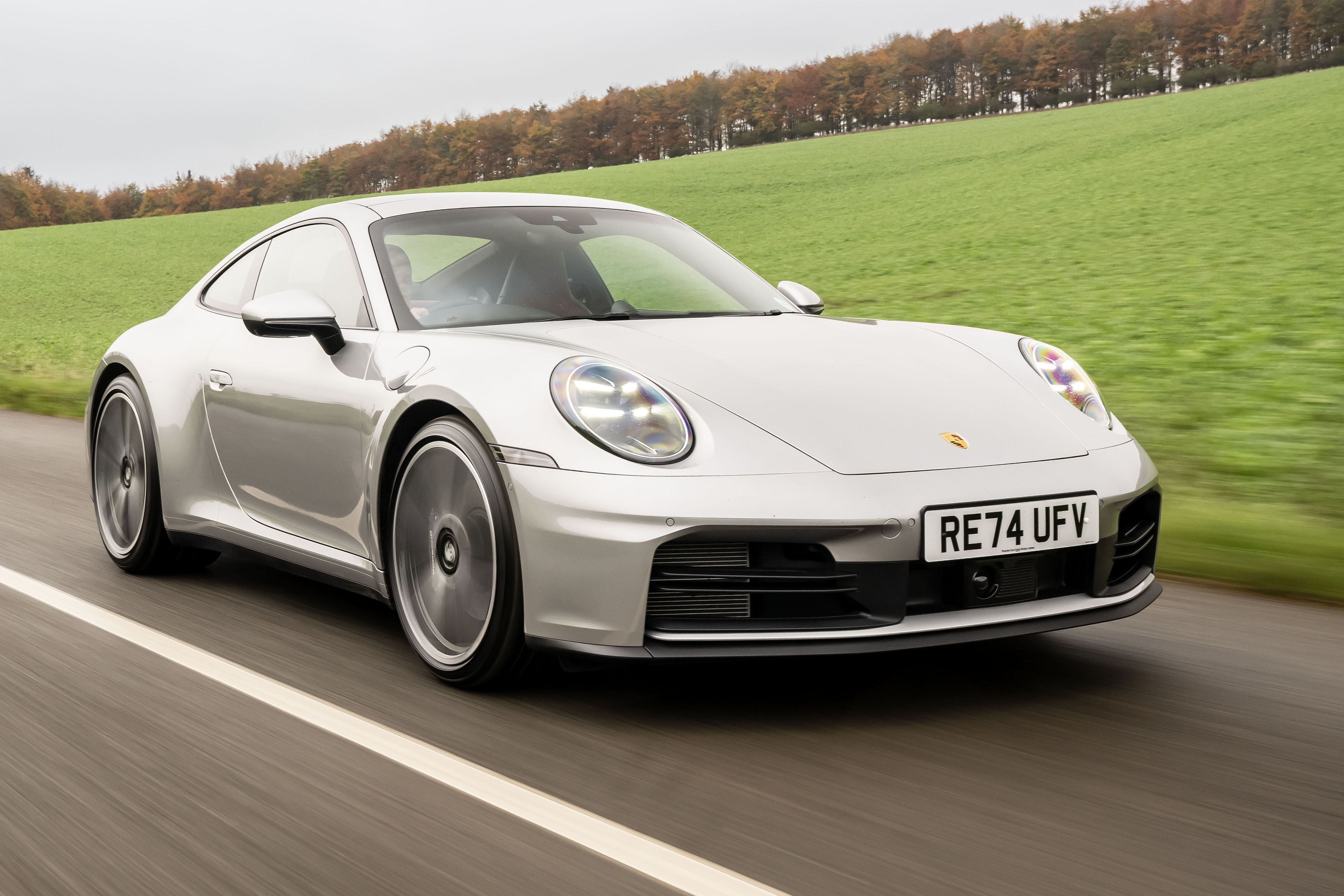
Porsche 718 Boxster Review

Written By Andrew Brady
- 2016
- Roadster
- Petrol
What we love
Still one of the best-balanced sports cars of its kind
Surprisingly usable for everyday life
The 4.0-litre GTS is a truly special thing
Things to consider
The turbo four-cylinder cars lack the charm of sixes
Porsche options make like-for-like comparisons tricky
Manual examples are rare
The DRIVE take on the Porsche 718, is it the right car for you?
The Porsche 718 Boxster remains a hugely convincing used sports car if you want something that feels special every time you drive it, but does not fall apart the moment daily life intrudes. It’s beautifully balanced, genuinely usable and still feels like the dynamic benchmark in this sort of price bracket.
Not every version has the same emotional pull, and the turbocharged four-cylinder cars remain the most divisive, but even the lesser Boxsters are remarkably complete sports cars. If you want an open-top performance car that can be both thrilling and easy to live with, the 718 Boxster still makes a very strong case.
The Porsche 718 in more detail
The 718 Boxster had one of the trickiest jobs in modern Porsche history. The Boxster was already deeply respected, but the move from naturally aspirated six-cylinder engines to turbocharged four-cylinder power in 2016 changed the character of the car in a way that some buyers found hard to forgive.
That backlash was understandable. The old flat-six Boxsters sounded wonderful and gave the car much of its emotional appeal. The newer turbo engines had punchier mid-ranges, were easier to use day to day and more efficient on paper, but they did not sound as special, and they lacked some of the old engine’s natural sweetness.
What saved the 718 Boxster was that the underlying car was, and still is, superb. The chassis is sensational, the steering beautifully judged, and the whole car feels lighter, more agile and more intuitive than most rivals. Even when buyers argued about the engine, very few argued about how well it drove.
Porsche later corrected some of the emotional shortfall by reintroducing naturally aspirated six-cylinder power at the top of the range. That gave the 718 line a second layer of appeal, because suddenly buyers could choose between the everyday punch of the turbo cars and the richer, more dramatic experience of the 4.0-litre GTS and Spyder.
That matters even more now. In the UK, the 718 Boxster is best treated as a nearly-new or used proposition rather than a straightforward live showroom model, and there’s still no direct replacement in place yet. That suits it rather well, because it lets the car stand on its own merits. It remains one of the most complete sports cars of its era: fast, practical enough, beautifully engineered and still the roadster by which many rivals are judged.
What's the best Porsche 718 trim and engine option?
For most buyers, there are really two sweet spots. The rational choice is the standard 2.0-litre 718 Boxster with a careful specification. It is quick, still brilliant to drive and often the easiest way into the car without spending deep into Porsche money.
The heart-over-head choice is the GTS 4.0, and that is the one we would choose if budget allows. It restores the naturally aspirated six-cylinder character many people felt the earlier 718 range lost, and it turns the Boxster into something much more memorable without undermining its everyday usability. Or if you have an even higher budget, there’s the Spyder and Spyder RS to consider.
The Boxster T has its own appeal if you want the slightly more focused chassis feel and do not mind that it uses the base 2.0-litre engine. The S is usefully faster, but for many buyers the jump to the GTS 4.0 is the one that feels most significant.
What’s the price of the Porsche 718?
Used 718 Boxster prices now start from around £35,000 for earlier 2.0-litre cars, while Boxster S, T, and especially GTS 4.0 models sit significantly higher. And inevitably, it’s more again if you want a Spyder or Spyder RS.
There’s plenty of choice in the market, but Porsche options matter enormously here. Two cars that look similar in the classifieds can feel very different in reality, depending on wheels, seats, suspension, stereo, sports exhaust and whether or not they have PDK.
For many buyers, the best value sits with a carefully chosen base car or a well-specced S rather than the very cheapest example or the most expensive GTS.
Alternatives to the Porsche 718
The Alpine A110 is the obvious alternative if lightness and delicacy matter most, though it’s less practical and does not offer the same open-top appeal. The BMW Z4 is another roadster rival, but it’s softer-edged and nowhere near as special to drive.
The Audi TT Roadster and Mercedes-Benz SLC were natural alternatives when new, but neither gets close dynamically. A used 911 Cabriolet also sits in the background for many buyers, but the Boxster remains the more focused and more intimate sports car.
What's the interior like in the Porsche 718?
The 718 Boxster’s cabin is not the most flamboyant in the class, but it is very clearly built around the driver. The ergonomics are strong, the quality is excellent, and it feels every inch a proper Porsche sports car rather than a lifestyle roadster.
Porsche 718 boot space and practicality
The 718 Boxster remains surprisingly useful for a two-seat sports car. There’s enough space in the cabin for taller adults, the driving position is excellent, and visibility is far better than you might expect from something this low.
Its clever trick is that it has two luggage compartments. There’s a front boot and a rear boot, and together they give the Boxster far more carrying ability than most rivals. Total capacity is 275 litres, which is enough for a weekend away and then some if you pack sensibly.
There’s not much loose-item storage inside the cabin itself, but that is easier to forgive when the car is otherwise such a credible everyday proposition.
Porsche 718 dimensions
The Porsche 718 Boxster measures 4,379mm long, 1,801mm wide and 1,281mm high. That makes it compact by modern standards, which is one of the reasons it feels so manageable on British roads.
It is low and wide enough to feel special, but never so large that it becomes a chore to place or park.
Tech and infotainment in the Porsche 718
All 718 Boxsters use Porsche Communication Management, centred around a 7.0-inch touchscreen on earlier cars and later improved through updates and options. It is not the flashiest system now, but it remains logical enough to use.
The bigger issue is that Porsche's options culture extended into the infotainment, too. Navigation, upgraded audio, and various convenience features were not always standard, so what you get depends heavily on the original specification.
As with many Porsches, it is worth buying the right car rather than simply the right model badge.
In stark contrast to pretty much everything else available just before the 718 Boxster went off sale, the model had a mostly physical instrument cluster with fabulous-looking analogue gauges. A small but useful multifunction screen is placed to the right.
Materials available on the Porsche 718
As standard, the 718 Boxster came with part-leather, part Race-Tex (a microfibre fabric) seats. As we’ve already made clear, there were myriad options beyond that, including multiple leather options and carbon fibre inlay packages.
You could spec different colour stitching and/or coloured seatbelts, or go truly wild with either the Porsche Exclusive Manufaktur service or the even more special (and expensive) Sonderwunsch (special request) department. This can make browsing for used examples quite complicated if there’s something in particular you’re looking for.
What's the Porsche 718 like to drive?
The 718 Boxster remains one of those rare sports cars where the brilliance is obvious within a few corners. It feels poised, alive and wonderfully intuitive, even at sensible road speeds.
Porsche 718 range and performance
The standard Boxster uses a 2.0-litre turbocharged flat-four with 300PS, while the Boxster S moves to a 2.5-litre turbo flat-four with 350PS. Both are seriously quick, and in day-to-day terms, they are easier and more flexible than the old naturally aspirated six-cylinder engines they replaced.
The problem is not pace, it’s personality. The four-cylinder engines do the job very effectively, but they lack the richness and sense of occasion many people expect from a Porsche sports car.
That is why the later GTS 4.0 matters so much. Its naturally aspirated six-cylinder engine transforms the Boxster’s character, giving it the sort of soundtrack, throttle response and upper-rev drama that make the car feel genuinely special.
That same engine is also found in the special Boxster Spyder, while the even more exclusive Spyder RS has a unit borrowed from the 911 GT3 RS that kicks out 500PS and revs to a spine-tingling 9,000rpm.
A curveball in all this is the Boxster T. It keeps the 2.0-litre engine but pairs it with a slightly more driver-focused chassis setup and a purer, more stripped-back appeal.
Manual and PDK versions both have merit. The manual suits the car’s interactive nature beautifully, but the PDK is so good that it remains a completely valid choice, especially if you plan to use the car regularly.
Performance data
| Model | Engine/battery size | Power | 0-62mph | Range/MPG |
|---|---|---|---|---|
Boxster | 2.0-litre | 300PS | 5.1 seconds | Up tp 31.7mpg |
Boxster S | 2.5-litre | 350PS | 4.6 seconds | Up to 29.4mpg |
Boxster GTS 4.0 | 4.0-litre | 400PS | 4.5 seconds | Up to 25.9mpg |
Boxster Spyder | 4.0-litre | 420PS | 4.4 seconds | Up to 28mpg |
Boxster Spyder RS | 4.0-litre | 500PS | 3.2 seconds | Up to 21.7mpg |
Porsche 718 driving and refinement
The Boxster’s chassis is the reason the car still sits at the top of this class. The steering is precise, the front end feels alive, and the car pivots with the sort of balance that makes it feel instinctive almost immediately.
Even the standard car is genuinely rewarding, and you don’t need huge power to enjoy it. The S adds more pace and more punch, but it is the chassis quality that defines the experience.
The T sharpens the focus again, while the GTS 4.0 adds the engine that the rest of the car always deserved.
Ride quality is also one of the Boxster’s underrated strengths. It can be firm, especially on larger wheels and in more focused configurations, but it rarely feels clumsy or brittle. Refinement is strong for a fabric-roof sports car too, which is another reason the 718 Boxster works so well as an everyday proposition.
Just bear in mind that the Spyder is a bit firmer, and the RS firmer still, to the point where the latter is less palatable as a daily driven prospect.
How safe is the Porsche 718?
The 718 Boxster was not tested by Euro NCAP, which is not unusual for a low-volume sports car in this part of the market.
It still offers the expected core safety structure, airbags and stability systems, though it lacks the more comprehensive driver-assistance suite that has become common in ordinary premium cars. As ever, check the exact specification because some assistance features were optional.
Running costs: What it's like to live with a Porsche 718
The 718 Boxster is not a cheap car to run, but it is more manageable than many exotic alternatives. Fuel, tyres, servicing and Porsche option-led purchase prices all need watching.
The thing to remember is that the Boxster backs those costs up with genuine usability. This is not a weekend toy that becomes a nuisance the moment the novelty fades. It can work as proper everyday transport if you want it to.
Porsche 718 fuel economy
Fuel economy depends heavily on which version you choose. The turbocharged 2.0-litre and 2.5-litre cars are the most efficient on paper, with the standard Boxster returning the strongest official number of the mainstream range.
The GTS 4.0 is naturally thirstier, but in context it remains acceptable for something with this sort of performance and character. As always, real-world results will depend far more on how often you use the performance than on the brochure figure.
The Spyder’s economy is similar to the GTS 4.0-litre, but if you opt for the RS, the MPG drops dramatically. We suspect you might not care about more frequent fuel stops when you hear what it sounds like approaching the 9,000rpm redline, though.
Porsche 718 warranty and servicing
Any remaining manufacturer warranty will depend on the age of the car, but Porsche-backed cars remain the most reassuring place to start.
Porsche’s Approved Warranty can apply up to 15 years of vehicle age, provided the car meets the required conditions, which is useful reassurance on a used performance car.
On cars like this, condition and history matter more than almost anything else. A specialist inspection and a full record of servicing, tyres and brakes are worth prioritising.
Porsche 718 insurance groups
Insurance sits firmly in sports-car territory. Even the standard Boxster is not especially cheap to cover, and S and GTS models push higher still.
Even the entry level is in group 45, while the S is in 46, the GTS in 49 and the Spyder plus Spyder RS in 50, the highest group of all.
How much does it cost to tax a Porsche 718?
For most 718 Boxsters first registered on or after 1 April 2017, the standard annual VED rate is now £200.
Because all 718 Boxsters originally cost more than £40,000, they are also caught by the Expensive Car Supplement for five years from the second licence. That takes the annual bill to £640.
What trims are available with the Porsche 718?
The main range consisted of the Boxster, Boxster T, Boxster S and GTS 4.0.
All versions get a reasonable amount of equipment, including climate control, a six-speaker sound system, the 7.0-inch infotainment system and an electronically folding fabric roof. If you wanted more equipment than that, generally your best bet was to add options – the different grades of 718 are more about mechanical differences than kit, but there are some changes as you climb up through the range.
The 718 Boxster S adds 19-inch alloy wheels (the standard Boxster is on 18s unless optioned otherwise), while the GTS adds the Sport Chrono package (also standard on the T), adaptive suspension, a sports exhaust and 20-inch alloy wheels.
Ask the Drive experts: common questions
Is the Porsche 718 Boxster still on sale new in the UK?
Is there a direct replacement for the Porsche 718 Boxster?
Is the Porsche 718 Boxster still worth buying?
Which Porsche 718 Boxster is best?
Get our latest advice, news and offers
Keep me updated by email with the latest advice, news and offers from Drive.
.jpg)

.jpg)