Porsche 911 Review

Written By Matt Robinson
- 2018
- Coupe
- Petrol, hybrid
What we love
Exceptional to drive
Powerful and characterful engines
Wide range means there’s a version for everyone
Things to consider
Range is broad, so choosing the right version matters
Manual gearboxes are limited to selected versions
Options can make specification vary significantly
The DRIVE take on the Porsche 911, is it the right car for you?
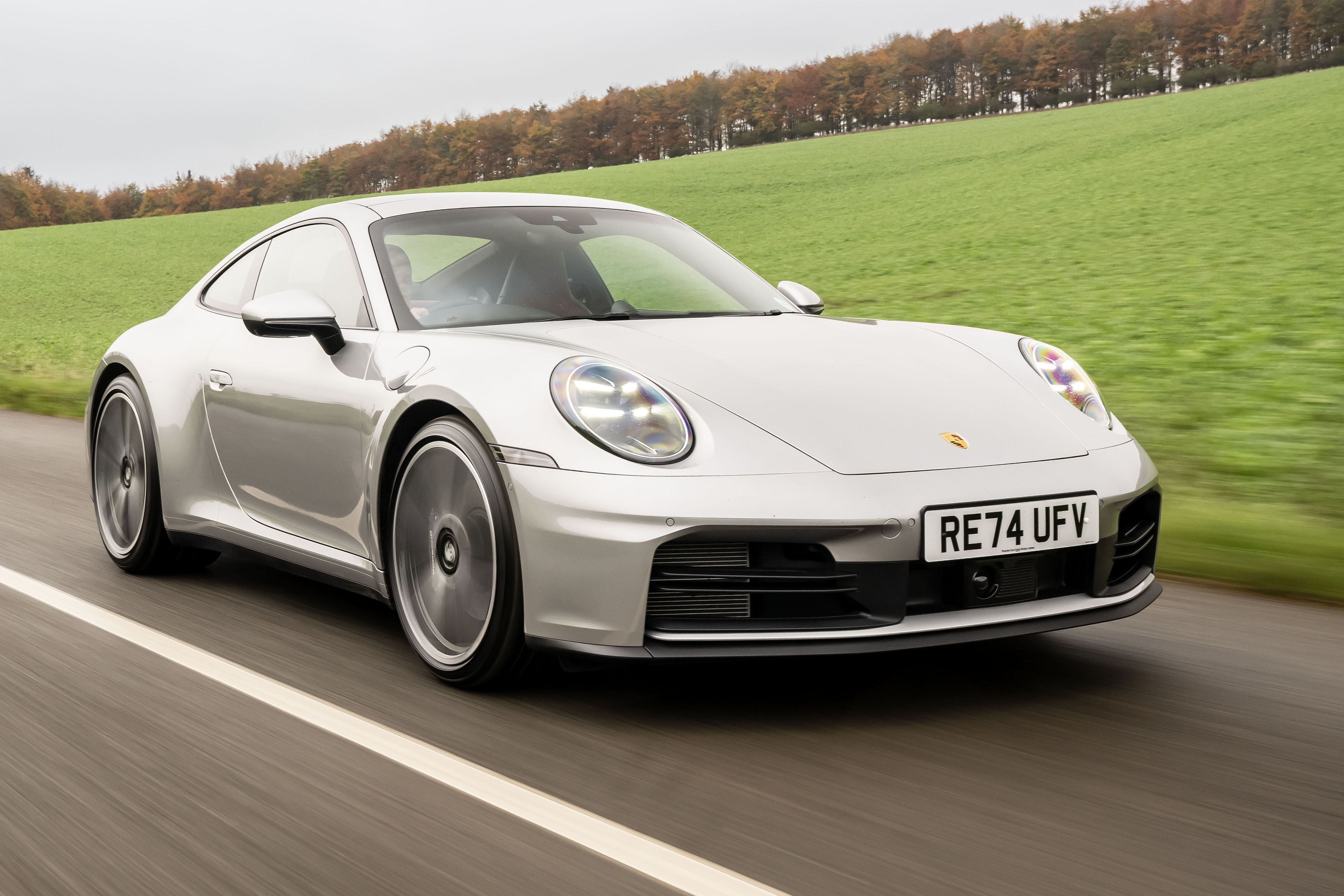
The Porsche 911 is probably the best sports car money can buy, but with such a large and diverse range of options, some versions stray into supercar territory.
Performance varies from fast to very, very fast. Some are super-focused and feel most at home on the track, while other 911 derivatives are surprisingly well-suited to day-to-day driving. Whichever you go for, the way the 911 drives will keep you feeling thrilled and involved.
The Porsche 911 in more detail
The Porsche 911 has been around since 1963, but Porsche has continually evolved its evergreen sports car, not just for the road, but for racetracks globally, where it’s won in every category it’s ever been raced in.
Its success hasn’t just been on the race track, with the 911 having sold over 1 million examples since the 60s, with the current 911 Carrera, described as the 992 model, having been introduced in 2019. It’s the eighth generation of 911, and like its predecessors, it was originally offered in a variety of guises, in coupe, cabriolet and Targa body styles, with rear- or four-wheel drive, in standard Carrera, Carrera S, Carrera T or range-topping Turbo S forms.
Browse used Porsche 911s for sale →
To that already extensive line-up, Porsche added a GTS trim, as well as more focused track-biased models from its Motorsport division, badged GT3 and GT3 RS. On occasion, Porsche produces other special editions and models, too, celebrating significant anniversaries, dropping weight, adding power and all sating collectors’ desires for low-volume, often numbered models.
Power for the standard 911 Carrera is 394PS, from a turbocharged 3.0-litre flat-six engine, with the Carrera S upping that output to 480PS. At the top end of the 911 pile is the Turbo S, which has a hybrid 3.6-litre turbocharged engine that delivers an incredible 711PS output and levels of performance that were once the exclusive preserve of hypercars.
Even with that surfeit of power, the Turbo S retains the usability of its Carrera relations, the 911’s enduring success largely down to its unusual usefulness against its sports car contemporaries. A 2+2, with a pair of, admittedly small, rear seats, you can get children in the back seats, or fold the seatbacks and use the space for additional luggage capacity.
The 911’s engine configuration of being a flat, boxer unit, and its positioning in the rear, behind the rear wheels facilitates that good-sized cabin, as well as allowing a deep luggage compartment under the front bonnet.
With every generation, Porsche’s engineers have made it ever easier to drive and more surefooted and predictable, but they’ve done so without sacrificing the core driver appeal that makes the 911, any 911, an absolute joy to drive.
The consummate all-rounder, the Porsche 911’s enduring appeal is largely thanks to its huge bandwidth, not just in performance and capability, but also in its usability. And that’s rare in this class. It’s not only one of the best sports cars you can buy, but one with GT and supercar genes in the mix. It drives exceptionally, looks sensational and is beautifully built.
What's the best Porsche 911 trim and engine option?
Asking this opens up a can of worms, so we’ll try our best to answer this as succinctly as we can. The ultimate expression of a road-going Porsche 911 is arguably the GT3, with its high-revving, naturally aspirated engine and super-sharp chassis.
Yes, the GT3 RS takes things further still, but that’s getting on for being a racing car for the road, so it’s just not as useable. And yes, the 911 Turbo S is much faster, but you aren’t going to use all its output legally on the road for more than a few seconds, and it doesn’t make as good a noise as the GT3. Plus, the GT3 Touring is now available with optional rear seats, making it surprisingly practical.
Of the 911s that are a bit easier to get hold of, our preferred option is the Carrera T. This combines the standard Carrera engine (albeit with a slight boost in power) with a manual gearbox, a reduction in soundproofing for both weight reduction and to give you more engine noise, and a more focused chassis.
On top of choosing which derivative you want, you may then also need to choose which body style you want. Porsche makes the 911 as a coupe, a cabriolet, and as a Targa, the latter being a sort of halfway house where a smaller roof section folds underneath a wraparound glass rear windscreen and roll hoop.
Some types of 911 are available as a coupe only, so you don’t need to worry about this, while some can be specced as a coupe or cabriolet, and in a few cases, you can pick between all three.
Just to throw one more choice into the mix, some variants can be specced as an all-wheel drive ‘4’. This makes for a car that’s more capable in wet conditions, but it doesn’t feel like something the 911 is clamouring after.
What’s the price of the Porsche 911?
Highlighting the breadth of the Porsche 911 range, you can pay anything from £103,700 to £209,100 on one. And you can add tens of thousands of pounds on top of that in options, especially if using Porsche’s Sonderwunsch bespoke programme.
£103,700 gets you into the entry-level 911 Carrera, and then it’s £115,400 for a 911 Carrera T and £120,500 for a 911 Carrera S. The cheapest GTS is £137,900, and you’ll need to part with £158,200 for either a 911 GT3 or 911 GT3 Touring.
At the pointy end of the range is the £192,600 911 GT3 RS, and the £199,100 911 Turbo S.
Where available, switching to a ‘4’ all-wheel drive variant incurs a £6,500 premium, and it’s £10,000 extra for Cabriolet versions of the above where they exist. The Targa roof is only available on the 4S and 4 GTS, and they’re not cheap, coming in at £137,600 and £154,400 respectively. There are also plenty of used Porsche 911s for sale for considerably less.
Porsche 911 residual values are very strong, so although you can make big savings by going for a used example, you’ll still be paying upwards of £70,000.
Alternatives to the Porsche 911
This is a tricky one. The 911 range is so expansive that it rivals anything from high-end sports cars to supercars. At the pointier end of the range, especially when looking at the ultra-fast Turbo S, you could compare the 911 to the McLaren Artura, or perhaps the Ferrari 296 and Lamborghini Temerio, although the latter two are much more expensive.
It’s more difficult to find a clear alternative to the lower-end models, especially now that cars like the Nissan GT-R, Jaguar F-Type and Audi R8 are no longer with us. The Mercedes-AMG GT always used to be a good foil for the cheaper 911 Carrera models, if not quite as sharp to drive, but it’s quite expensive these days – the cheapest V8 is nearly £150,000.
What's the interior like in the Porsche 911?
The 911’s cabin is roomier than you might expect, thanks to the car’s unique rear-engined layout giving a set of small seats in most models, which can be folded to provide more cargo room. It’s a sports car through and through with a driver-focused cockpit, but you still get a very useable infotainment system and a decent-sized digital instrument cluster.
Porsche 911 boot space and practicality
The 911 doesn’t have a traditional boot, with its rear-engined layout making such a thing impossible. Conversely, that means it can have a decent-sized ‘frunk’ front storage compartment offering 162 litres of space.
You’ll be able to stow more than that behind the front seats if you fold the rear bench - 373 litres, in fact. That’s a more practical configuration for the 911 than actually using those rear seats, as they’re so small that you’ll struggle to get anyone larger than a small child back there. That said, many rival cars are strict two-seaters, so it’s nice to have the flexibility, which owners with younger kids might appreciate.
Some versions of the 911 do without the rear seats, such as the GT3 and GT3 RS, because there’s a roll cage in the way. The GT3 Touring and Carrera T do without rear seats as standard, but you can option them in at no cost.
Porsche 911 dimensions
Most versions of the 911 are 4,542mm long, 2,033 wide (including the mirrors) and 1,302mm tall. There are some slight variations, with the GT3 and GT3 RS body kit adding a little length, and versions with lower suspension losing a bit of height. The exception on the latter front is the GT3 RS – its wing is so big, it protrudes above the roofline and adds a small amount of height.
The 911 has grown considerably over the years, but it is still relatively compact as far as cars like this go. A Mercedes-AMG GT, for instance, is 4,728mm long, 2,100mm wide and 1,354mm tall. And spare a thought for anyone trying to get through a tight gap in a Lamborghini Temerio, which is 2,246mm wide.
Tech and infotainment in the Porsche 911
The entertainment is in the drive, but the 911’s breadth of ability makes it a very accomplished daily driver, so the infotainment offering is important. It’s all centred around a large 10.9-inch touchscreen in the middle of the dash. You can swipe and pinch for the nav, there’s app connectivity in the form of Apple CarPlay and Android Auto (earlier cars only had the former). There’s also an eight-speaker sound system, DAB, Bluetooth connectivity, a pair of USB connectors and voice control activation.
The menu system takes a bit of learning, but is configurable, with it possible to programme shortcut buttons for favourite functions, while a good deal of the operation is replicated via the steering wheel controls and small right-hand screen within the instruments. Thankfully, unlike the Panamera, Porsche has kept the ventilation and heating controls independent of the touchscreen control, with physical buttons in the transmission tunnel, that’s a very good thing indeed.
Obviously, there’s the possibility to have higher grade audio added, with the BOSE upgrade a worthwhile spend, it being a 12-speaker set-up with 570 watts, though if you really love your music, the optional Burmester system comes with 13 speakers and 855 watts of power, adding a whole new level of sound to your listening experience – it’s not cheap, though.
Materials available on the Porsche 911
To get the very best look and feel, you do admittedly have to start ticking some options, with the extended leather trim to cover the dashboard top and door tops/trims an absolute must-have extra, while things like contrasting stitching colours, and coloured seatbelts help make it feel even more special inside, too.
There’s plenty of opportunity to choose your finishes inside, from soft leather and Alcantara to metal, carbon fibre and even wood trims in a variety of colours and finishes to your choice, and if they’re not on the configurator, Porsche’s Exclusiv [sic] and Sonderwunsch (special request) departments can fulfil almost any wish – at a price – covering everything from the steering column to the air vents in myriad materials.
What's the Porsche 911 like to drive?
We’ve driven most versions of the current Porsche 911 on roads and race circuits across the world to get a good sense of the range. We’ve enjoyed every single mile. The 911 puts the driver first, with an involving, intoxicating time behind the wheel thanks to sublime handling and wonderful noises for a characterful range of six-cylinder engines. This is Porsche at its very best.
Porsche 911 range and performance
All 911 use six-cylinder engines arranged in an atypical ‘flat’ or ‘boxer’ arrangement, with the pistons lying flat and pushing outwards in two groups of three. No other road cars currently on sale use this layout, and it’s an important historical link for 911s of the past, which have all used flat-sixes.
The base Carrera has a 3.0-litre, twin-turbocharged engine that’s good for 394PS and 450Nm of torque for a 0-62mph time of 4.1 seconds, or 3.9 seconds with the Sport Chrono package added, because this includes a launch control feature. The top speed is 183mph.
The Carrera T has this same engine, but switches out the Carrera’s eight-speed dual-clutch automatic (or Porsche Doppelkupplung/PDK as the manufacturer calls it) for a six-speed manual. This is now the only 911 Carrera you can have with a manual, and its gearbox arrangement slows the 0-62mph time to 4.5 seconds. It’s a car that’s about driving engagement and fun, though, so the people interested in this particular version aren’t likely to care.
Even though these are the babies of the range, they still feel plenty fast, and make a great, characterful noise that’s unlike anything else from other brands. The engine is also surprisingly revvy and responsive for a turbocharged unit.
Really, we don’t think you need to go faster, but Porsche will happily oblige anyone who wants more pace with a Carrera S or the all-wheel drive Carrera 4S. It’s still a 3.0-litre, twin-turbo engine, but one that pumps out 480PS and 530Nm of torque. 0-62mph happens in 3.5 seconds, or 3.3 with Sport Chrono, while the top speed is 191mph.
The GTS uses a completely different 3.6-litre engine with a single turbocharger and a hybrid system. The electrical stuff is there primarily to make the car quicker, so there’s no electric-only running. That gives 541PS, while the torque sits at 570Nm. The total weight of the setup is only 50kg, so performance isn’t blunted by its presence. In fact, it’ll crack 0-62mph in three seconds dead, and carry on to a top speed of 194mph.
It feels noticeably more responsive than the Carrera and Carrera S, and makes a better noise. With the motor giving an extra boost of instantly available torque, the engine also becomes more flexible, because wherever the revs are at, it’ll be able to build speed quickly. It feels like it’s getting on for being too much for the road, though.
Perhaps it’s fitting, then, that the next most expensive 911 is actually a bit slower. That’s the 911 GT3, which uses yet another engine. This one does without turbochargers entirely, and relies on a larger displacement of 4.0 litres to generate its 510PS and 450Nm of torque.
While not as quick as the GTS, its 3.2-second 0-62mph time is not to be sniffed at, nor is the 193mph top speed. In any case, the number that really matters here is 9000rpm – the redline, at which point the GT3 sounds incredible. And as a naturally aspirated engine, it’s extremely responsive.
At no extra cost, you can swap its seven-speed dual-clutch automatic gearbox for a six-speed manual, which makes for a 3.9-second 0-62mph time. There’s also the manual-only 911 GT3 Touring, which loses the rear wing and gains the no-cost option of rear seats.
The even more track-focused GT3 RS uses a variation of the same engine bumped up to 525PS and 465Nm, although the 0-62mph time is the same as the GT3’s. The top speed is also lower at 184mph, because there’s an enormous rear wing increasing drag.
Topping the 911 range both in terms of price and performance is the Turbo S. It has a 3.6-litre, twin-turbo engine plus the hybrid stuff from the GTS, putting out an unholy 711PS and 800Nm of torque when combined. The 0-62mph time is just 2.5 seconds, and the top speed is 200mph. We’re not sure yet if a slightly less powerful, non-S model will join the ranks.
Performance data
| Model | Engine/battery size | Power | 0-62mph | Range/MPG |
|---|---|---|---|---|
Carrera | 3.0-litre | 394PS | 4.1 seconds | Up to 28.5mpg |
Carrera T | 3.0-litre | 394PS | 4.5 seconds | Up to 27.0mpg |
Carrera S | 3.0-litre | 480PS | 3.5 seconds | Up to 27.9mpg |
Carrera GTS | 3.6-litre | 541PS | 3.0 seconds | Up to 27.9mpg |
Turbo S | 3.6-litre | 711PS | 2.5 seconds | 24.6mpg |
GT3 | 4.0-litre | 510PS | 3.4 seconds | 20.5mpg |
GT3 RS | 4.0-litre | 525PS | 3.2 seconds | 21.4mpg |
Porsche 911 driving and refinement
The 911’s unusual rear-engined layout has long meant that these cars have a tendency to push a bit wide in tighter corners, but this has been dialled back over the years, and all but eradicated in the GT3 and GT3 RS models, which get their own, more sophisticated front suspension setup.
Really, you need to be pushing hard on a track to notice any of this in the Carrera models. What’s more noticeable in a greater variety of conditions is the additional traction you get from where the engine sits. The rear wheels stick to the ground so convincingly, you’ll question the need for one of the AWD ‘4’ models.
Every 911 has a stiff suspension setup, as should be expected for a sports car. Standard-fit adaptive dampers across the range do give a decent amount of comfort, although models like the GT3 and GT3 RS can feel quite stiff on uneven road surfaces and over speed bumps.
There’s also quite a difference in terms of refinement across the range. Regular 911 models do a good job of keeping you isolated from wind noise, although there is a fair bit of roar from the wide tyres Porsche fits to these cars.
Some versions like the Carrera T have reduced levels of soundproofing, which lowers the weight of the car while making for a noticeably noisier cabin. Driving enthusiasts will appreciate the extra engine noise this brings, of course, but these models can get a bit tiring to drive on long motorway jaunts.
How safe is the Porsche 911?
The 911 might be a high-performance sports car, but it’s a safe one. Along with excellent brakes, stability and a traction control system, the 911 actually recognises if the road is wet, and changes the characteristics of the drivetrain to suit.
In addition to the sophisticated drive settings, there’s an emergency call system (in the EU) full-sized, two-stage front airbags, Porsche Side Impact Protection with a head/thorax airbag for the driver and passenger, brake assist and ISOFIX mounting points for a pair of child seats in the rear, or an optional ISOFIX mount in the front passenger seat. There’s tyre pressure monitoring in all, too.
Front and rear park assist is standard, with Porsche’s more sophisticated driver aids all being on the options list. Porsche InnoDrive adds adaptive cruise control with predictive speed adjustment to the equipment at an extra cost, while there’s a night view system, Lane Change Assist and Lane Keeping Assist systems all in the cost options if you want them, too.
Running costs: What it's like to live with a Porsche 911
Some versions of the 911 are more economical than you might think, but make no mistake – all versions will involve a decent amount of investment to keep them insured, serviced and on fresh tyres. That’s to be expected for a high-performance sports car.
It is worth pointing out, though, that the 911’s residual values are excellent, with a low level of depreciation making up for the high running costs. The same can’t be said for the 911’s rivals, which typically cost as much if not more to run, but often shed significant value in the first few years.
Porsche 911 fuel economy
The Carrera versions of the 911 are more economical than you might think, with the entry-level version managing 28.5mpg. On a gentle cruise, you might even break 30mpg. From here, the fuel economy inevitably drops. The manual-only nature of the T robs it of some efficiency, managing 27mpg, then it's 27.9 for the S, the same for the GTS, 24.6mpg for the Turbo, and then a big drop to just 21.9mpg for the GT3 and 21.4mpg for the GT3 RS.
The biggest problem with the 911 in terms of fuel economy is that the engines are so enjoyable to rev out that, unless you’re especially disciplined, you’ll struggle to match the combined figures. But no one’s buying a 911 because of its fuel economy.
Porsche 911 warranty and servicing
New Porsche models come with three years of unlimited mileage warranty coverage. There’s also a Porsche Approved warranty available for purchase on models up to 15 years old with a choice of 12, 24 or 36 months of cover, again with unlimited mileage.
You’ll need to bring your 911 in for its first service after 12 months or 10,000 miles – whichever arrives first.
Porsche 911 insurance groups
All versions of the 911 are in insurance group 50, the highest one. It’ll be worth shopping around and trying specialists to get your premium down as low as possible.
How much does it cost to tax a Porsche 911?
Along with the flat rate of £200 annually from the second year of ownership onwards, you’ll need to part with an extra £440 annually from years two to six as part of the government’s Expensive Car Tax Supplement. The threshold is £40,000, which even the cheapest 911 is well beyond.
What trims are available with the Porsche 911?
The 911 isn’t available in trim levels as such – each of the models below has distinct mechanical variations. There are some equipment differences between each, though.
The entry-level Porsche 911 Carrera comes with 19-inch front, 20-inch rear wheels, adaptive suspension, matrix LED headlights, front and rear parking sensors, a rear parking camera, electrically adjustable and folding door mirrors with electric folding, wireless smartphone charging, wireless Android Auto and Apple CarPlay, electrically adjustable front seats, cruise control, a heated steering wheel and dual-zone climate control.
The 911 Carrera T switches to a set of 20-inch front, 21-inch rear wheels while adding black exterior detailing, a different steering wheel design and the Sport Chrono Package. The Carrera S is broadly the same as the entry-level Carrera, aside from the addition of silver 20-inch front, 21-inch rear wheels.
The 911 GTS gets the same size wheels, but they’re special forged ones. There’s also a 12-speaker Bose surround system, the Sport Chrono package, black exterior detailing and Race-Tex fabric interior upholstery included at no extra cost.
Although it gets a radically different technical setup with a different engine and an aero package, in terms of actual equipment, the 911 GT3 is pretty much the same as the 911 Carrera, albeit with a set of GT3-specific 20-inch front, 21-inch rear wheels.
The same goes for even more GT3 RS, which gets yet another distinct set of 20-inch front/21-inch rear wheels, while switching the front seats for carbon fibre-reinforced plastic bucket seats.
All of the Carrera’s kit is carried over to the Turbo S, which includes, again, some model-specific 20/21-inch wheels, and much more besides. The equipment upgrades include fancier matrix LED headlights, the Bose sound system, Sport Chrono Package and carbon fibre interior trim.
Ask the Drive experts: common questions
How much is a Porsche 911?
Why is it called a Porsche 911?
Is the Porsche 911 a supercar?
Get our latest advice, news and offers
Keep me updated by email with the latest advice, news and offers from Drive.