Audi RS 3 Review

Written By Lawrence Allan
- 2021
- Hatchback or saloon
- Petrol
What we love
Five-cylinder engine still feels genuinely special
Devastating pace in all weather
Broad enough to use every day
Things to consider
Premium pricing reflects its performance focus
Sportback boot prioritises everyday essentials
Driving character is dominated by grip and performance
The DRIVE take on the Audi Rs3, is it the right car for you?
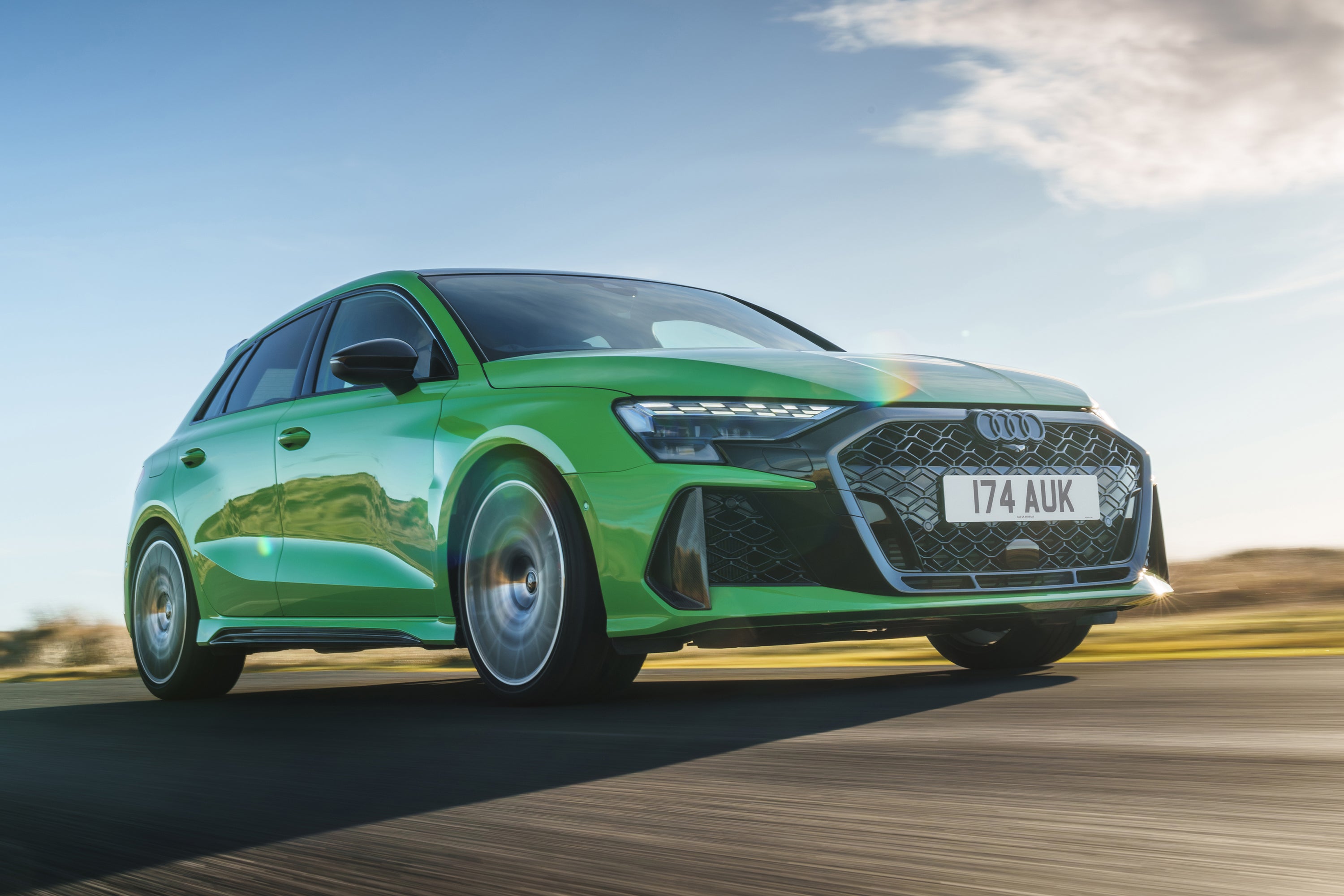
The Audi RS 3 remains one of the great modern performance cars because it manages to feel wild and usable at the same time. The five-cylinder engine still gives it a sense of theatre that most rivals cannot match, the current chassis is much more adjustable than older RS 3s, and it is refined enough to use every day without resentment. The Sportback still makes the strongest case for most buyers because it combines all that pace with hatchback practicality, but the Saloon is worth a look if you prefer a more elegant shape and can make use of its extra boot space. It is expensive, of course, and some rivals feel more tactile from behind the wheel, but as an all-weather, all-occasion fast Audi RS 3 it still feels very hard to beat.
The Audi Rs3 in more detail
The Audi RS 3 has always traded on a simple but hugely effective recipe. Take a premium compact Audi, give it a charismatic five-cylinder turbo engine, add quattro four-wheel drive, then engineer enough traction and grip to make the whole thing feel faintly absurd in the best possible way. That was the appeal of the first Audi RS 3 Sportback back in 2011, and it is still the appeal now.
What has changed is that the latest Audi RS 3 finally feels like more than just a blunt instrument with enormous straight-line pace. Older versions were devastatingly quick, but keener drivers could find them nose-heavy and a bit one-dimensional once the road got interesting. The current car is better judged. Audi kept the engine that makes the Audi RS 3 special, but worked much harder on how the chassis deploys all that performance.
Browse used Audi RS3s for sale →
A big part of that's the torque splitter on the rear axle. It is the key piece of hardware that changed the Audi RS 3’s character from merely crushingly effective to genuinely entertaining. It can distribute power much more intelligently across the rear axle, reducing the old nose-led feel and making the car far keener to rotate into corners. That doesn't suddenly turn the Audi RS 3 into a rear-drive hooligan, but it does make it much more adjustable and satisfying than older versions.
The other reason the Audi RS 3 still works so well is that it hasn’t forgotten the everyday brief. It still sits on familiar Audi A3 underpinnings, so the driving position is good, visibility is decent, the cabin is solidly built and the technology is easy enough to live with once you learn it. The Sportback is the one most buyers will probably gravitate towards because it remains the most practical expression of the car, even if the boot is smaller than you might expect. The Saloon, meanwhile, feels a touch more grown-up in the way it looks and gives you another 39 litres of luggage room.
That body-style split is worth understanding. Mechanically, the Sportback and Saloon are the same car. Both get 400PS, quattro four-wheel drive, the same torque splitter and the same broad dynamic character. So this is really a choice between shape and usability rather than a choice between two meaningfully different performance cars. The Sportback still feels like the natural default because it better suits the Audi RS 3’s everyday-supercar brief, but the Saloon is far from an afterthought.
What's the best Audi Rs3 trim and engine option?
There's only one engine in the current Audi RS 3 line-up, but that's hardly a hardship because it is the engine that defines the whole car. The turbocharged 2.5-litre five-cylinder gives the Audi RS 3 its character as much as its pace, with 400PS, 500Nm and a soundtrack that still feels distinctive in a class full of fast four-cylinders.
For most buyers, the Audi RS 3 Sportback in Carbon Black trim makes the strongest case. The standard car is already very well equipped and gives you the important hardware, but Carbon Black adds the darker styling treatment that suits the Audi RS 3 particularly well without pushing the price all the way to the top. It looks sharper and more serious, which matters in a car like this.
The Sportback remains the version most people should choose because it is the one that best balances theatre, convenience and everyday usefulness. That said, the Saloon is worth considering if you prefer its cleaner shape or simply want a little more boot space. You are not giving anything away dynamically by choosing it.
What’s the price of the Audi Rs3?
The Audi RS 3 Sportback currently starts at £61,975 in the UK, while the Audi RS 3 Saloon opens at £62,975. The Carbon Black trim takes the Sportback to £66,290 and the Saloon to £67,290, while Carbon Vorsprung rises to £70,780 for the Sportback and £71,780 for the Saloon. There are also plenty of used Audi RS3s for sale for considerably less.
That's a lot of money for a car based on the Audi A3, even one as special as this. The Audi RS 3 is no longer just a very fast hatchback or compact saloon with a premium badge. It is priced like a serious performance car, and buyers are entitled to expect a lot at this level.
The good news is that the Audi RS 3 does feel expensive in the right places. The engine remains a genuine point of difference, the cabin quality is strong, and the overall polish is better than you get in some more extroverted alternatives. The less good news is that plenty of cheaper fast cars are now extremely quick too, even if they do not deliver their pace in quite the same memorable way.
Alternatives to the Audi Rs3
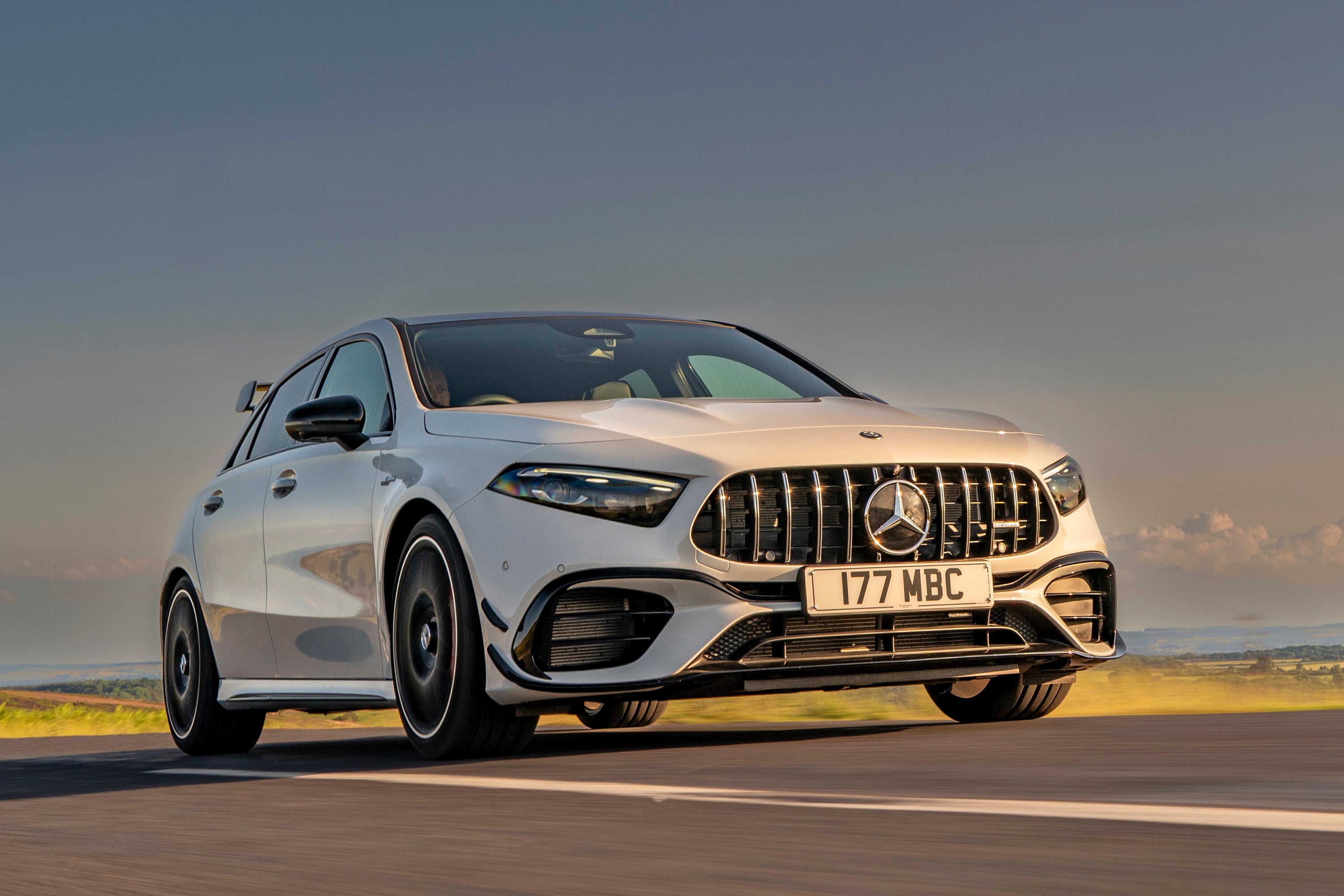
The most obvious rival remains the Mercedes-AMG A 45 S if you want a mega hatch with huge power and four-wheel drive traction. It is still the closest direct competitor in concept, even if the Audi counters with the more charismatic engine.
The BMW M135 xDrive is another name on the shortlist, though it is not really as close dynamically or in outright theatre. It is quick and usable, but it doesn't feel as special as the Audi RS 3.
If you are happy to look beyond five-door hatchbacks, the BMW M240i xDrive offers a different sort of fast-car appeal, while the Audi RS 3 Saloon itself gives you a slightly more mature alternative to the Sportback without changing the core mechanical recipe.
Fast EVs can also enter the conversation if sheer straight-line pace matters more than engine character, but that's exactly where the Audi RS 3 still earns its keep. Its biggest strength is that it remains one of the most complete blends of theatre and usability in this part of the market.
What's the interior like in the Audi Rs3?
The Audi RS 3’s cabin is solid, purposeful and built to last rather than flashy for the sake of it. It still feels premium and mature, even if it is not the most visually dramatic interior in this class.
Audi Rs3 boot space and practicality
This is one of the few areas where the Audi RS 3 gives something away. In Sportback form, boot capacity is 282 litres, which is meaningfully down on a regular Audi A3 Sportback and noticeably smaller than many family hatchbacks. The Saloon is a little more useful than you might expect, offering 321 litres, so if luggage space matters the four-door car has a clear advantage.
Even so, the Audi RS 3 is still easier to live with than many performance cars with similar pace. The Sportback’s hatchback body is convenient, the rear seats remain usable, and folding them down gives you enough flexibility for bulky loads. It is not the most practical fast hatch for outright carrying ability, but it is hardly a toy either.
The Saloon deserves a mention here because it broadens the Audi RS 3’s appeal slightly. It gives you extra boot capacity and a more conventional loading area, though the Sportback still wins for sheer convenience. If you regularly carry awkward items, the hatch remains the smarter choice. If you mostly carry overnight bags, a pushchair or a couple of cases, the Saloon is perfectly workable.
The driving position is excellent in either body style, with plenty of adjustment, supportive seats and better visibility than you get in most genuinely fast performance cars. That's a big part of what makes the Audi RS 3 so effective as a daily car. You do not feel as though you are climbing into something compromised just because it has 400PS.
Audi Rs3 dimensions
The Audi RS 3 Sportback measures 4,389mm long, while the Audi RS 3 Saloon stretches to 4,533mm. Both feel compact enough to place easily on a tight British road, but the Saloon has a slightly longer tail and a more traditional three-box shape. The difference is not huge from the driver’s seat, though it is worth knowing if you park in tight spaces.
Tech and infotainment in the Audi Rs3
The current Audi RS 3 uses a 10.1-inch Audi MMI touchscreen and a 12.3-inch Audi Virtual Cockpit Plus as standard. The digital cluster includes RS-specific display modes, and the standard car also gets smartphone integration, connected services, a head-up display and SONOS 3D premium audio.
That all sounds impressive, and mostly it is. The main screen is a sensible size, the virtual cockpit remains one of the best digital driver displays in the business, and the RS-specific layouts suit the car well. The weak point is not the content but the way modern Audi cabins sometimes trade simplicity for presentation. The system is not difficult to learn, but it is still more screen-led than ideal.
Standard driver-assistance kit is strong too, with lane departure warning with emergency assist, adaptive cruise control, park assist and a rear-view camera included across the range. Carbon Vorsprung also gets surround-view cameras as standard.
Audi’s Technology Pack Pro remains worth knowing about on the lower trims because it adds a panoramic sunroof, electrically adjustable front seats with memory, Comfort Key, hands-free boot opening, surround-view cameras, park assist plus and a broader driver-assistance package.
Materials available on the Audi Rs3
The Audi RS 3 still feels solid and well built inside, which is one of the reasons it justifies its price better than some rivals. The general fit and finish remain strong, with proper RS detailing and a sense that the main touchpoints have been thought through.
You are not getting a radically different trim concept between Sportback and Saloon, because the cars share the same cabin architecture. Fine Nappa leather heated sports seats are part of the appeal, while Carbon Vorsprung versions go further with electrically adjustable front seats featuring memory and massage functions. The result is a cabin that feels expensive and durable, even if some smaller details are not quite as special as the price might lead you to expect.
What's the Audi Rs3 like to drive?
This is where the current Audi RS 3 really earns its place. Older RS 3s were devastatingly fast but could feel a bit remote. The current car is still devastatingly fast, but now it is much keener to involve you. That's the big change.
Audi Rs3 range and performance
The Audi RS 3’s 2.5-litre five-cylinder turbo remains the star of the show, and it is the main reason this car still feels so special in a class that now includes some astonishingly quick alternatives. It produces 400PS and 500Nm, reaches 62mph in 3.8 seconds and delivers the sort of savage real-world pace that makes even a quick Audi S3 feel relatively ordinary once you have experienced it.
What makes the Audi RS 3 more than just another very fast hatchback or compact saloon is the character of that engine. The five-cylinder layout gives it a warbling, offbeat soundtrack that still evokes Audi’s old rally-bred heroes, and there's a sense of theatre to the way it delivers its performance that many turbocharged four-cylinder rivals simply cannot match.
The pace is immense in all conditions. With a quick-shifting dual-clutch gearbox and four-wheel drive, the Audi RS 3 can deploy its performance with almost absurd ease. It is the sort of car that can feel supercar-fast on a typical British road, not because it has exotic styling or a dramatic driving position, but because the combination of power, traction and gearbox response makes it devastatingly effective.
That gives the Audi RS 3 real depth. It still feels outrageous, but it no longer relies purely on straight-line shock value to make its point.
Performance data
| Model | Engine/battery size | Power | 0-62mph | Range/MPG |
|---|---|---|---|---|
RS 3 Sportback | 2.5-litre | 400PS | 3.8 seconds | Up to 30.4mpg |
RS 3 Saloon | 2.5-litre | 400PS | 3.8 seconds | Up to 31.0mpg |
Audi Rs3 driving and refinement
This is where the current Audi RS 3 improves most obviously on its predecessors. Older versions were deeply fast but could feel like blunt instruments once the road turned twisty. The current car is better judged.
The torque splitter on the rear axle is the key mechanical upgrade. In simple terms, it lets the Audi RS 3 distribute power much more intelligently across the rear wheels when you are pressing on. The effect is not subtle. Where older cars could feel as though they wanted to drag themselves out of corners with brute force, this one feels keener to tuck into a bend and carry speed through it. There's still huge grip, of course, but there's now more flexibility in how the chassis responds.
Keen drivers will notice the difference straight away. The Audi RS 3 now feels more agile, more adjustable and much less of a nose-led car than before. It is still not the absolute last word in steering feel, and that remains one area where some rivals feel a bit more connected, but the steering is accurate, well weighted and confidence-inspiring.
Audi has also gone further than just making the car faster point to point. There's an RS Torque Rear mode, which is essentially drift mode by another name. On the road, that's more of a technical showcase than something most owners will exploit properly, but it underlines how much more effort has gone into making the Audi RS 3 feel playful rather than merely relentless.
Just as importantly, the Audi RS 3 still works when you are not driving like a lunatic. That's a huge part of its appeal. With adaptive dampers fitted, the dynamic range is especially impressive because the car can be composed and genuinely comfortable in its softer settings, then tighten up noticeably when you want to push on. Even in firmer modes, it never becomes intolerable, and in comfort settings it is barely much less civilised than a regular A3.
There's no meaningful difference in the core dynamic character between the Sportback and the Saloon. Choose the shape you prefer, because both deliver the same combination of crushing pace, secure traction and broadened everyday usability.
How safe is the Audi Rs3?
The Audi RS 3 sits under the current Audi A3’s maximum five-star safety result from independent safety organisation EuroNCAP, which gives it a strong and current safety story rather than relying on an old inherited rating. Standard assistance kit includes lane departure warning with emergency assist, adaptive cruise control, park assist and a rear-view camera, while Carbon Vorsprung adds surround-view cameras.
That means the Audi RS 3 has the sort of safety and assistance baseline you would expect of a modern premium performance car, whether you choose the Sportback or the Saloon.
Running costs: What it's like to live with a Audi Rs3
The Audi RS 3 is not a cheap performance car to run. That should not surprise anyone given the engine, performance and purchase price, but it is worth being explicit. It is expensive to buy, expensive to insure and only moderately efficient unless you are driving gently.
Audi Rs3 fuel economy
Official economy is 30.1mpg, which is actually fairly reasonable given the performance on offer. Driven gently, the Audi RS 3 can get close to that. Driven hard, it will dip well into the twenties. That makes it tolerable rather than thrifty.
Audi Rs3 warranty and servicing
The standard UK new-car warranty is three years or 60,000 miles. Audi’s current service guidance is split between fixed and flexible regimes, with flexible servicing running to every two years or up to 18,600 miles, while fixed-regime oil services are due every year or 9,300 miles. For a car like this, exact set-up is worth checking individually at dealer level.
Audi Rs3 insurance groups
Insurance is expensive, but perhaps not quite as extreme as some buyers might expect. Current UK data across recent Audi RS 3 derivatives puts the car between groups 35 and 42 (of 50) depending on trim and body style. That's still firmly high-cost territory for an A3-sized Audi.
How much does it cost to tax a Audi Rs3?
The Audi RS 3 is still expensive to tax after the first year because every current version costs well over £40,000. That means it attracts the Expensive Car Supplement in years two to six, adding £440 a year on top of the standard annual rate of Vehicle Excise Duty, bringing the total to £640. In other words, this is not a car where tax becomes a minor running-cost footnote once the initial registration bill has passed.
What trims are available with the Audi Rs3?
The current walk-up for both body styles is RS 3, Carbon Black and Carbon Vorsprung. Even the standard car is well equipped, so this is not a range where you start with a stripped-out base model and have to spend heavily just to get the essentials.
The regular Audi RS 3 already comes with 19-inch alloy wheels, Matrix LED headlights with selectable light signatures, RS projection lighting, the RS-specific body kit, the torque splitter, sport suspension with damper control, a 10.1-inch MMI touchscreen, 12.3-inch Virtual Cockpit Plus, a head-up display and SONOS 3D premium audio. That means the essential appeal is there from the outset.
Carbon Black is the trim many buyers will land on. It adds darker exterior detailing and leans harder into the black styling treatment across the grille, spoiler and diffuser areas. On both the Sportback and the Saloon, it gives the Audi RS 3 a more serious, more cohesive look.
Carbon Vorsprung sits at the top and is the version for buyers who want the fullest equipment list without diving into the options list. It includes Technology Pack Pro as standard, which means a panoramic sunroof, electrically adjustable front seats with driver memory, Comfort Key, hands-free boot opening, surround-view cameras, park assist plus and a broader assistance package. Carbon Vorsprung also gets adaptive suspension with Audi drive select and RS modes as standard.
In simple terms, the regular Audi RS 3 already has the core performance and infotainment hardware, Carbon Black is the best-looking middle ground, and Carbon Vorsprung is the all-in version if you want the fullest luxury and assistance specification straight from the factory.
Ask the Drive experts: common questions
Is the Audi RS 3 a good performance car?
How fast is the Audi RS 3?
Should I choose the Audi RS 3 Sportback or Saloon?
What is the best Audi RS 3 trim?
Get our latest advice, news and offers
Keep me updated by email with the latest advice, news and offers from Drive.