Nissan Leaf Review

Written By Matt Robinson
- 2024
- SUV
- Electric
What we love
Good quality and refinement
Strong official range from the 75kWh battery
Clever Google-based infotainment and route planning
Things to consider
Rear-seat space is decent rather than generous
No rear wiper
52kWh versions don’t get a heat pump
The DRIVE take on the Nissan Leaf, is it the right car for you?
The Nissan Leaf is a polished and impressively efficient family EV that sits neatly between a conventional electric hatchback and a taller compact SUV. Its broad range is a major strength: the affordable 52kWh versions should suit buyers who mostly charge at home, while the 75kWh Engage can cover up to 387 miles on the official WLTP test.
That maximum is slightly better than the figures available from the longest-range Kia EV3, Škoda Elroq and Volkswagen ID.3. The Leaf also has a competitive starting price, a comfortable and refined driving experience and a particularly good Google-based infotainment system.
It’s not an outright class leader in every area. A Kia EV3 or Škoda Elroq gives you more luggage space, the Leaf’s rear seats are only average for the class and its rapid-charging times are respectable rather than outstanding. Nevertheless, it’s a convincing all-rounder with enough choice to work as anything from an urban family car to a long-distance motorway EV.
The Nissan Leaf in more detail
Once one of the real trailblazers of the electric car world, the Nissan Leaf has been falling away for some time now. The range and charging stats of the second-generation model aren't exactly earth-shattering, and while some of us might have found it refreshing to see a model that isn't yet another SUV, high-ish riding crossovers are where the market is at.
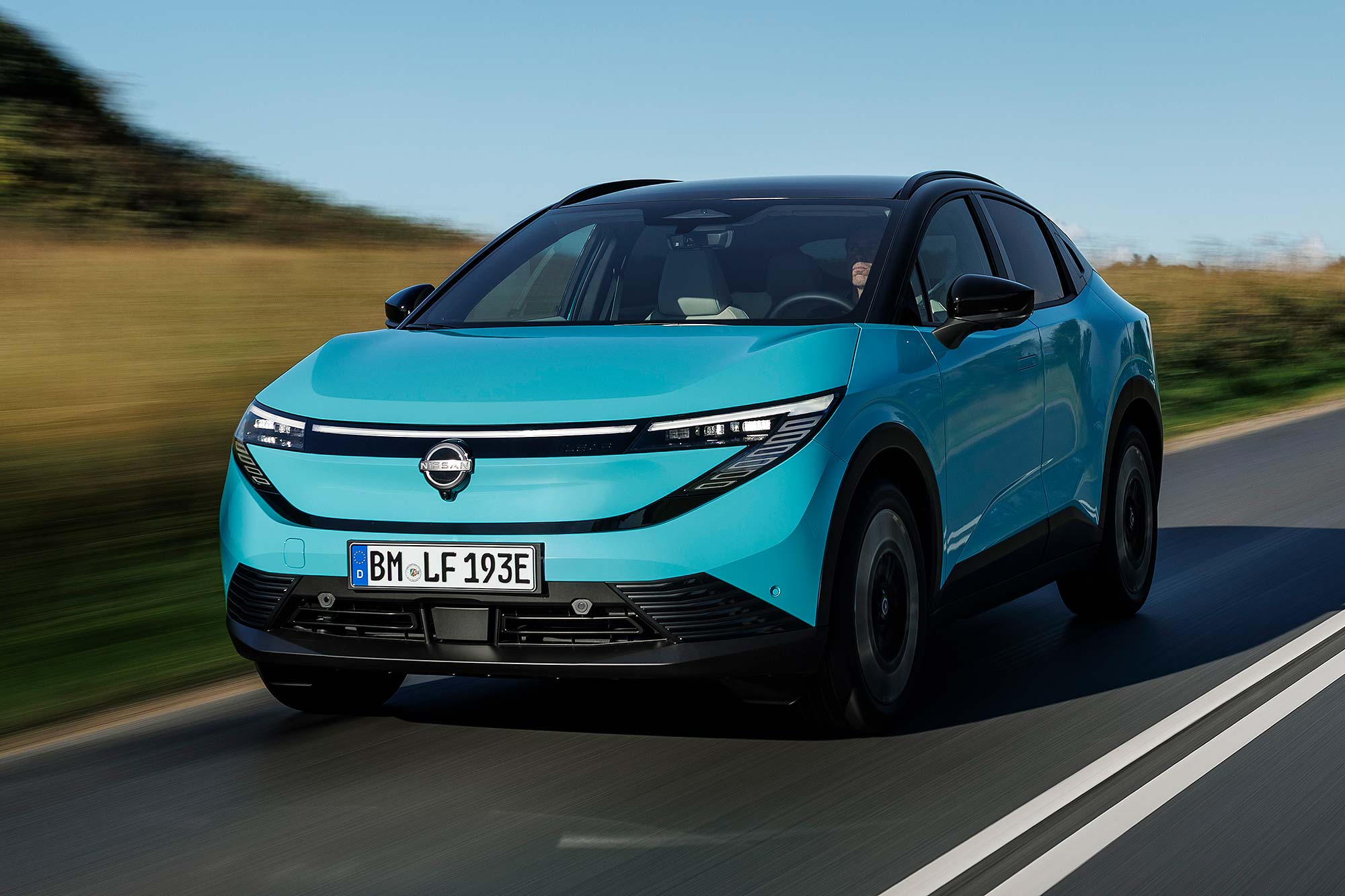
It's no surprise, then, to see that the all-new, third-generation Nissan Leaf is, drumroll please, a crossover. Derived from the Nissan Ariya, it is a very stylish-looking car. We love the overall design, which is smooth and sharply sculpted. It’s particularly smart at the rear, with an almost coupe-like look that, thanks to the gloss black upper section, references famous Nissan coupes from the past. Special mention to the 3D LED tail lamps, which appear to ‘float’. The holographic effect references the ‘ni-san’ pattern in Japanese.
Happily, the all-important EV stats look very competitive as well. There is a choice of two battery packs, with the bigger one offering up to 387 miles on a full charge, and the smaller one a still very impressive 271 miles.
We like how the Nissan Leaf drives, too. It is a big step on from its predecessors, which could feel a bit low-rent and downmarket. This is a different proposition entirely, with its Ariya underpinnings giving it a far more mature and upscale feel. It's now very much a competitor of models such as the Skoda Elroq and Kia EV3.
Inside, the design is clean and technology-focused and while the cabin doesn’t feel as visually adventurous as the Kia EV3’s, it’s straightforward, calming and easy to settle into.
The main compromises concern practicality and charging. There’s enough room for normal family use, but the boxier EV3 and Elroq make better use of their cabins. The Leaf’s 35-minute 10%-to-80% rapid-charging time is also beaten by several versions of those rivals. Even so, its combination of range, refinement, equipment and pricing makes it one of the strongest choices in this part of the market.
What's the best Nissan Leaf trim and battery option?
The 52kWh Advance is the standout choice if you don’t regularly cover long motorway distances. It features dual 14.3-inch displays with Google built-in, heated front seats, a heated steering wheel, wireless phone charging, a head-up display, a panoramic roof and an electric tailgate, making it feel properly upmarket without a big jump in price.
If you do want maximum range, the 75kWh Engage+ is the one to go for. It combines the larger battery and heat pump with the bigger Google-based displays and useful comfort equipment, without the cost or 19-inch wheels of the Evolve, making it the best all-round long-distance option.
Advance adds the panoramic roof, head-up display and electric tailgate, while Evolve is the more indulgent version with larger wheels, Bose audio, powered front seats, a driver’s massage function and the V2L connector supplied as standard.
In simple terms, the 52kWh Advance is the best all-round choice for most buyers, while the 75kWh Engage+ is the one to pick if you want maximum range without overspending.
What’s the price of the Nissan Leaf?
The Nissan Leaf starts from £28,849 in 52kWh Engage form, while the better-equipped 52kWh Advance costs £30,849.
The larger-battery range starts at £32,249 for the 75kWh Engage, followed by Engage+ at £33,149 and Advance at £34,249, before topping out at £36,249 for the Evolve.
Those prices include the £3,750 Electric Car Grant currently applied to the Leaf. Without the grant, the range costs between £32,599 and £39,999.
That pricing puts the Nissan Leaf right into the heart of the family EV market rather than above it. The smaller-battery model strengthens its value case considerably, while the 75kWh versions offer unusually strong range for the money.
Alternatives to the Nissan Leaf
The Skoda Elroq is one of the Leaf’s most relevant rivals because it offers the kind of sensible family-EV package many buyers will be looking for. It's practical, straightforward and likely to appeal if space, ease of use and value matter more than design flourish. If you expect to use the rear seats and boot heavily, the Elroq is likely to feel like the more rational choice.
The Volkswagen ID.3 is the other rival the Nissan Leaf should be measured against closely. It's a more traditional hatchback than the Nissan, and that makes it a good reference point for buyers who do not necessarily want a full SUV but do want a modern electric family car. The ID.3 still feels a little more conventional in concept, while the Leaf’s shape and higher stance give it slightly more crossover appeal.
The Kia EV3 is another car worth shortlisting if you want a boxier, more overtly SUV-like alternative with strong range and modern cabin design. A Tesla Model 3 remains tempting if efficiency and charging infrastructure are top priorities, but it's a different kind of proposition and less practical in hatchback terms.
The Nissan Leaf makes the most sense if you want something that sits neatly between hatchback and crossover, with strong range, a calming cabin and a more polished feel than older Leafs ever managed.
What's the interior like in the Nissan Leaf?
The Nissan Leaf’s cabin is one of the biggest reasons to take it seriously. It feels open, modern and suitably upmarket, even if rear-seat space is not class-leading.
Nissan Leaf boot space and practicality
The Nissan Leaf does a good job of feeling more spacious than its exterior footprint suggests. Up front, the open dashboard design and low-set fascia help the cabin feel airy, while the semi-raised seating position gives you a useful view out without making the car feel bulky or SUV-like in the way a taller crossover can.
Storage up front also looks well thought through. There's a big central cubby, large cupholders and a wireless charging area that should be genuinely useful rather than token. The absence of a conventional gear lever helps keep the centre console cleaner too.
The rear is more mixed. Adults will fit, but it's not the roomiest car of this size. The roofline and overall aero shape mean headroom and foot room are not as generous as in some boxier rivals, and that could matter if you regularly carry taller passengers in the back. This is one of the few areas where the Nissan Leaf doesn't feel like a class leader.
Boot space is 437 litres, which is a useful number for a family EV of this size. The double-floor arrangement and cable storage solution make it sound practical in day-to-day use, and the split floor adds a bit of flexibility. There's no front boot, though, and the lack of a rear wiper is an irritation that will be hard to ignore in bad weather.
So the Nissan Leaf should be practical enough for most family use, but if outright rear-seat space is a priority, a Skoda Elroq may still have the edge.
Nissan Leaf dimensions
The Nissan Leaf measures 4,350mm long, 1,810mm wide & 1,550mm high. That makes it easier to place than a larger family SUV, while still giving it more road presence and a more crossover-like stance than the old Leaf hatchback.
In practical terms, those dimensions put it into a sweet spot for buyers who want something compact enough for urban use but substantial enough to work as a main family car. It's not a towering SUV, and that should help both efficiency and ease of use.
Tech and infotainment in the Nissan Leaf
Technology is one of the Nissan Leaf’s strongest areas. UK cars use either dual 12.3-inch screens or dual 14.3-inch displays depending on trim, and the more advanced versions run NissanConnect with Google built-in.
That matters because it makes the integrated route planning far more useful than the usual in-car navigation systems that many drivers ignore. Google Maps can plan charging stops, estimate state of charge at arrival and work with battery preconditioning, which takes a lot of friction out of long journeys.
It also helps that the wider system sounds properly up to date. Over-the-air updates, Google Assistant, Google Play apps and smartphone mirroring should make the Nissan Leaf feel current for longer than many rivals that rely on more closed systems.
There are still a few caveats. Some key functions are handled through haptic controls, and those are not always as intuitive on the move as proper physical buttons. But overall, this looks like one of the strongest infotainment setups Nissan has yet put into a mainstream UK model.
Materials available on the Nissan Leaf
The Nissan Leaf has a convincing level of perceived quality. The upper dashboard uses interesting finishes, including fabric trim, while the overall layout feels calm and suitably upmarket.
Higher trims bring synthetic leather upholstery and, in Evolve form, extra comfort features including electrically adjustable front seats and a massage function for the driver. Even the lower trims benefit from the clean design and appealing mixture of materials.
The Kia EV3 has a more distinctive and adventurous interior, while the Škoda Elroq takes a more conventional and functional approach. The Leaf sits neatly between them, with a cabin that feels modern without becoming overly complicated.
What's the Nissan Leaf like to drive?
The Nissan Leaf majors on comfort and refinement rather than outright excitement, and that feels like the right call. It feels smooth, quiet and mature, with the sort of relaxed character that suits a mainstream family EV.
Nissan Leaf range and performance
Keeping things relatively straightforward, your chosen size of Leaf battery also determines the motor output. The 52kWh battery has a 177PS, 345Nm motor, while the 75kWh 'Extended' battery has a unit outputting 218PS and 355Nm of torque. In each case, the motor is fitted to the front axle.
Unusually, Nissan details 52kWh Leaf performance figures to two decimal places. It accelerates from 0-62mph in 8.35 seconds, Nissan says, rather than rounding it up to 8.4 seconds. Run it in ‘Sport’ mode and it falls further, to a highly precise 8.26 seconds. The 75kWh version is more conventional – and closely-matched – with 0-62mph in 7.8 seconds, or 7.6 seconds in Sport mode. Both versions have a top speed electronically restricted to 99mph.
Performance data
| Model | Engine/battery size | Power | 0-62mph | Range/MPG |
|---|---|---|---|---|
Nissan Leaf 52kWh | 52kWh | 177PS | 8.4 seconds | Up to 280 miles |
Nissan Leaf 75kWh | 75kWh | 218PS | 7.8 seconds | Up to 387 miles |
Nissan Leaf driving and refinement
The Nissan Leaf feels mature and well resolved. Ride comfort is one of its biggest strengths, because it deals with poor surfaces with a calm, well-damped feel that should suit British roads well. There's a slight edge from the suspension at lower speeds, but the overall setup is impressively supple and becomes more settled as pace rises.
Refinement is strong, too. Wind noise stays well contained until motorway speeds, road noise is nicely suppressed and the electric power delivery is smooth and quiet. All of that helps the Leaf feel substantial and comfortable on longer journeys.
The handling balance is sensible rather than sporty. There's a bit of body lean if you turn in sharply, but it settles quickly and the overall impression is of a car tuned for comfort, confidence and composure rather than hot-hatch reactions. A Volkswagen ID.3 feels slightly more like a conventional hatchback from behind the wheel, but the Leaf’s relaxed approach will suit many family buyers.
The brakes are mostly easy to judge in normal driving, though they can feel a little snatchy under heavier use as the car transitions between regenerative and friction braking. Even so, the overall driving experience is polished and easy to get on with.
How safe is the Nissan Leaf?
Independent safety organisation Euro NCAP has not yet published a rating for the latest Nissan Leaf, so this is one area where a little caution is sensible. Nissan’s current materials make a strong case for its assistance systems, but a formal rating will still matter to many family buyers.
The good news is that the Nissan Leaf is fitted with a broad spread of modern driver-assistance tech, including ProPILOT Assist, intelligent cruise functions and camera-based visibility aids such as Invisible Hood View and Front Wide View. Those should make it feel well equipped from launch.
So while we can’t yet point to a fresh Euro NCAP score, the underlying safety story looks promising.
Running costs: What it's like to live with a Nissan Leaf
The Nissan Leaf’s running-cost case looks strong because it combines long range, competitive charging speeds and very good motorway efficiency for a car of this shape.
Nissan Leaf charging times and costs
The Nissan Leaf uses CCS charging, which is a major improvement over the old car’s outdated CHAdeMO setup.
The 52kWh model can rapid-charge at up to 105kW, while the 75kWh battery raises the maximum to 150kW. Nissan quotes the same 35-minute 10% to 80% charging time for both, because the smaller battery has less energy to replenish.
In 30 minutes, Nissan says the 52kWh version can recover up to 176 miles and the 75kWh version up to 273 miles under suitable conditions.
Those charging times are competitive rather than class-leading. Some versions of the Kia EV3, Škoda Elroq and Volkswagen ID.3 can complete a comparable charge more quickly, although the Leaf’s strong efficiency and long maximum range mean the 75kWh model should not need to stop especially frequently.
All versions have an 11kW AC onboard charger. A 10–100% charge takes around six hours for the 52kWh battery or seven hours for the 75kWh battery when connected to a suitable 11kW supply. On a typical 7.4kW home wallbox, Nissan quotes around eight and a half hours for the smaller battery or 11 and a half hours for the larger one.
Charging cost depends on the electricity tariff. At 25p per kWh, replenishing the advertised usable capacity would cost approximately £13 for the 52kWh version or £18.75 for the 75kWh model, before allowing for charging losses. An off-peak EV tariff could reduce that considerably.
Nissan Leaf warranty and servicing
Nissan covers the new Leaf with a three-year or 60,000-mile manufacturer warranty, while the battery gets separate eight-year or 100,000-mile cover.
As for servicing, full long-term costs will become clearer once more UK cars are on the road, but the Leaf should benefit from the usual EV advantage of lower routine maintenance needs compared with petrol or hybrid alternatives.
Nissan Leaf insurance groups
Insurance groups for the 75kWh Nissan Leaf run from 31 to 33 (of 50).
Confirmed groups for the newer 52kWh models haven’t yet been published, so you should obtain a quote for the exact version before ordering.
That means the Nissan Leaf is unlikely to be especially cheap to insure, but the established 75kWh versions sit broadly where you would expect for a modern family EV with a large battery and plenty of standard technology. As ever, trim level, repair costs, location and driver profile will make the biggest difference to the quote you actually get.
How much does it cost to tax a Nissan Leaf?
The Nissan Leaf now costs £200 a year in Vehicle Excise Duty after year one, while the EV Expensive Car Supplement only applies to cars with a list price of more than £50,000, and the Nissan Leaf’s current UK pricing sits comfortably below that threshold. That means the expensive-car charge should not be a concern for regular Leaf buyers.
What trims are available with the Nissan Leaf?
The Nissan Leaf line-up consists of Engage, Engage+, Advance and Evolve, although not every trim is available with both batteries.
Engage is available with either the 52kWh or 75kWh battery. It includes 18-inch alloy wheels, LED headlights, dual 12.3-inch screens, wireless smartphone mirroring, dual-zone climate control, an around-view camera system and an 11kW onboard charger. A heat pump is standard on the 75kWh version but is not fitted to the 52kWh car.
Engage+ is offered only with the 75kWh battery. It moves to 18-inch diamond-cut alloy wheels and dual 14.3-inch displays with Google built-in, while also adding heated front seats, a heated steering wheel, wireless phone charging, an auto-dimming rear-view mirror and a luggage-board system.
Advance is available with either battery. It adds a dimming panoramic roof, adaptive headlights, an electric tailgate, roof rails, privacy glass, synthetic leather and fabric upholstery, 64-colour ambient lighting and a head-up display.
Evolve is exclusive to the 75kWh battery. It adds 19-inch wheels, full synthetic leather upholstery, electrically adjustable front seats, a driver’s massage function, Bose audio and the V2L connector.
Ask the Drive experts: common questions
Is the new Nissan Leaf any good?
What is the maximum range of the Nissan Leaf?
Does the Nissan Leaf pay the Expensive Car Supplement?
Which Nissan Leaf is best?
Get our latest advice, news and offers
Keep me updated by email with the latest advice, news and offers from Drive.

.jpg)