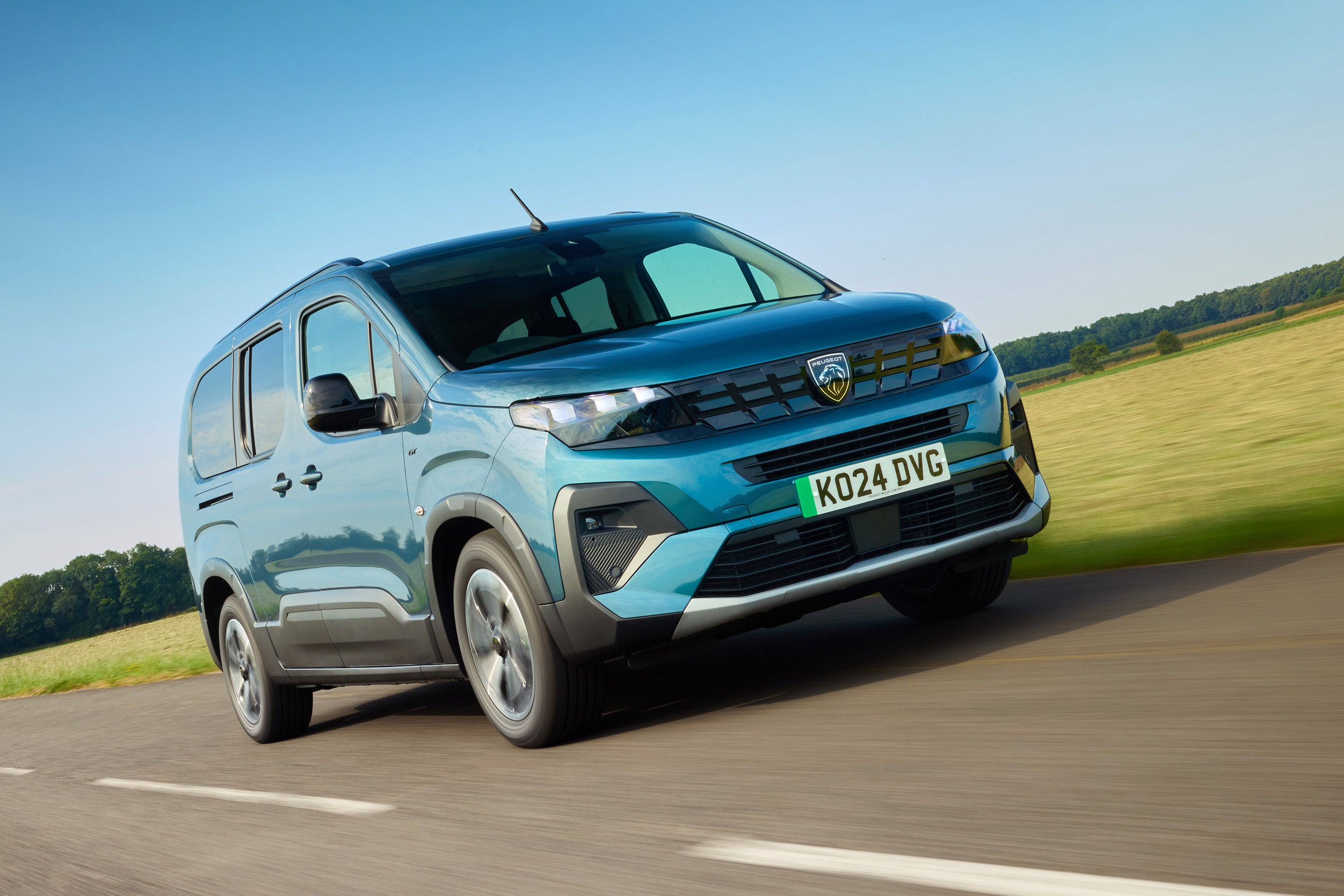
Peugeot e-Rifter Review

Written By Ivan Aistrop
What we love
Enormously roomy and practical
Comfortable and easy to drive
Potentially low running costs
Things to consider
Not exactly glamorous
Limited real-world range
Euro NCAP result is only average by modern standards
The DRIVE take on the Peugeot Rifter, is it the right car for you?
The Peugeot e-Rifter is about as clear-cut as family cars get. If you want something stylish, premium-feeling or especially desirable, this is not it. But if you want a relatively compact electric family car with an extraordinary amount of interior space, superb flexibility and the kind of easy access that makes daily life with children, dogs or bulky luggage much simpler, the e-Rifter is very easy to recommend. Its limited real-world range means it makes best sense for shorter-range family duties rather than constant motorway schleps, but if maximum space and ease of access matter more than image, few EVs do it better.
The Peugeot Rifter in more detail
The Peugeot e-Rifter occupies a very unusual niche in today’s market. It is a van-based people carrier, which means it starts with the basic architecture of the Peugeot Partner van and then turns that into something family friendly with extra seats, more glass and a much more usable interior.
That sounds utilitarian, and in many ways it is. But there is also something refreshingly honest about the e-Rifter. It does not try to be an SUV, and it does not pretend to be a premium family car. Instead, it simply focuses on moving people and luggage as effectively as possible.
That makes it a natural fit for larger families, dog owners, wheelchair users, or anyone who just needs massive practicality without stepping up to a much larger minibus. Cars such as the Citroen E-Berlingo, Vauxhall Combo Life Electric and Toyota Proace City Verso Electric all offer a very similar idea, because they share much of the same underlying hardware.
The 2024 facelift helped the e-Rifter feel more current, with a smarter front end, improved infotainment and a stronger official range figure of up to 199 miles. Even so, this is still not an EV bought for long-distance glamour. It is bought because it solves practical problems better than most alternatives.
The key thing is to be realistic about the range. For school runs, local family life and moderate regional driving, the e-Rifter works well. For regular long motorway journeys, it makes much less sense than an electric SUV with a bigger battery.
What's the best Peugeot Rifter trim and battery option?
There is only one battery and motor combination in the Peugeot e-Rifter, so the main choice is body length and trim rather than powertrain.
For most buyers, the best Peugeot e-Rifter is the Standard Allure. Allure already comes with a useful amount of kit, and Standard gives you the core appeal of the car without becoming any more cumbersome than necessary. If you do not genuinely need the extra seats or extra load length, the smaller body is the easier one to live with.
The Long version is the one to choose if you need the maximum possible practicality. In Allure trim, it can be had with seven seats, and that makes it the clear option for larger families. The caveat is that Long GT does not bring the extra third-row seats, only a larger boot, so it is worth checking carefully which layout you actually need.
As for trim, GT adds desirable touches such as adaptive cruise control and a 180-degree reversing camera, but the e-Rifter’s appeal is fundamentally about utility rather than indulgence. That means Allure is still the smartest value pick.
In simple terms, Standard Allure is the sensible buy, Long Allure is the family-maximising choice and GT is the convenience-led upgrade.
What’s the price of the Peugeot Rifter?
The Peugeot e-Rifter currently starts from £30,500 on the road in Standard Allure form via Peugeot’s UK offers. The Long Allure is listed from £33,975 OTR, while current UK offer pricing puts Standard GT at £33,795.
That means the e-Rifter is not exactly cheap in absolute terms, but it does look more reasonable once you consider just how much metal, space and versatility you are getting. In family-car terms, it can still undercut or match many electric SUVs that offer far less interior usefulness.
Used values are also worth watching, because as-new examples often make a much stronger value case than ordering one at full retail price.
Alternatives to the Peugeot Rifter
The Citroen e-Berlingo is one of the most obvious alternatives because it follows exactly the same van-based MPV recipe. It feels a little more comfort-led and a little less sharp in its detailing, but it offers the same kind of vast practicality and family-friendly thinking.
The Vauxhall Combo Life Electric is another direct rival, sharing much of the same engineering and layout. As with the Citroen, your decision will probably come down to styling, equipment packaging and price rather than any major mechanical differences.
The Toyota Proace City Verso Electric is also closely related and worth considering, especially if Toyota’s dealer reputation and broader brand appeal matter to you.
Beyond those direct cousins, the Ford Tourneo Connect is worth a look if you are open to combustion power, while the Volkswagen Caddy remains a strong practical alternative with a more mature feel. The Peugeot e-Rifter makes most sense if you specifically want maximum practicality in an EV without stepping up to a much larger and more expensive people mover.
What's the interior like in the Peugeot Rifter?
The e-Rifter’s interior is more functional than fashionable, but that is exactly the point. It feels solid, hard-wearing and exceptionally well thought through for family life.
Peugeot Rifter boot space and practicality
This is the Peugeot e-Rifter’s strongest area by a distance. Space and flexibility are the entire reason this car exists, and in those terms it is hugely impressive.
The Standard version is 4,405mm long and comes with five seats. The Long stretches to 4,755mm and can be had with up to seven seats in Allure trim. Whichever version you choose, there is excellent headroom, lots of legroom and an upright seating position that makes the cabin feel very open and accessible.
Sliding rear doors on both sides are a major practical win, especially in tight car parks or when loading children. The middle-row seating is also family-friendly, with three individual rear seats in GT and three Isofix points across the second row. That alone makes the e-Rifter much easier to live with than many SUVs.
Boot space is enormous by the standards of a relatively compact family car. The five-seat Standard offers 775 litres under the parcel shelf, while the Long in five-seat mode gives you 1,050 litres. Fold the rear seats and the load space becomes vast, with up to 3,000 litres in the Standard and up to 3,500 litres in the Long.
There are some caveats. The rear seats do not fold into a perfectly flat floor despite Peugeot’s broad modularity claims, and some trim and seat-layout details vary by version. But taken as a whole, the e-Rifter remains one of the most practical electric family cars on sale.
Peugeot Rifter dimensions
The Peugeot e-Rifter comes in two lengths. Standard measures 4,405mm long, while Long measures 4,755mm. Both are around 1,850mm wide and 1,880mm high.
That means the e-Rifter is still compact enough to manage in town, but it uses its height and boxy profile to create an extraordinary amount of usable space inside. If you need maximum room without going to a full-sized van-based people carrier, that packaging is a big part of the appeal.
Tech and infotainment in the Peugeot Rifter
The 2024 facelift improved the e-Rifter’s technology offering. The central touchscreen is now a 10.0-inch unit across the range, and the digital instrument display is also now standard.
Apple CarPlay and Android Auto are included, and the interface is simple enough to get used to. It is not class-leading, and some transitions and touchscreen responses still feel slower than they should, but it is usable enough once you have spent some time with it.
The good news is that Peugeot has kept physical climate controls, which makes the e-Rifter easier to operate on the move than many more modern-feeling EVs. The less good news is that some of those controls are not backlit, which is an annoying oversight at night.
Materials available on the Peugeot Rifter
The e-Rifter’s cabin materials are honest rather than plush. There is lots of hard, durable plastic, and you can clearly see the van roots in places.
That said, Peugeot has done a decent job of lifting the atmosphere with fabric dashboard sections and a few smarter trim details. It is not premium, but it does not feel bleak, either. More importantly, it feels built to withstand family life.
What's the Peugeot Rifter like to drive?
The Peugeot e-Rifter is comfortable, easygoing and more settled than you might expect from something derived from a van. It is not fun in the conventional sense, but it is very easy to get on with.
Peugeot Rifter range and performance
The Peugeot e-Rifter uses a 52kWh battery pack, of which 50kWh is usable, plus a front-mounted electric motor. Output depends on the selected drive mode, but in Power mode the motor delivers its full 136PS.
Performance is modest. The 0-62mph time is 11.3 seconds, and top speed is only 84mph. That tells you everything you need to know about the e-Rifter’s priorities. It is built for family duty, not excitement.
Official WLTP range is up to 199 miles in the facelifted version, which is an improvement on earlier cars. Even so, real-world results can drop sharply on cold motorway journeys, so the e-Rifter makes most sense for shorter-range duties than constant long-haul use.
For most buyers, the powertrain is sufficient. The bigger question is whether the range fits your life.
Performance data
| Model | Engine/battery size | Power | 0-62mph | Range/MPG |
|---|---|---|---|---|
e-Rifter Standard Allure | 50kWh | 136PS | 11.3 seconds | Up to 199 miles |
e-Rifter Standard GT | 50kWh | 136PS | 11.3 seconds | Up to 199 miles |
e-Rifter Long Allure | 50kWh | 136PS | 11.3 seconds | Up to 199 miles |
Peugeot Rifter driving and refinement
The Peugeot e-Rifter is more comfortable than you might expect from a van-based MPV. The soft suspension does a good job of dealing with potholes and broken surfaces, and the car feels calm and settled rather than jumpy.
Handling is predictably van-like, but not untidy. There is more grip and body control than the boxy shape might lead you to expect, and the light steering is a real advantage when manoeuvring in urban areas.
Refinement is respectable, too. The electric motor is very quiet, and while wind and road noise are more noticeable at speed than in a more aerodynamic EV, the overall experience is still relaxed enough to suit the car’s purpose.
The key point is that the e-Rifter does not feel intimidating or awkward to drive despite its practical packaging. That makes it easy to live with.
How safe is the Peugeot Rifter?
The Peugeot Rifter’s Euro NCAP result is not especially flattering by modern standards. The original test dates back to 2018, and the result that applies to the e-Rifter is only four stars at a time when many family cars were managing five.
Standard safety kit is decent enough, with autonomous emergency braking, lane-keeping assistance, intelligent speed assistance, driver-attention alert and high-beam assist included. GT adds adaptive cruise control with stop-and-go and lane positioning assistance.
So the e-Rifter is not devoid of useful safety technology, but it is not a class leader here.
Running costs: What it's like to live with a Peugeot Rifter
If the e-Rifter’s range suits your lifestyle, it should be relatively cheap to run. The modest battery keeps charging costs down, and routine maintenance demands are fairly light.
Peugeot Rifter charging times and costs
The Peugeot e-Rifter supports DC rapid charging at up to 100kW. Peugeot quotes a 0 to 80 per cent charge in 38 minutes, which is respectable enough for a family MPV with a relatively small battery.
At home, Peugeot says a full charge on a 7.4kW wallbox takes 6 hours 43 minutes. A regular three-pin socket is far less practical, because a full charge takes more than 22 hours.
That means the e-Rifter works best if you have access to home charging. If you do, the battery’s modest size helps keep electricity costs relatively manageable.
Peugeot Rifter warranty and servicing
Peugeot’s standard manufacturer warranty is three years, with the third year capped at 60,000 miles. The traction battery is covered separately for eight years or 100,000 miles if capacity falls below 70 per cent.
Peugeot Care also applies here. That means up to eight years of additional special coverage can be activated through Peugeot servicing, subject to the usual terms and mileage limits.
Service intervals are every two years or 25,000 miles, which is pleasantly infrequent and should help keep routine servicing convenient.
Peugeot Rifter insurance groups
Insurance sits at the more palatable end of average. The Standard Allure is in group 19, while the rest of the line-up generally sits in group 20. That means the e-Rifter should not be especially painful to insure by EV standards, which helps its family-car case.
How much does it cost to tax a Peugeot Rifter?
The Peugeot e-Rifter now costs £200 a year in VED after year one. The EV Expensive Car Supplement only applies to electric cars with a list price above £50,000, and the e-Rifter sits well below that threshold. So there is no premium-car sting to worry about here.
What trims are available with the Peugeot Rifter?
The Peugeot e-Rifter range is centred on Allure and GT.
Allure already covers the essentials well. Standard equipment includes manual air-conditioning, a heated leather steering wheel, automatic lights and wipers, cruise control, rear parking sensors, LED headlights and the improved touchscreen setup. For many buyers, that will be enough.
GT is the richer version. It adds 17-inch alloy wheels, rear privacy glass, automatic climate control, adaptive cruise control, electric rear windows and a 180-degree reversing camera. It certainly feels better equipped, though the e-Rifter’s core appeal remains the same either way.
In simple terms, Allure is the sensible buy and GT is the convenience-led upgrade.
Ask the Drive experts: common questions
Is the Peugeot e-Rifter a good family EV?
What is the range of the Peugeot e-Rifter?
Is the Peugeot e-Rifter practical enough for a large family?
Does the Peugeot e-Rifter get the Expensive Car Supplement?
Get our latest advice, news and offers
Keep me updated by email with the latest advice, news and offers from Drive.
.jpg)