Skoda Elroq vRS Review

Written By Matt Robinson
- 2025
- SUV
- Electric
What we love
It is properly quick without losing its comfort
More space than you might think
Standard equipment is generous
Things to consider
vRS performance comes with a price premium
Performance is balanced with everyday comfort
A heat pump is not standard
The DRIVE take on the Skoda Elroq, is it the right car for you?
The Skoda Elroq vRS is one of those performance EVs that makes more sense the longer you look at it. Yes, it is quick enough to feel genuinely fun, but the best thing about it is that it doesn’t sacrifice the things people actually buy an Elroq for. It’s roomy, easy to live with, comfortable on poor roads and packed with standard kit. That makes it a far more rounded choice than some more extroverted performance EVs.
That does not automatically make it the right Elroq for everyone. We reckon the regular Elroq 85 is the smarter buy for the majority of people because it gives you the same practicality and much of the same appeal for considerably less money. But if you want the range-topper, like the look of the vRS styling, or want family SUV usefulness with hot-hatch levels of acceleration, the Elroq vRS is easy to recommend.
The Skoda Elroq in more detail
The Elroq vRS is the flagship version of Skoda’s compact electric SUV and, as with the best fast Skodas of the past, it aims to blend performance with common sense, rather than chase maximum theatre. It’s still roomy, comfortable and good on quality, and that’s what you buy an Elroq for, be it a fast one or not.
It sits at the top of the Elroq range and uses two electric motors to give four-wheel drive. And a total power output is 340PS, which is enough for 0-62mph in 5.2 seconds. That is properly fast on paper, and feels it in the real world, too, especially when powering off the mark.
Browse used Škoda Elroqs for sale →
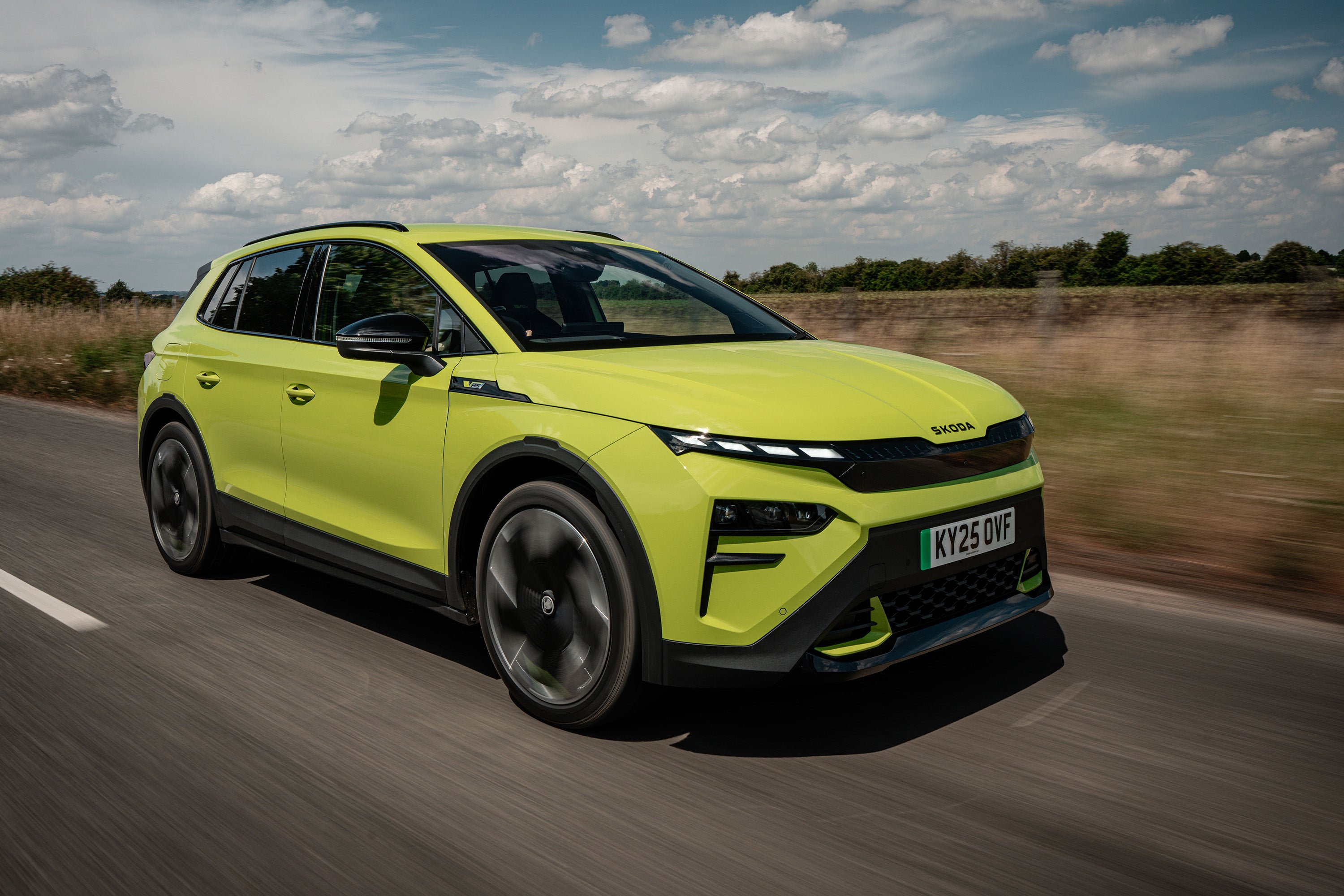
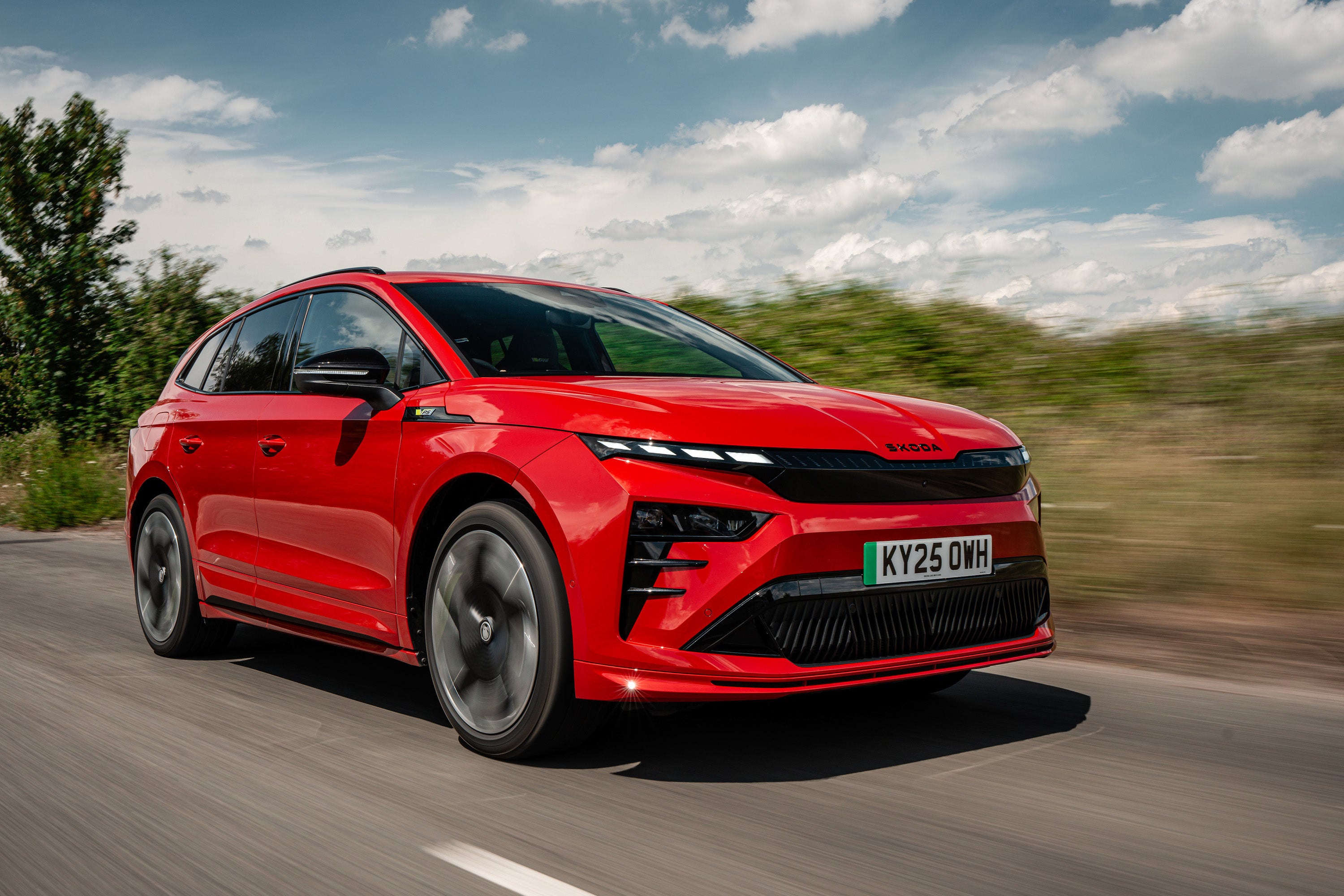
Skoda has not just dropped more power into the regular car and hoped for the best. The Elroq vRS gets Dynamic Chassis Control adaptive suspension, which allows you to choose between softer settings and firmer ones depending on your mood, or the nature of the road in front of you. It also has the usual visual cues buyers expect from a vRS model, including black exterior detailing, vRS-specific bumpers, larger wheels and a cabin trimmed to feel more special than the standard car.
That cabin arguably represents the Elroq’s biggest attractions. The dashboard layout is familiar from the regular Elroq, which means a modern, clean design, although the 13.0-inch central touchscreen has rather too much to contend with due to the shortage of physical buttons and switches in the cabin. There’s also a smaller digital driver display and, in the vRS, a standard head-up display.
More importantly, there is plenty of room for adults front and rear, plenty of storage and a 470-litre boot that is very competitive for a car in this class. If you need your performance car to double as the family car, the Elroq vRS feels far more convincing than many alternatives.
The car also has generous standard equipment, so you don’t have to spend hours on the configurator to make it feel complete, spending thousands more in the process. Features such as matrix LED headlights, a Canton sound system, 360-degree cameras, sports seats, and an electrically-adjusting driver’s seat with massage function are all part of the package. That partially helps justify the asking price, even if the Elroq vRS still looks expensive compared with the regular Elroq range.
What's the best Skoda Elroq trim and battery option?
If you know you want an Elroq vRS, there is no battery or trim decision to make in the usual sense because this version comes as a single, fully loaded flagship model.
The more useful buying question is whether you should choose the vRS at all, or stop lower down the range. For most people, the answer is that the regular Elroq 85 remains the sweet spot. It offers stronger value, excellent real-world usability and more than enough performance for everyday driving. The vRS makes sense if you specifically want the stronger performance and the richer equipment list, but it’ll be a niche choice.
What’s the price of the Skoda Elroq?
The Skoda Elroq vRS is priced at £46,970 on the road, which places it right at the top of the Elroq line-up, and quite a long way above the versions of the Elroq that represent the best value for money. That’s why the vRS has to work hard to justify itself. There are also plenty of used Škoda Elroqs for sale for considerably less.
Fortunately, it does have some justification. You are not simply paying for more power. You also get all-wheel drive, faster charging capability, upgraded chassis hardware and a much stronger standard equipment list.
There are still limits to the value argument. The Elroq vRS doesn’t qualify for the Government’s current Electric Car Grant, while cheaper Elroq models do. That widens the effective gap between this car and the rest of the range. It also puts the vRS into territory where buyers may begin cross-shopping slightly larger or more premium electric SUVs.
Alternatives to the Skoda Elroq
The nearest alternatives depend on what you most like about the Elroq vRS. If it is the blend of speed and day-to-day usability, the Smart #1 Brabus and Volvo EX30 Twin Motor are obvious places to start. Both deliver hard-hitting acceleration and a more obviously performance-focused character, but both are smaller cars. If rear-seat space and boot space are priorities, the Skoda has both beaten.
The most direct rival may actually be the Skoda Enyaq vRS. It costs more, but it gives you a larger body, a bigger boot and a slightly more grown-up feel on longer journeys. If you have the extra budget then the Enyaq vRS is definitely worth a look, but equally, if you like the Elroq but do not need the pace, the regular Elroq 85 is arguably the smartest alternative of all.
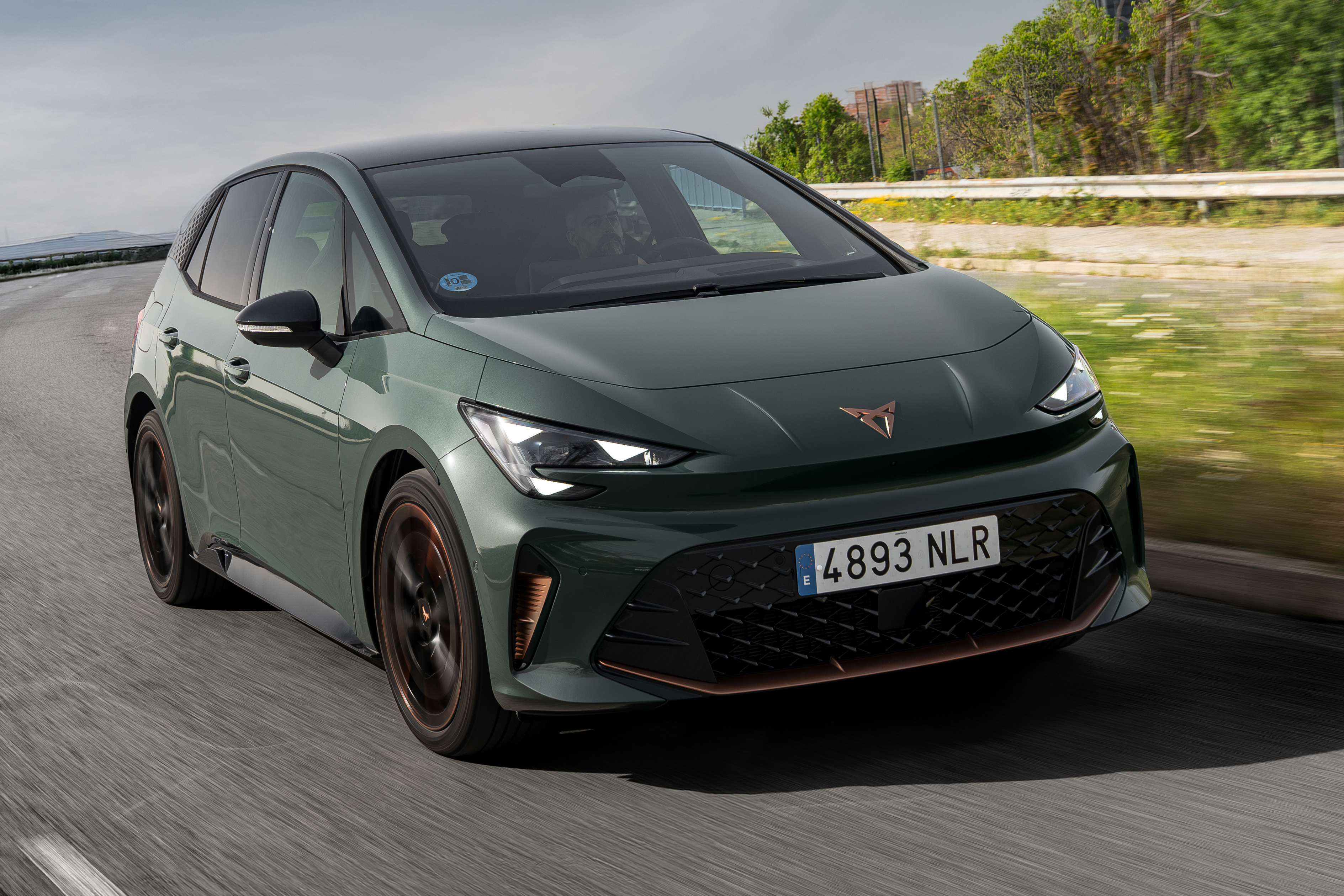
A Cupra Born is another car to consider if styling and a more extroverted feel matter to you. An Audi Q4 e-tron is also worth shortlisting if you want a more premium badge and are prepared to pay for it.
The Renault Scenic E-Tech is not a direct performance rival, perhaps, yet it remains relevant because it offers strong practicality, a roomy interior and a pleasant EV driving experience for less money. Mind you, as we’ve said, so does the regular Elroq.
What's the interior like in the Skoda Elroq?
The Skoda Elroq vRS has a cabin that gets the balance about right. It looks modern and mildly sporty, but it doesn’t fall into the trap of sacrificing usefulness in the pursuit drama. You get the visual lift of vRS-specific trim, sports seats and contrast stitching, yet the underlying layout is still that of a sensible family SUV. That’s good news, because there’s plenty of space, good visibility and a general feeling that this is still a car built for family life.
Skoda Elroq boot space and practicality
Practicality is one of the Elroq vRS’s strongest areas and one of the main reasons it makes such a convincing case against rivals.
Up front, the driving position is easy to get comfortable in, with enough adjustment in the seat and steering wheel to suit a wide range of drivers. The sports seats look the part and offer stronger support than those in the standard Elroq, but they are not so aggressively shaped that they feel awkward to get in and out of.
The dashboard architecture is neat and simple, although as we’ll discuss further in the infotainment section lower down the page, that does have some ramifications with ergonomics and ease-of-use. The centre console has useful storage space, though, while the door bins are a decent size, too.
Rear-seat space is where you might be most surprised given the car’s compact footprint. There’s a huge amount of legroom and headroom, so six-foot adults can sit behind front-seat occupants of the same size and still have space to stretch out, while the flat floor helps make the middle seat more usable than it is in most rivals.
Boot space is a quoted 470 litres with the rear seats in place, rising to 1,580 litres when they’re folded down. That’s larger that performance-focused electric SUV rivals such as the Volvo EX30 and Smart #1, and is competitive by the standards of compact SUVs generally. The boot is also usefully square and easy to load, while Skoda also includes a variable boot floor and a net arrangement to help keep charging cables and smaller items out of the way, which sounds minor but makes a difference in daily use. So does the standard handsfree powered tailgate.
Skoda Elroq dimensions
The Elroq vRS is 4,488mm long, 1,884mm wide (2,148mm wide including the door mirrors) and 1,618mm tall. That makes it compact enough to be manageable in town and in tight car parks, but large enough inside to feel properly family-friendly.
Compared with the Enyaq vRS, it is an easier car to place on narrower roads and in urban areas. Compared with smaller alternatives such as the Volvo EX30 and Smart #1, it gives you more useful cabin and luggage space without becoming awkwardly bulky.
Tech and infotainment in the Skoda Elroq
The Elroq vRS uses the same basic infotainment system as the rest of the Elroq range, which includes wireless Apple CarPlay and Android Auto, DAB radio, Bluetooth, voice control, and native sat-nav. You also get wireless phone charging, an upgraded Canton sound system, and a head-up display on the vRS, which you don’t get on some other versions.
It’s all centred around a 13.0-inch central touchscreen backed up by a smaller 5.0-inch digital driver display. The touchscreen looks good, with graphics that are crisp and quick, plus quick, reliable responses to inputs. However, like a lot of cars these days, the touchscreen is required to operate too many of the car’s functions, including the climate control. This makes the screen look cluttered, and actually operating those functions is more difficult, more time-consuming, and more distracting than if they were operated with simple buttons and knobs.
Materials available on the Skoda Elroq
The materials that make up the Elroq’s interior are largely very good. There’s the odd hard plastic panel to be found if you root around in the footwells, but that’s true of pretty much any rival, and the surfaces in your direct eyeline are all smart-looking, tactile and interesting.
The Elroq vRS gets its own interior treatment, catchily named the vRS Lounge Design Selection. This combines microsuede and artificial leather upholstery with lime green stitching and carbon-look trim inlays. The visual effect is sportier than the standard Elroq, but without being too garish.
What's the Skoda Elroq like to drive?
The Elroq vRS is fast, tidy and reassuring, rather than being particularly thrilling or engaging. Some will see that as a weakness, while others will see it as a strength. The former will wish for more playfulness on the road, while the latter will appreciate the fact that it’s comfortable and easy to drive whatever the situation, easy to live with every day, but you can enjoy its performance when you want to.
Skoda Elroq range and performance
The Elroq vRS uses a dual-motor four-wheel-drive powertrain producing a total of 340PS. That makes it the most powerful Elroq on sale and one of the fastest accelerating Skodas you can buy. The official 0-60mph time is given at 5.2 seconds, while top speed is 111mph.
Those numbers are fairly meaningless to most people, mind. What you really need to know is that the vRS has the capacity to be very quick indeed, especially off the line where its colossal, instantly-delivered torque throws the car forward with real ferocity. It’s not the face-melting acceleration that some of the pottier EVs on the market deliver, but it’s undeniably brisk when you floor it. It’s brisk when picking up speed on the move, too, and although the rate of accelerative potential tails off the faster you go, like it does in pretty much all EVs, the effect isn’t as marked as in some.
Perhaps more importantly, though, the vRS isn’t some hair-triggered nutter. The throttle is very easy to modulate, so when you’re just pottering to the shops or dropping the kids off at school, it stays calm and easy.
The powertrain is fed by an 82kWh battery with 77kWh of net usable capacity, which is a wee bit smaller than the one used in the more mainstream 85 version, which is 84kWh, or 79kWh usable (it’s the other way round with the bigger Enyaq: the vRS gets the bigger battery and the 85 the slightly smaller one).
Official range is up to 344 miles on the WLTP cycle. That is less than the longest-range rear-wheel-drive Elroq 85, which is no surprise given the vRS’s extra power, four-wheel drive and more aggressive positioning. Even so, 344 miles is a decent figure for a fast electric SUV and should be enough to make the car feel easy to live with if you charge at home and plan longer trips sensibly.
Performance data
| Model | Engine/battery size | Power | 0-62mph | Range/MPG |
|---|---|---|---|---|
Elroq vRS | 82 kWh | 340PS | 5.2 seconds | Up to 344 miles |
Skoda Elroq driving and refinement
Skoda has pitched the Elroq vRS in a very Skoda sort of way. It’s not trying to be a hard-edged performance SUV that constantly eggs you on. Instead, it aims to be composed, secure and usefully quicker than the regular car, with the capacity to raise a smile when called upon. For many buyers, that will be exactly the right call, and more importantly, the car performs that role very effectively.
The vRS gets Dynamic Chassis Control adaptive suspension as standard (it’s optional on SportLine Elroqs), and this adjusts the firmness of its dampers according to which of the drive modes you select, or which of the settings you dial in yourself with the Individual mode selected. There are no fewer than 15 settings on offer, so you have a fair old level of variation.
Most of the time, we reckon you’ll just want to leave it in the default Normal mode. The softer modes have the car’s body bouncing and bobbing a wee bit too much, while the firmer modes introduce a shade too much jitter to proceedings: not enough to make it feel uncomfortable, but enough to take the shine off things. The Normal mode gets the balance just about right in our book, with enough control to keep the car feeling tidy, but enough compliance to deal with poor road surfaces effectively at all speeds. And with so much variation on offer, you can choose to kick things up or down a few notches according to your mood.
It should be noted, though, that even with everything turned up to 11, the Elroq vRS still doesn’t feel like the thrill-ride that some buyers might want. It’s tidy, secure, grippy and neutral, but it’s not playful or adjustable in the way the best performance cars are. The steering, meanwhile, is well-weighted and responsive, but offers very little feel, while the brakes can also feel a bit spongey.
All in all, we’d say that the vRS - despite its trick suspension - isn’t really any better to drive than any other Elroq: the stuff it does best is stuff that the regular car also does really well. To enthusiast buyers, or those trying to justify the vRS’s lofter price, that may be a stumbling block
On the other hand, however, the fact that the vRS still has the regular car’s everyday comfort, ease-of-use and refinement might be precisely why other buyers like it. And that refinement is very good, by the way. The powertrain is as quiet as you’d expect in an EV, and wind noise is well suppressed at 70mph. Those big 20-inch wheels kick up a bit of road noise at the national limit, but it’s nothing unacceptable.
How safe is the Skoda Elroq?
Safety is a strong area for the Elroq vRS. The wider Elroq range earned a five-star Euro NCAP rating in 2025, with particularly strong scores for adult occupant protection and child occupant protection.
Standard safety kit is generous. The Elroq vRS comes with a broad suite of driver assistance systems, including autonomous emergency braking, adaptive cruise control, multi-level lane assistance, traffic-sign recognition, a driver attention warning system, and blind-spot monitoring.
You also have multiple airbags, two more than in lower-spec Elroqs thanks to the addition of rear side airbags. Isofix points are fitted to the outer rear seats, and there is also Isofix provision for the front passenger seat. The standard 360-degree camera should also help you avoid parking scrapes.
Running costs: What it's like to live with a Skoda Elroq
The Elroq vRS is not cheap to buy, and so has less of a value-for-money appeal than cheaper Elroqs. However, it’s not bad by performance SUV standards, and it should be reasonably painless to own. Energy costs will likely be far lower than the fuel bills of an equivalent fast petrol SUV if you can charge mostly at home, while servicing requirements are relatively light and the standard equipment list is strong enough that you do not need to stretch the budget further with optional extras.
Skoda Elroq charging times and costs
For the lowest running costs, charge your Elroq vRS at home. This will take around 13 hours on a standard 7kW wallbox charger (if you rely on a regular domestic three-pin socket, you’ll be talking days rather than hours), and assuming that you pay for your domestic electricity as the UK’s national average rate, it’ll cost you around £21.
If you’re smart, though, you’ll get your home onto a variable power tariff that lets you charge your car overnight on massively discounted off-peak power. That’ll cut down the price of a charge by at least half and probably more.
Conversely, you can probably treble that original cost when you use a DC public rapid charger, because the power that comes out of these is tremendously expensive. The Elroq vRS supports DC rapid charging at up to 185kW, which is faster than the lesser Elroq models. Under ideal conditions, that allows a 10% to 80% top-up in around 29 minutes. In practice, that is a good enough figure to make motorway stop-offs manageable rather than irritating (aside from the cost, that is), assuming you find a charger capable of delivering the necessary power.
Skoda Elroq warranty and servicing
Skoda covers the Elroq vRS with a three-year warranty, made up of two years with unlimited mileage plus a third year capped at 60,000 miles. The battery has separate cover for eight years or 100,000 miles. It’ll be repaired or replaced for free if the usable capacity drops to below 70% of its original level within this time.
Service intervals are fixed, with inspection due at 24 months, which will reduce costs and simplify ownership. A service light in the car will inform you when work is needed.
Skoda Elroq insurance groups
The Skoda Elroq vRS sits in insurance group 36. That means premiums certainly won’t be cheap, but it is also not wildly out of step with a 340PS electric SUV. Insurance costs will still depend heavily on your age, location and claims history. As ever, it is worth getting quotes before committing, especially if you are moving into the performance EV class for the first time.
How much does it cost to tax a Skoda Elroq?
The Elroq vRS has a list price of less than £50,000, which is the point at which EVs become liable for the higher rate of VED road tax. This higher rate adds an additional £440 per year to the basic-rate payment of £200 between years two and six of the car’s life, totalling five annual payments of £640, after which you revert back to the standard flat rate.
Be careful, though. Although the vRS escapes the threshold on basic list price, it’s not all that far off, and adding a few optional extras could easily be enough to take you over, and saddle you with liability for the higher rate. If buying new, keep an eye on your box-ticking exploits, and if buying used, Google the reg of any potential buyer to ensure that the original owner did the same.
What trims are available with the Skoda Elroq?
The vRS is a single trim level at the top of the Enyaq range, and as such, it comes with plenty of equipment. There are 20-inch wheels in a design exclusive to the vRS, matrix LED headlights, LED rear lights, a power-operated boot, dual-zone climate control, ambient lighting, keyless entry and start, a heated leather steering wheel, heated front seats with an electrically adjustable driver's seat, a head-up display, a 360-degree parking camera plus front and rear sensors, and a 13-inch infotainment screen.
Ask the Drive experts: common questions
How much is the Skoda Elroq vRS in the UK?
What range does the Skoda Elroq vRS have?
How fast is the Skoda Elroq vRS?
How long does the Skoda Elroq vRS take to charge?
Is the Skoda Elroq vRS bigger than a Volvo EX30?
Should I buy the Skoda Elroq vRS or a regular Elroq 85?
Get our latest advice, news and offers
Keep me updated by email with the latest advice, news and offers from Drive.
.jpg)
_1.jpg)