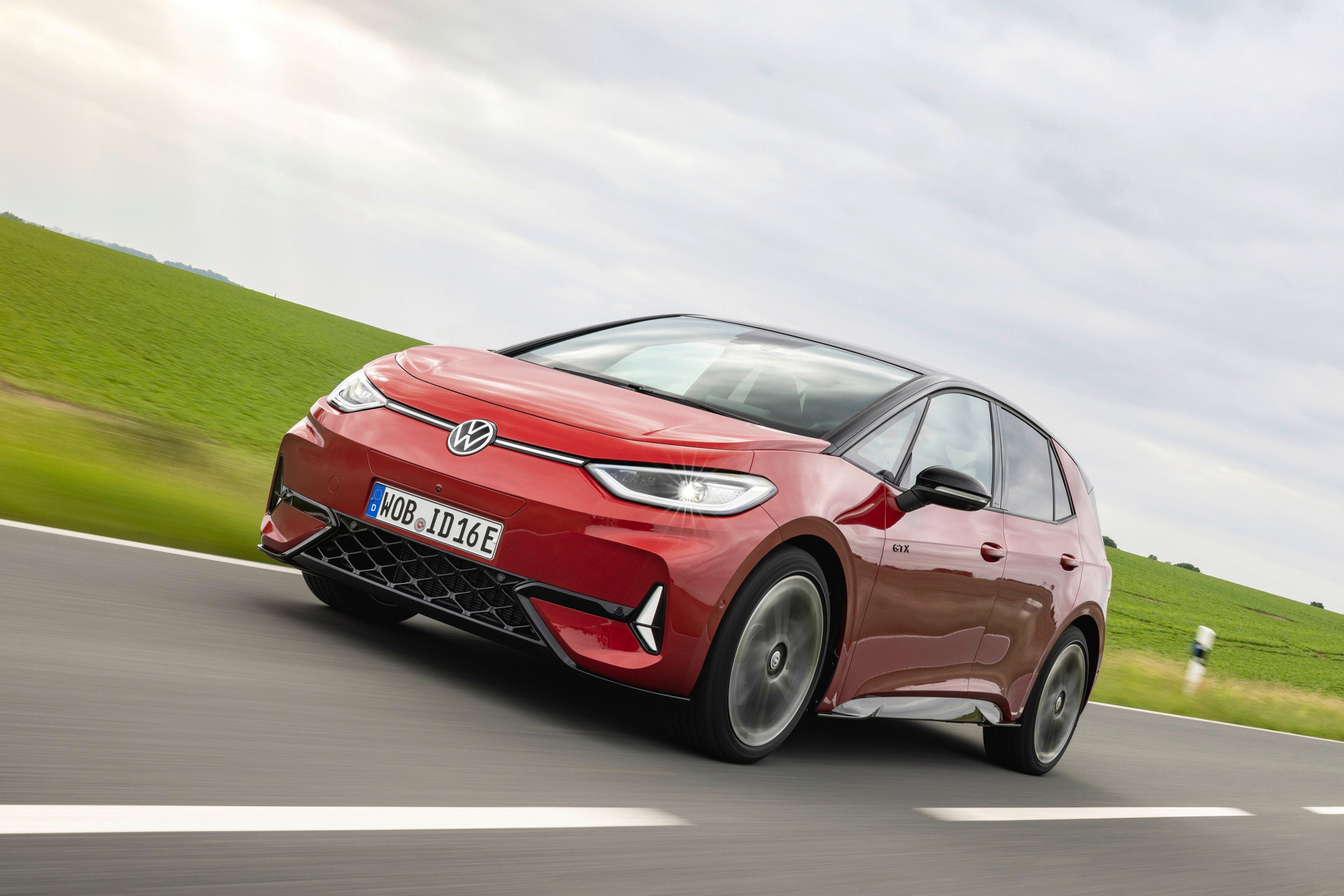
Volkswagen ID.3 GTX Review

Written By Matt Robinson
- 2024
- Family hatch
- Electric
What we love
Strong real-world efficiency
Plenty of standard kit
Spacious cabin for the size
Things to consider
Performance takes priority over maximum efficiency
Larger wheels can make the ride a little firmer
Extra performance is more than many buyers will need day to day
The DRIVE take on the Volkswagen Id3, is it the right car for you?
The Volkswagen ID.3 GTX makes most sense if you want a fast, well-equipped family EV rather than a true electric hot hatch. It is quick, refined and efficient enough to be easy to recommend, and the updated cabin materials and infotainment are definite improvements over early ID.3s. The problem is that the GTX badge promises more excitement than the car actually delivers, and it’s a badge you pay plenty for. If outright driver appeal is your priority, there are better options.
The Volkswagen Id3 in more detail
How you feel about the Volkswagen ID.3 GTX will largely depend on what you’re expecting from it. If you view it as simply a faster version of the regular ID.3 electric hatchback with some racier styling, then you’ll likely be very happy with it, provided that you’re happy to pay the considerable extra sum it costs.
If, however, you're expecting it to be a proper electric hot hatch with a thrill-a-minute driving experience akin to that of an electric Golf GTI, then you’ll be distinctly underwhelmed. It’s a nice car, but you can get all that’s good about the ID.3 in a more humble version that costs a lot less.
Browse used Volkswagen ID.3s for sale →
It’s not lacking much in the performance stakes, mind. Its single electric motor delivers 326PS to the rear wheels, giving it an official 0-62mph time of 5.7 seconds. Its 79kWh battery, meanwhile, gives an official range of up to 371 miles. All of those figures look strong on paper, but they don’t translate into the excitement you’d hope for in the real world, with slightly lacklustre handling that just doesn’t feel as playful or as charismatic as you might like.
It does plenty right in other areas, though. The ID.3 is a naturally roomy hatchback for its size, so there’s generous space for passengers and a decent boot, and because the GTX version was released after the 2023 facelift of the regular ID.3, it benefits from the significant upgrades in interior quality and infotainment usability. The GTX’s efficiency is also genuinely impressive given the performance on offer. It is also very well equipped, which partly - but not entirely – justifies the high price.
What's the best Volkswagen Id3 trim and battery option?
This is a simple one, because in the UK, there’s only one Volkswagen ID.3 GTX and it comes with one battery and one power output. We get the GTX Performance version only, with the 79kWh battery and 326PS motor.
That means the real question is not which GTX to choose, but whether you need the GTX at all. If you want the fastest, longest-range ID.3 with the strongest equipment list, then this is the one to have. If you’re prepared to compromise - even a little bit - on any of that, though, then you’ll be better-served by a more humble version of the regular ID.3.
What’s the price of the Volkswagen Id3?
The Volkswagen ID.3 GTX Performance currently starts at £46,325. That makes it very expensive compared to other, more humble versions of the ID.3, and compared to other rival alternatives. Fortunately there are also plenty of used Volkswagen ID.3s for sale for considerably less.
Alternatives to the Volkswagen Id3
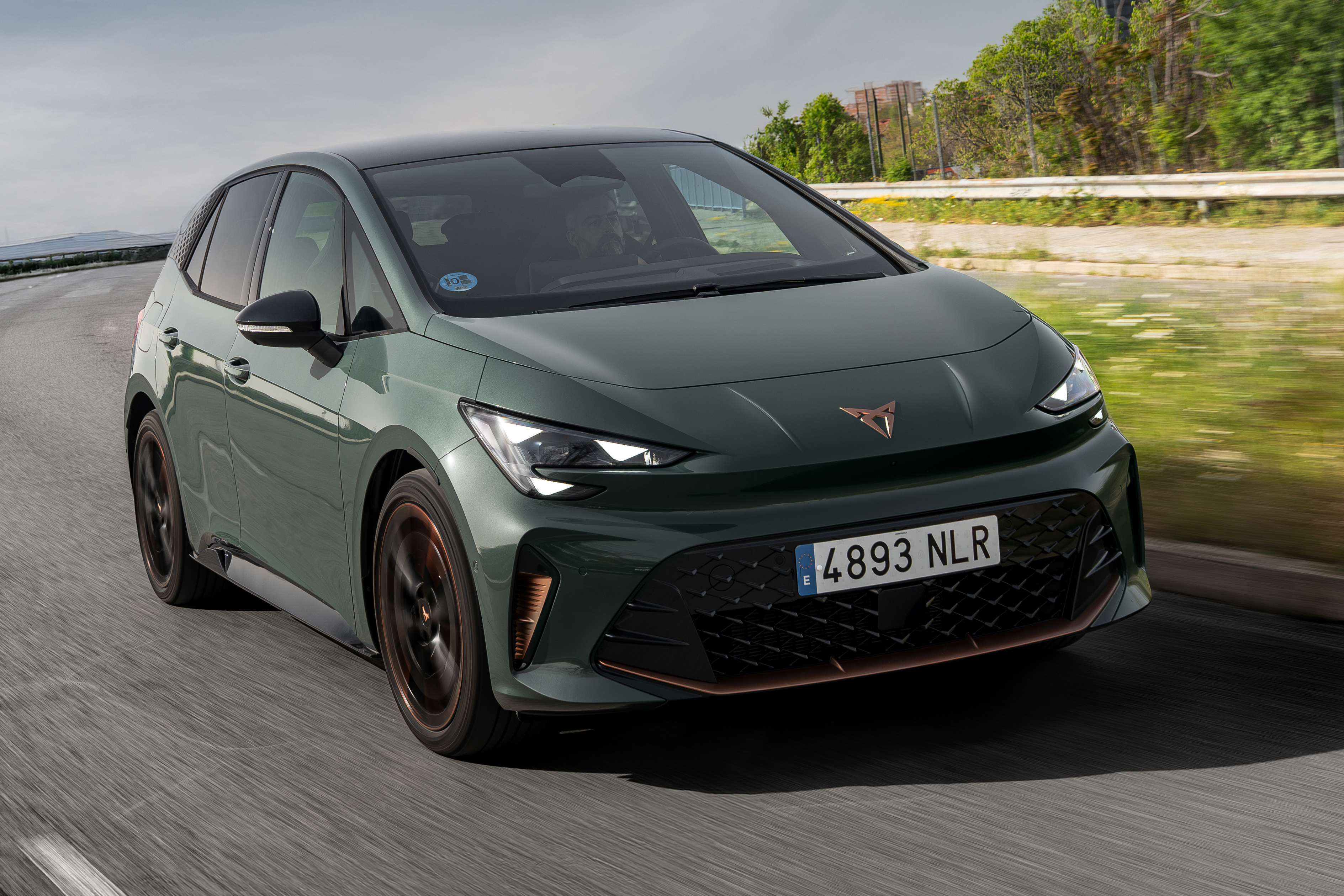
The Cupra Born VZ is the closest relative to the ID.3 GTX Performance, and the most obvious rival. It shares the same platform and powertrain, and most of the same tech, but it manages to be slightly more engaging and playful on the road. If you are already looking at an ID.3 GTX, the Cupra should be on your shortlist alongside it.
The MG4 XPower is another key alternative. It’s much cheaper, much more powerful and far more dramatic in a straight line. It’s actually not as polished or as well resolved as the more humble versions of the MG4, but those cost a lot less still.
The Abarth 600e or Alfa Romeo Junior Elettrica 280 Veloce might also be worth a look if you want something more intentionally mischievous. These aren’t as spacious as the ID.3 GTX, and the range gets nowhere near, but they do bring more character and a stronger sense of occasion.
You could also simply spend similar money on a petrol hot hatch, such as Volkswagen’s own Golf GTI.
What's the interior like in the Volkswagen Id3?
The Volkswagen ID.3 GTX doesn’t do a great deal inside to distinguish itself from the rest of the ID.3 range, but the good news is that it benefits from the broader facelift improvements that made the standard car more convincing.
Volkswagen Id3 boot space and practicality
Like with any other ID.3, this is one of the GTX’s strongest areas. Despite the car’s compact footprint, the in has a passenger compartment that feels more spacious than many conventional hatchbacks of a similar size.
It’s particularly good in the rear seats where both headroom and legroom are impressively generous, and a pair of tall adults will be happy and comfortable. The rear bench isn’t quite wide enough to comfortably accommodate a third passenger, but that’s the case in pretty much all cars of this size, and you’ll be okay to squeeze in for short hops. The flat floor helps give everyone lots of foot space, too.
Up front, the driving position is easy enough to get comfortable in, visibility is very good, and there’s a very decent amount of cabin storage.
Boot space stands at 385 litres, which is respectable rather than outstanding. Fold the rear seats down and you open up a useful 1,267 litres, although the floor is not completely flat because the folded rear seats lie at a slight angle.
Volkswagen Id3 dimensions
The Volkswagen ID.3 GTX measures 4,264mm long, 1,809mm wide and 1,564mm high. That keeps it compact enough to work well in town, while still offering impressive cabin space for the class.
Tech and infotainment in the Volkswagen Id3
The GTX was released after the rest of the ID.3 range was facelifted in 2023, whereupon the glitchy old 10.0-inch infotainment screen was replaced by the newer 12.9-inch system. That means all GTXs have the new-and-improved system.
Improved how? Well, the glitchy software was sorted out so that it glitched no more, and the menu structure was made simpler so that it was less confusing. However, it’s still not perfect, and the user-interface could still be a bit more intuitive.
Some of the previous gripes remain, though. The touch-sensitive steering wheel controls are still used, and these are too easy to brush by mistake, operating a function that you never intended to.
The cabin temperature and stereo volume are still adjusted with touch-sensitive slider controls rather than physical buttons or dials, which is both more fiddly and more distracting. At least these controls are now backlit so you can use them at night.
Like most versions of the ID.3 range, you get wireless Apple CarPlay and Android Auto, along with wireless phone charging, navigation, DAB radio and Bluetooth. The GTX adds to that with an upgraded 480-watt Harman Kardon sound system.
Materials available on the Volkswagen Id3
As we just mentioned, the GTX was released after the rest of the ID.3 range was facelifted in 2023. The other benefit of this is that the GTX gets all the improvements in cabin quality that the facelift brought. More cushioned surfaces were introduced to inject some lustre into the ID.3’s previously rather underwhelming cabin, and the upgrades were largely successful.
Largely, but not totally. There are still a few hard and unappealing panels to be found if you root around, so while the ID.3 no longer feels bargain-basement, it doesn’t have the premium-esque feel you might expect, either, especially for the elevated cost of the GTX over the rest of the ID.3 range.
What's the Volkswagen Id3 like to drive?
The Volkswagen ID.3 GTX is easy, quick and capable to drive, but it never quite develops the sense of fun or excitement you want from a hot hatch, electric or otherwise. It is better considered as a slightly more rapid version of the regular ID.3.
Volkswagen Id3 range and performance
There is just one powertrain available in UK versions of the Volkswagen ID.3 GTX (other foreign markets get more choice). It has a 326PS electric motor driving the rear wheels, giving a 0-62mph time of 5.7 seconds. It’s powered by a 79kWh battery, giving an official range of 371 miles.
The performance figure looks decent on paper, but in the real world, the acceleration lacks the razzmatazz you might be expecting. The acceleration is eager and easy at all times, but when you really press your foot to the floor, there will likely be times when you think to yourself: ‘is that it?’
For context, the Volkswagen Golf R that you can buy from exactly the same forecourt for a very similar amount of cash, has a very similar amount of power, but it’ll do the 0-62mph sprint a full second quicker. The petrol car’s standard four-wheel drive helps on that score, of course but so does the fact that the R weighs almost 500kg less than the GTX. This all conspires to make the GTX feel like merely a marginally faster version of the regular ID.3, rather than a full-on standalone performance model.
Performance data
| Model | Engine/battery size | Power | 0-62mph | Range/MPG |
|---|---|---|---|---|
Volkswagen ID.3 GTX | 79kWh | 326PS | 5.7 seconds | 371 miles |
Volkswagen Id3 driving and refinement
Volkswagen hasn't just given the GTX more power and some sportier styling touches, and then simply left it at that. It's also been given an extensively retuned suspension, complete with adaptive dampers as standard, plus tweaked steering. Oddly, though, despite all the changes, it doesn't feel especially different in character to any other ID.3.
What’s undeniable is how capable the car is. It has bags of grip and fast, predictable responses, making it a very easy car to drive quickly. However, there’s simply not enough engagement or playfulness to convince as a proper electric hot hatch. You can feel the car’s considerable weight shifting around as you change direction, and the steering, although responsive, is short on both weight and feedback.
The adaptive dampers have no fewer than 16 settings, although 15 of them feel pretty pointless. The GTX feels at its best with the suspension set as soft as possible, because it flows much better with undulations in the road surface, while also making for much less fuss over speed bumps. Neither comfort nor refinement are in question with the GTX, because it has both attributes in spades. And because body control remains tight in all modes, even this softest one, there isn’t much benefit to firming things up, as it makes very little difference to the car’s handling abilities.
We don’t want you to get the wrong end of the stick: the GTX is still a pleasant car to drive, and if you simply want a brisker version of the regular ID.3, with its generally mature, relaxed and easy-going character, then it’ll suit you down to the ground. It’s just that if you’re looking for an extra layer of dynamic sparkle worthy of a standalone performance model, we don’t think you’ll find it here.
How safe is the Volkswagen Id3?
The Volkswagen ID.3 was first assessed by independent safety organisation Euro NCAP in 2020, several years before the GTX existed. Happily, it scored the full five-star rating. The GTX came along in 2024, and the ID.3 was retested by Euro NCAP in 2025 against newer, more stringent safety standards. Yet again it scored the full five-star rating, and that rating applies to the GTX along with the rest of the range.
The roster of standard safety kit is reasonably generous, including adaptive cruise control, automatic emergency braking with cyclist and pedestrian detection, lane assist, a driver attention and drowsiness monitor, and dynamic road sign display. You also get three Isofix child seat mounting points, two in the back and one on the front passenger’s seat.
Running costs: What it's like to live with a Volkswagen Id3
The Volkswagen ID.3 GTX isn’t cheap to buy, but it should be affordable to run if you can charge at home. Only rely on DC rapid chargers in emergencies, though, as these are really expensive.
Volkswagen Id3 charging times and costs
The most affordable way to run any electric car is to charge it at home, and for the most convenient way of doing that, get yourself a 7kW home wallbox charger installed. On that type of connection, the GTX’s 79kWh battery pack will take around 11.5 hours to take on an empty-to-full charge and, assuming for a moment that your domestic electricity is billed at the UK’s national average rate, that full charge will cost you around £22.
There’s a very easy way of saving much more cash, though, and that’s to transfer your home onto a variable electricity tariff that allows you to charge your car overnight on heavily discounted off-peak power. Doing so will likely slash your charging costs down to around a third of that sum, so it’s a total no-brainer.
The opposite is true when you use a DC public rapid charger, because the power that comes out of those often costs three times more than the national average due to the convenience of such a quick charge. And how quick will that charge be? Well, the GTX accepts DC charge up to a maximum rate of up to 185kW, so if conditions are perfect, a 10-80% top-up can be delivered in around 26 minutes.
Volkswagen Id3 warranty and servicing
Like the rest of the Volkswagen ID.3 range, the GTX comes with a three-year or 60,000-mile vehicle warranty. The cover on the high-voltage battery is for eight years or 100,000 miles.
Servicing is simpler on an EV than with a combustion-engined car because there are far fewer moving parts, but don’t expect a service to be any cheaper. You will save money through the fact that your car will need servicing less often, though, with intervals of two years regardless of mileage.
Volkswagen Id3 insurance groups
The Volkswagen ID.3 GTX sits in insurance group 34 of 50, which is a fair step above the rest of the regular ID.3 range. That is not a huge surprise given the price and performance.
If you’re buying used and you happen to find a Fire and Ice special edition (only 1990 examples were made), do bear in mind that this sits slightly higher in group 36.
How much does it cost to tax a Volkswagen Id3?
If the list price of your electric car sits below £50,000, then you pay the annual flat rate of £200 per year for your VED road tax. If the list price is higher than that, then you pay the Expensive Car Supplement on top of that, adding another £440 to your annual bill. That applies for a temporary five-year period between years two and six of the car’s life, after which you pay just the regular flat rate.
No version of the GTX busts that barrier in its standard form, but it does get close. And remember, too, that the threshold includes any optional extras added, and you don’t have to add too many to tip your GTX over, saddling you with liability for the extra charge. Be very careful when speccing your brand new GTX, or if buying used, perform a quick Google search on any potential purchase to make sure that the original owner did the same.
What trims are available with the Volkswagen Id3?
The Volkswagen ID.3 GTX is effectively a standalone trim level that sits at the very pinnacle of the ID.3 range, and although it doesn’t deliver the driving experience worthy of a standalone performance model, it does come with a level of standard equipment worthy of a range-topper.
The standard roster includes 20-inch alloy wheels, Matrix LED headlights, rain-sensing wipers, exterior ambient lighting, a two-tone styling pack, rear privacy glass, front- and rear parking sensors, a reversing camera, DCC adaptive suspension, keyless entry and start, heated front seats with power adjustment, a heated leather steering wheel with multifunction controls, dual-zone climate control, an augmented-reality head-up display, 30-colour interior ambient lighting, adaptive cruise control, a 480-watt Harman Kardon sound system, and the 12.9-inch infotainment system, with navigation, wireless phone charging, DAB radio, and wireless smartphone integration.
That’s a lot of toys, but it jolly well should be considering the price of the car.
Ask the Drive experts: common questions
How powerful is a Volkswagen ID.3 GTX?
What is the range of the Volkswagen ID.3 GTX?
What does Volkswagen GTX mean?
Does the Volkswagen ID.3 GTX avoid the expensive EV tax surcharge?
Get our latest advice, news and offers
Keep me updated by email with the latest advice, news and offers from Drive.
.jpg)