Volvo V90 Review

Written By Phil Hall
- 2016
- Estate
- Plug-in hybrid
What we love
Beautifully restrained design inside and out
Exceptionally comfortable seats and long-distance refinement
Plug-in hybrid range is genuinely useful for many commutes
Things to consider
Not as sharp to drive as the best German alternatives
Boot space is good rather than class-leading for such a big estate
Prices are firmly in luxury-car territory
The DRIVE take on the Volvo V90, is it the right car for you?
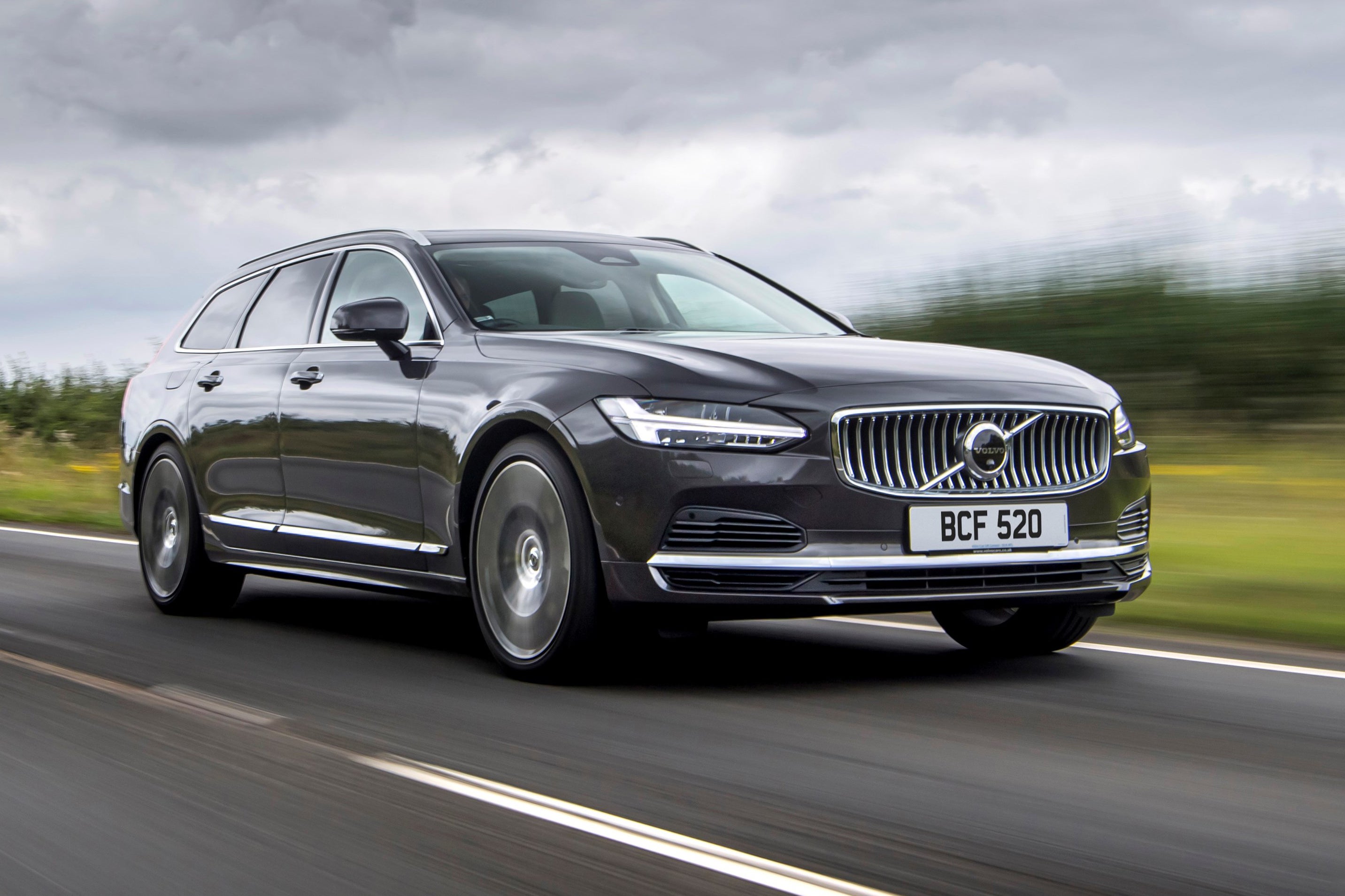
The Volvo V90 remains one of the most appealing large estates you can buy if you want something elegant, relaxing and a little different from the usual German choices. It does not try to win the class with flashy technology or sporty intent. Instead, it leans on calm design, excellent seats, impressive refinement and the sort of easy long-distance character that makes a big estate car feel genuinely special. It is expensive, and it is no longer the broad-range model it once was, but the Volvo V90 still makes a strong case if comfort, style and real-world usability matter more than badge one-upmanship.
The Volvo V90 in more detail
The Volvo V90 is an important car for a couple of reasons. First, it is one of the few remaining premium estates that still feels unapologetically like an estate, rather than a crossover trying to borrow some wagon credibility. Second, it is one of the last cars of its kind from Volvo, a brand whose reputation was built in no small part on elegant, useful long-roof machines exactly like this.
It first arrived in 2016, replacing the old V70 and slotting in as the estate sister to the S90. From the start, it offered a different flavour to the obvious German alternatives. Where a BMW 5 Series Touring leaned into driver appeal and a Mercedes-Benz E-Class Estate majored on traditional luxury, the Volvo V90 carved out its own niche with minimalist Scandinavian design and a very calm, unhurried character.
That basic appeal has aged well. The V90 still looks expensive without being showy, and its interior still feels more interesting and less contrived than many rivals. It has also benefited from Volvo’s later Google-based infotainment update and from the latest plug-in hybrid hardware, which gave the Recharge models a much more convincing electric range than before.
The range you can buy in the UK today is much simpler than it used to be. Volvo’s own UK site says the V90 mild hybrid has been discontinued, while the V90 plug-in hybrid remains available from stock. That means the current live range is centred on the Recharge plug-in hybrid in Plus and Ultra forms, rather than the older spread of petrol, diesel and mild-hybrid versions that previously shaped the model’s story.
That matters for how you should read the car in 2026. If you are shopping brand new or nearly new from current stock, the plug-in hybrid is the relevant V90. If you are buying used, the older B4 and B5 petrols, as well as the earlier diesels, still matter because they make up a big part of the model’s wider market presence. The regular V90 review therefore needs to cover both realities without muddling them.
The V90 also sits in a slightly unusual part of today’s market. SUVs dominate, and that means cars like the V90 no longer have the same volume or mainstream visibility they once did. In some ways that only adds to its appeal. A V90 feels like a deliberate choice, and a discerning one, rather than the default family-car purchase. It is a car for people who still understand the appeal of a low roofline, a long load bay and a big, comfortable cabin.
What's the best Volvo V90 trim and engine option?
For current-stock buyers, the Volvo V90 Recharge T6 Plus is the version to focus on. It has more than enough performance, a useful official electric range of up to 54.1 miles, and it avoids the extra expense of the T8 while still feeling effortlessly strong in normal use.
The T8 Ultra is tempting because it adds serious pace and the richest equipment count, but the T6 already feels quick enough for a large luxury estate and suits the car’s relaxed character better. The V90 is most convincing when it is wafting quietly along or covering daily miles on electric power, not when it is pretending to be a sports wagon.
If you are buying used, the older diesel models are still worth considering. A D4 or D5 can suit the V90 brilliantly if you do big motorway mileage, because the low-down torque and long-legged nature fit the car’s brief so well. The newer plug-in hybrid is still the more modern answer, but the diesel V90 remains a very natural used-market fit.
What’s the price of the Volvo V90?
The current Volvo V90 range starts at £61,445 for the T6 Plug-in Hybrid Plus and rises to £70,745 for the T8 Plug-in Hybrid Ultra. That is serious money, even by premium estate standards.
It puts the V90 firmly into the same territory as high-spec German rivals, and well beyond the sort of money that buys very spacious mainstream estates such as the Skoda Superb. The Volvo’s defence is that it feels genuinely premium, comes generously equipped and offers a distinctive alternative to the usual German trio.
There is also a used-market story here that makes the V90 easier to justify. Older diesel and petrol examples can look attractively priced now, especially against newer plug-in hybrids, and that broadens the appeal of the car beyond its current six-figure-adjacent list pricing.
Alternatives to the Volvo V90
The Audi A6 Avant is one of the clearest alternatives if you want a polished premium estate with a slightly more conventional German feel and a very strong cabin. The BMW 5 Series Touring remains the driver’s choice in this part of the market, while the Mercedes-Benz E-Class Estate is still the obvious pick if comfort and traditional luxury come first.
The Volkswagen Passat Estate and Skoda Superb Estate are also important alternatives if outright space and value matter more than badge prestige. They do not have the same design-led feel as the Volvo, but they are tremendously practical and easier to justify financially.
If you like the Volvo idea but want something more rugged and niche, the V90 Cross Country is the obvious in-house alternative. It adds extra ride height, chunkier styling and a tougher image, but the standard V90 remains the cleaner, more elegant thing.
What's the interior like in the Volvo V90?
The V90’s interior is one of the clearest reasons to choose it. Even after several years on sale, it still looks and feels special in a way that many more aggressively modern rivals do not.
Volvo V90 boot space and practicality
A big estate has to deliver on usability, and the V90 largely does. Space in the front is excellent, with lots of seat adjustment, a roomy cabin and the sort of all-day comfort Volvo has made a speciality over decades.
The seats deserve special mention because they are genuinely among the best in the business. Support is excellent, the driving position is easy to perfect and the overall sense of comfort fits the V90’s long-distance brief perfectly. This is the kind of car you can climb out of after several hundred miles feeling surprisingly fresh.
Rear-seat space is also strong. There is plenty of legroom, and two adults will be very comfortable in the outer rear seats. The centre seat is more compromised, partly because of the transmission tunnel and partly because these sorts of cars are rarely perfect for carrying three grown adults across the back, but families with three children will find the V90 perfectly manageable.
Boot space is more nuanced. The current plug-in hybrid offers 488 litres to the glass line and 651 litres to the roof with the rear seats in place. Fold the rear seats and that rises to 1,544 litres to the roof. Those are good figures, but not quite the huge class-leading numbers some buyers may expect from a car this large.
That is the key comparison point with rivals. A V90 Recharge is not as capacious as the very biggest estate-car benchmarks, and the battery packaging inevitably eats into some of its luggage advantage. In simple terms, it is a large estate with a good boot rather than a large estate with a truly enormous one.
Earlier non-hybrid versions did better on headline capacity, with the old V90 quoted at 560 litres and the plug-in hybrid at 488 litres. That means used buyers who put boot space first may still prefer one of the older conventional versions, while current buyers need to accept that the price of the PHEV powertrain is a little less luggage volume.
What the V90 does offer is a very usable load area. The opening is wide, the load bay is long and the electrically operated tailgate makes access easy. It is also low enough to the ground to be simpler to load than an SUV, which is one of the enduring benefits of a good estate.
Volvo V90 dimensions
The Volvo V90 measures 4,945mm long, 1,895mm wide and 1,463mm high, with a 2,941mm wheelbase. That makes it every inch a large estate car, and explains why it feels so substantial on the road and so roomy inside.
Despite those dimensions, it never feels clumsy in the way some larger SUVs can. The low body and long roofline make it easier to judge than you might expect, and it remains a more elegant answer to family-car space than a high-riding alternative.
Tech and infotainment in the Volvo V90
The V90 has had more than one infotainment era during its life. Earlier cars used Volvo’s own Sensus system, while later versions moved to Google built-in and a more modern software experience.
For current buyers, the Google-based set-up is the one that matters. It brings Google Maps, Google Assistant and Google Play integration, which makes the V90’s infotainment feel much more current than the old system now does. It is still centred on Volvo’s portrait touchscreen layout, and that still gives the interior a distinctive, neatly minimalist look.
In use, the system works reasonably well. The graphics are clear, the screen is responsive enough and the built-in Google functionality is genuinely helpful. Google Assistant can handle a decent number of commands, and Google Maps remains one of the best navigation systems available in any car.
The main drawback is familiar from many modern Volvos. Too many functions sit within the screen, and while the climate controls are pinned low down, you still need more taps and swipes than ideal for some tasks. The V90 does not feel hopelessly fiddly, but neither is it the easiest system to use on the move.
Audio also deserves mention because higher-spec cars can be fitted with genuinely excellent premium systems. The standard sound set-up is perfectly decent, the Harman Kardon upgrade is strong, and the Bowers & Wilkins system available on higher trims or via options is one of the best factory-fit stereos you can get in a non-exotic estate.
Materials available on the Volvo V90
Material quality is a major strength. The V90 cabin feels expensive in a very understated way, using attractive woods, tasteful metals and upholstery choices that give it warmth rather than cold showroom gloss.
That is part of the reason it has aged so well. Where some rivals now look a little too busy or a little too dependent on giant screens, the Volvo V90 still feels elegant and carefully judged. It is not just premium in a generic sense. It has character.
What's the Volvo V90 like to drive?
The V90 is best understood as a comfort-led large estate rather than a sporting one. That is not a weakness. It is simply where Volvo chose to place the emphasis.
Volvo V90 range and performance
The current UK V90 range is now centred on two plug-in hybrid powertrains
The T6 is the better fit for the car’s character. It is already very quick by any reasonable standard, and the extra shove from the electric motor means it feels effortless in the sort of overtaking and slip-road situations that matter most in a big estate.
The T8 goes from effortless to frankly excessive. Its performance is impressive, and for some buyers that will be a major attraction, but the V90 never feels like a car that really needs 455hp. The T8 is best understood as the indulgent choice rather than the necessary one.
The earlier petrol and diesel engines are still relevant if you are buying used. The B4 and B5 mild-hybrid petrols were perfectly good, smooth enough and strong enough, but the older diesels arguably suited the V90 particularly well. Their torque and long-distance economy matched the car’s laid-back touring nature beautifully.
Performance data
| Model | Engine/battery size | Power | 0-62mph | Range/MPG |
|---|---|---|---|---|
Volvo V90 T6 AWD Plug-in Hybrid | 2.0-litre plug-in hybrid auto | 350PS | 5.5 seconds | 256.5–352.6mpg / up to 54.1 miles |
Volvo V90 T8 AWD Plug-in Hybrid | 2.0-litre plug-in hybrid auto | 455PS | 4.8 seconds | 256.5–313.4mpg / up to 52.2 miles |
Volvo V90 driving and refinement
The V90 goes down the road with the sort of relaxed confidence that makes a large estate feel worthwhile. It rides well, settles into a motorway cruise beautifully and generally feels more interested in smoothing things out than encouraging you to attack every roundabout.
That makes it very easy to like. It is not soft or sloppy, and body control is tidy enough, but there is not much sense of enthusiasm in the steering or the way the car changes direction. If you want a big estate that feels especially engaging, a BMW 5 Series Touring still has the edge.
The V90’s strength is refinement. Wind noise is low, tyre noise is mostly well contained and the plug-in hybrid versions can be wonderfully hushed at lower speeds when running on electric power. Even the older diesel models are quieter than many buyers may expect.
Wheel size matters, however. The bigger wheels fitted to higher-spec versions can bring a firmer edge and more impact harshness, and that means Plus models on smaller wheels often give the most convincing ride-comfort balance. Ultra cars add desirable luxury kit, but their larger alloys do slightly dilute the V90’s naturally soothing character.
Overall, though, the V90 does exactly what a large premium estate should. It makes long distances feel easy, and it has a calm, expensive gait that still feels distinctive in today’s SUV-dominated market.
How safe is the Volvo V90?
The Volvo V90 carries a five-star Euro NCAP result from 2017, with Euro NCAP confirming that the V90’s rating is based on the S90 saloon and that the estate performs as well or better. Euro NCAP also highlighted the standard-fit City Safety autonomous braking system for scoring full points at highway speeds and the car’s lane assistance system for warning and corrective steering support.
That is very much in keeping with Volvo’s broader safety reputation. Even by the standards of its class, the V90 has a comprehensive suite of airbags, driver aids and child-seat provisions, and safety remains one of the model’s strongest selling points.
Running costs: What it's like to live with a Volvo V90
Running costs depend heavily on whether you are looking at a current plug-in hybrid or an older petrol or diesel used example. The good news is that the V90 at least gives you clear paths depending on what sort of driving you do.
Volvo V90 fuel economy
The current T6 and T8 plug-in hybrids post spectacular official economy figures, but as ever those numbers only make real sense if you can charge regularly and use the battery properly. The official electric range of up to 54.1 miles in the T6 is genuinely useful, though, and enough to cover plenty of shorter daily journeys without using the petrol engine.
Charging is straightforward enough for home use. Volvo’s official figures show 0-100 per cent charging in around three hours on a 16-amp three-phase supply, or around five hours on a 16-amp single-phase set-up. That makes the V90 PHEV a realistic overnight or workplace charger car rather than a chore to top up.
On longer journeys with a depleted battery, fuel economy inevitably falls back towards normal petrol-estate levels. That is the familiar PHEV compromise. Buyers who do lots of motorway miles without regular charging may still find the older diesel used cars more logical.
Volvo V90 warranty and servicing
Volvo covers the current V90 with a three-year or 60,000-mile warranty, while the plug-in hybrid battery is covered for eight years or 100,000 miles. That is respectable, but not especially generous in today’s market.
Service and maintenance costs are unlikely to be bargain-basement either. This is a premium large estate, and it should be budgeted for accordingly.
Volvo V90 insurance groups
Insurance sits on the high side, which is no surprise for a large, expensive estate with strong performance. Earlier cars could start as low as group 27, but the broader V90 range rose well into the 40s, and the current T8 plug-in hybrid sits right at the expensive end.
In practical terms, buyers should expect the V90 to be costly rather than ruinous to insure, and the T8 will obviously be the priciest of the lot.
How much does it cost to tax a Volvo V90?
For current V90 buyers, the tax picture is fairly simple. From the second year onwards, petrol plug-in hybrids pay the standard VED rate, which is now £200 a year.
The bigger issue is the Expensive Car Supplement. Both current V90 plug-in hybrids sit above the £40,000 threshold, so they attract the extra charge from years two to six.
In real terms, that means a new V90 will cost £640 a year from years two to six before dropping back to the standard rate afterwards.
Used buyers need to be more careful, because older cars may fall under different tax rules depending on registration date. Early pre-April 2017 cars are treated under the old CO2-based system, which can make a material difference. So for used purchases, it is always worth checking the registration-specific VED result rather than assuming
What trims are available with the Volvo V90?
The current V90 range is built around Plus and Ultra.
Plus is the entry point, but it is still generously equipped. The official price list shows that Plus includes items such as 19-inch wheels, Pilot Assist, 360-degree parking camera, handsfree tailgate, heated front and rear outer seats, leather-faced upholstery, Google Automotive Services, Apple CarPlay and Android Auto, and a full spread of safety systems.
That is a strong standard package, and one of the reasons the T6 Plus is so easy to recommend. It already has the substance of a luxury estate without forcing you into the most expensive trim.
Ultra adds a more indulgent layer, including active bending headlights, Four-C adaptive dampers with rear air suspension, front seat ventilation, Nappa leather options, and the superb Bowers & Wilkins audio system with 1,400W output and 18 speakers. It is lavish, but it is also the spec that pushes the V90 firmly into the realm of a very expensive luxury estate rather than merely a premium one.
Ask the Drive experts: common questions
How much does the Volvo V90 cost?
Which Volvo V90 is best?
Is the Volvo V90 still on sale?
Get our latest advice, news and offers
Keep me updated by email with the latest advice, news and offers from Drive.