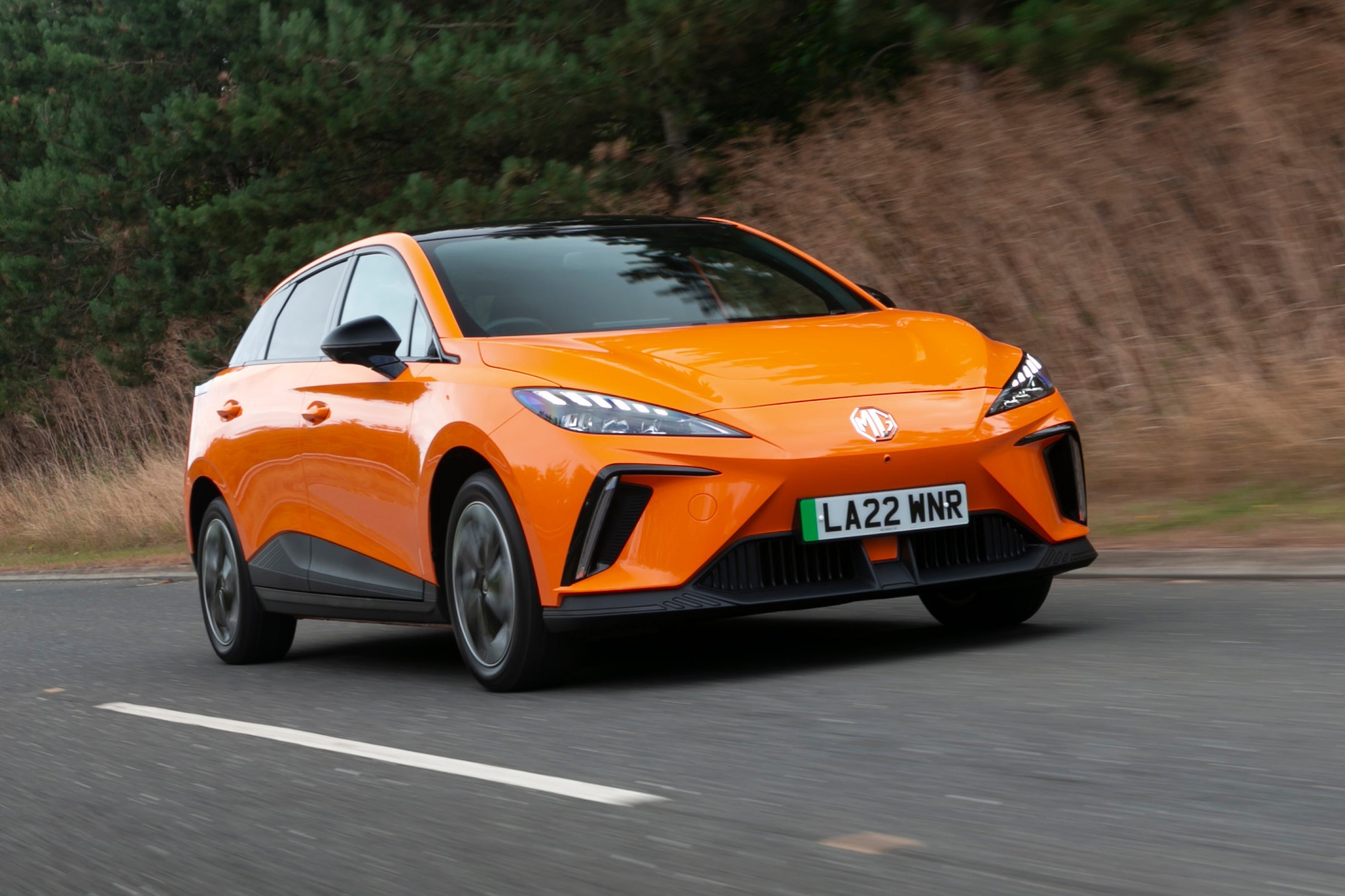
Peugeot e-308 Review

Written By Ivan Aistrop
- 2023
- Hatchback
- Electric
What we love
Pleasant to drive
Nice interior finish
Good refinement
Things to consider
So-so practicality
Real-world range could be better
Driving position might irritate some
The DRIVE take on the Peugeot 308, is it the right car for you?
The Peugeot e-308 is an easy electric family hatchback to like. It takes the regular 308’s smart styling, polished road manners and classy cabin, then adds a smooth electric powertrain that suits the car’s relaxed character well. It is not the roomiest or most long-legged EV in the class, and some rivals make a stronger family case, but if you want an electric hatchback that feels stylish, refined and reassuringly normal, the Peugeot e-308 is well worth a look.
The Peugeot 308 in more detail
Thanks to the ever-growing popularity of SUVs, family-sized hatchbacks such as the Peugeot 308 have become much less common sights on the UK’s roads. Could the addition of a fully electric version be the stimulus it needs to catch car buyers’ collective attention? Find out with our full Peugeot E-308 review.
For the Peugeot 308, choice is king. You can have one as a mild hybrid or plug-in petrol, a diesel (yes, still), and as an EV in the form of this Peugeot e-308. Given that none of the 308's combustion engines are particularly amazing, going for the electric one seems like it might be a good idea, but a look at the e-308's 'line-up presents a bit of an issue. Because there isn't one.
Its original battery and motor combination consisted of a 156PS front-mounted motor with a 50.4kWh (but marketed as 54kWh) useable capacity battery. This resulted in modest performance and a modest range. Living with the former is fine, but with a real-world driving range of around 200 miles, even at warmer times of year, it seemed a shame to not even have the option of a bigger battery.
Now that the Peugeot e-308 has been treated to an array of mid-life updates, the driving range issue has been addressed. To an extent.
Before you get too excited, the e-308 has fundamentally the same motor and battery pack as before, but the chemistry of the latter has been improved, bumping the useable capacity to 55.4kWh. That's enough to nudge the official driving range figure up by 21 miles to a best of 279 miles.
Not game-changing but definitely a step in the right direction, all without the weight penalty of an enlarged massive battery pack.
There's also a new Vehicle-to-Load (V2L) function making it possible to use the high-voltage battery to power devices that use a three-pin plug. A kettle or, as suggested in the lifestyle-heavy marketing materials, an e-bike — something Peugeot also happens to make.
Originally, the Peugeot e-308 was quite pricey, but its cost has dropped considerably. As it's also eligible for the government's Electric Car Grant (ECG), it's cheaper still, with a starting price under £30,000. Plenty of other EVs have also seen price drops and the e-308's field of rivals has got bigger since its launch.
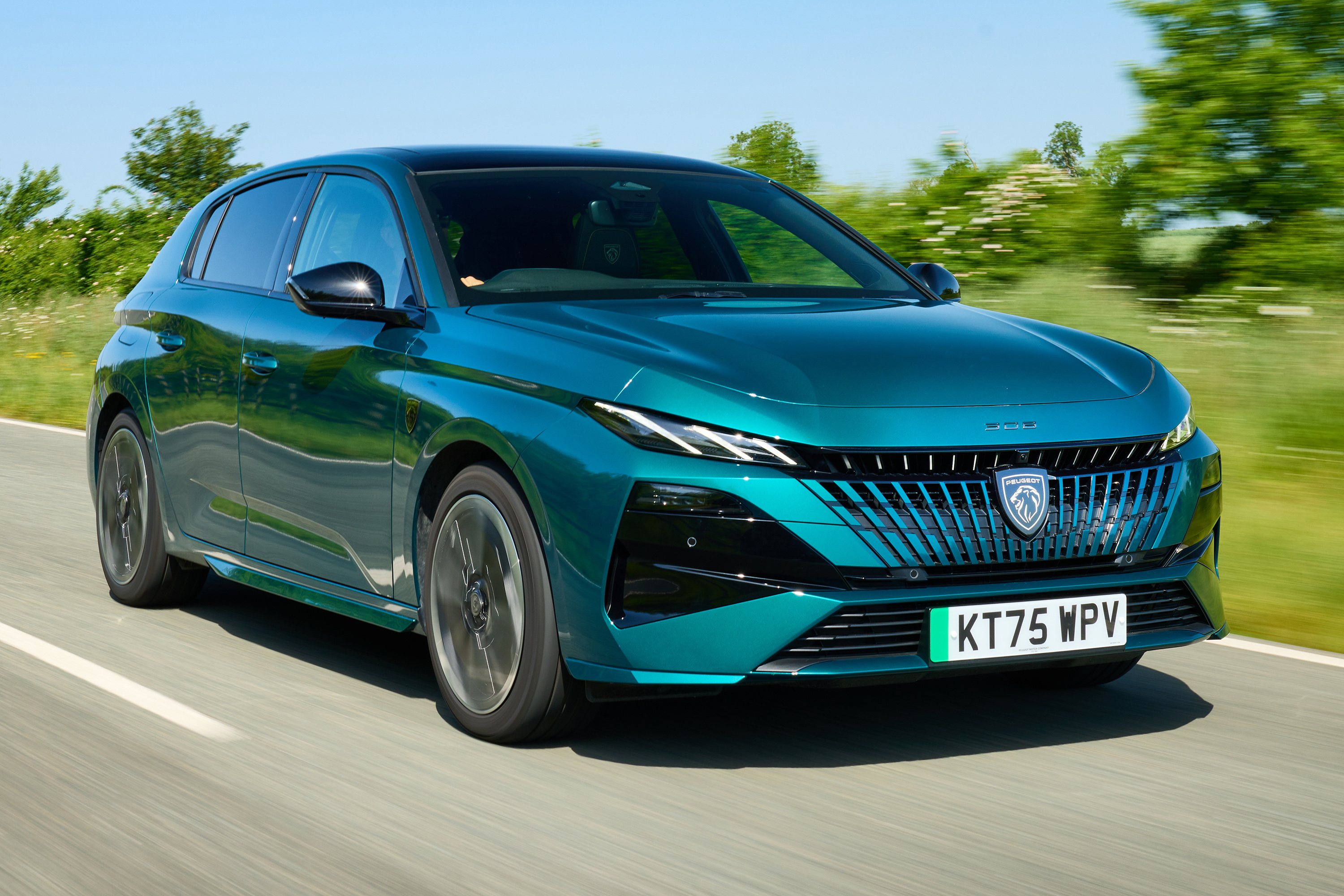
Aside from the improved range the e-308 also gains the same aesthetic tweaks as its combustion-engined siblings. This includes a revised front end that ditches the massive 'lion's claw' daytime-running lighting elements for a more subtle triple-claw-like motif inside the redesigned headlights.
Those tie in with strokes of LEDs above the grille, all subtly done, unlike some cars' front ends which give Blackpool's illuminations a run for their money. Whether you like the backlit grille badge is a matter of personal taste.
The e-308 was already a great-looking car and now it's more distinctive than ever. Its exterior is matched by a similarly stylish cabin, although the strange i-Cockpit driving position won't be for everyone. The infotainment system isn't amazing, either, nor are we keen on having to use it for climate functions.
What's the best Peugeot 308 trim and battery option?
There is only one battery and motor combination in the Peugeot e-308 hatchback, so the main choice is trim rather than powertrain.
For most buyers, the best Peugeot e-308 is the Allure. It already comes with a lot of the equipment you will actually care about day to day, including 18-inch alloy wheels, a reversing camera, heated front seats, a heated steering wheel, dual-zone climate control and the twin 10-inch screen setup.
GT adds sportier styling, front parking sensors, ambient lighting and a few richer trim details, but it is also pricier and does not transform the ownership experience. That means Allure makes the strongest all-round value case.
In simple terms, Allure is the sensible buy and GT is the style-led choice.
What’s the price of the Peugeot 308?
The Peugeot e-308 hatchback starts at around £31,000 in Allure trim and rises to around £38,000 in GT specification, depending on current offers and version details.
That means it is not cheap for a family hatchback, but nor is it wildly out of step with the electric class as a whole. The problem is that buyers spending this sort of money will also be looking at rivals with more range, more space or faster charging.
Used values are worth keeping an eye on, though. The e-308 has already started to appear on the market in lightly used form at significantly more tempting prices, and that improves its case considerably.
Alternatives to the Peugeot 308
The Volkswagen ID.3 is still the obvious rival if you want a family EV hatchback with a more spacious cabin and a slightly stronger long-distance case. It is not as stylish inside or out, but it is roomier and more clearly engineered around electric family use.
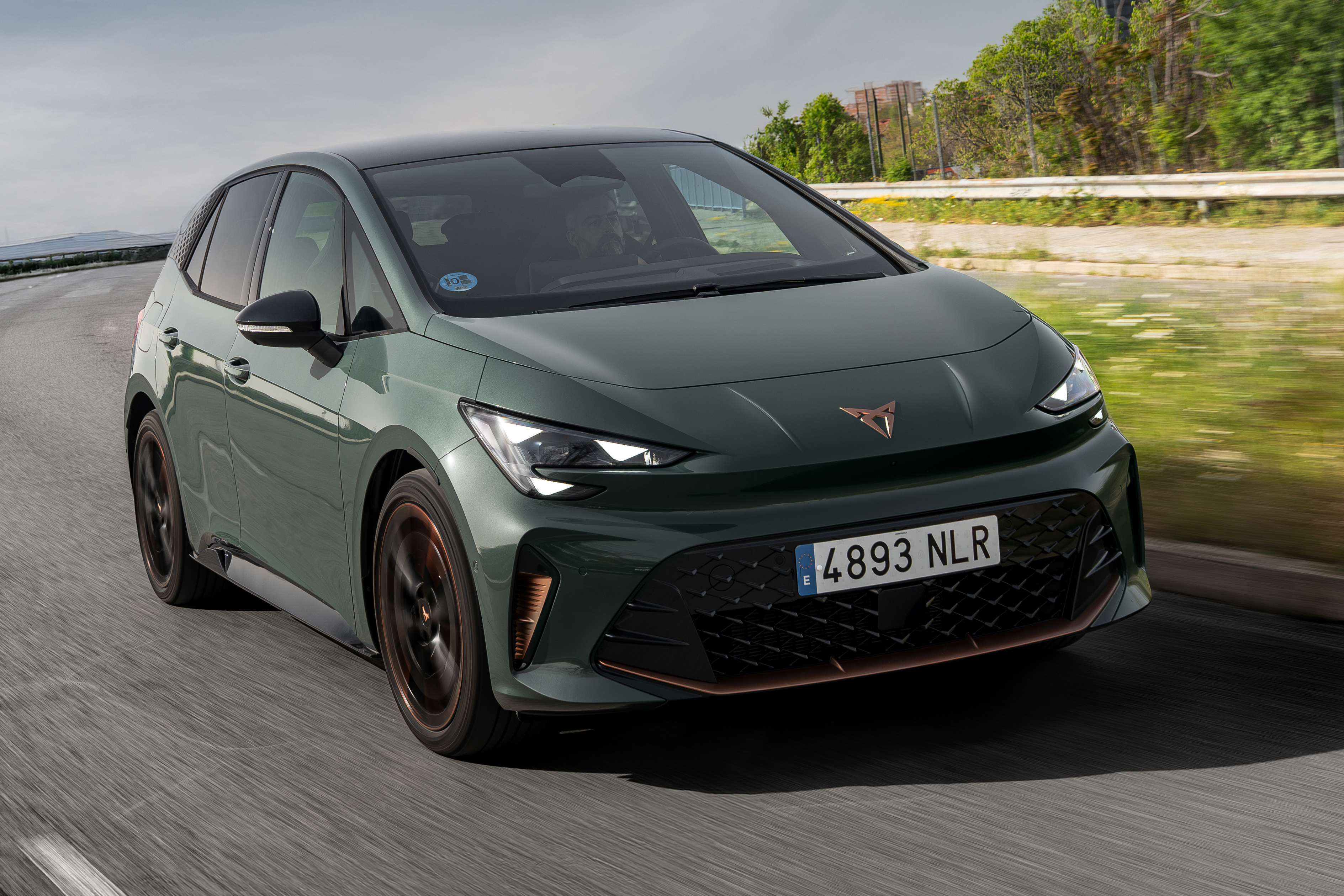
The Cupra Born is another key alternative if you want something that feels a little more driver-focused. It shares much with the ID.3 underneath, but wraps it in a sharper design and a more engaging character than the Peugeot e-308 can quite match.
The Renault Megane E-Tech is worth close attention if you are happy to blur the line between hatchback and crossover. It feels fresh, modern and cleverly packaged, and it is one of the strongest alternatives if style and technology matter to you.
Beyond those three, the Vauxhall Astra Electric is the obvious close relation, while the MG4 makes a very strong value-led case if you can live without the Peugeot’s richer cabin ambience. The e-308 makes the most sense if you want an electric family hatchback that feels stylish and refined rather than overtly futuristic.
What's the interior like in the Peugeot 308?
The Peugeot e-308 has one of the more distinctive interiors in this class. It feels modern, well finished and much more interesting than many mainstream alternatives, even if the cabin layout still will not suit everyone.
Peugeot 308 boot space and practicality
The Peugeot e-308 is adequate rather than exceptional when it comes to practicality. Up front, there is enough space for two adults to get comfortable, and the front seats are supportive enough for longer journeys.
Rear-seat space is good enough for a pair of adults, but no more than that. Legroom is only average, the rear door openings are not especially generous and a third passenger in the middle will feel the cabin’s limited width and the hump in the floor. In other words, this is fine for occasional family duty rather than class-leading rear accommodation.
Boot space stands at 361 litres, which is the same as the plug-in hybrid 308 but down on the regular petrol and hybrid hatchback’s 412 litres. That puts the Peugeot e-308 slightly below the class average, and it means alternatives such as the Volkswagen ID.3 or MG4 make a stronger practicality case.
The good news is that the e-308 still offers a more useful boot than some smaller EVs, and it will cope well enough with the weekly shop, school bags or a couple of cabin-sized suitcases. Fold the rear seats and you get a more useful extended load bay, though the floor is not especially flat.
Peugeot 308 dimensions
The Peugeot e-308 measures 4,367mm long, 1,852mm wide & 1,441mm high. That places it right in the heart of the family hatchback class and gives it a footprint very close to conventional rivals.
In practical terms, it is easy enough to place in town and still large enough to feel substantial on a motorway run. That familiar sizing is part of the e-308’s appeal, because it does not feel like a compromised niche EV.
Tech and infotainment in the Peugeot 308
Peugeot e-308 evidently reflects the firm’s attempt to correct an area of its cars that has caused most consternation in the recent past. Peugeot’s multimedia systems have been historically poor, while this one's 10.0-inch touchscreen is good… If not still not quite there, yet.
The i-Toggles work well, offering you a neat, configurable and always-on row of shortcuts under the main screen. Plus there’s a physical volume knob — always a winner — and proper buttons for accessing driving modes and air con menus.
But the e-308’s main issue is software-related. Its operation is sluggish, partly because Peugeot has built a transition graphic between menus. That’s lovely for PowerPoint presentations, but not when you’re switching between navigation and media menus at 70mph. A lot of the control icons are on the small side, too.
Wireless smartphone mirroring is standard, at least, so you can bypass the proprietary system’s media and navigation quirks for something familiar.
Materials available on the Peugeot 308
Ostensible cabin quality is one of the main attractions that will swing you towards a Peugeot e-308. Saying nothing of overall reliability, which is improving slowly for Peugeot, the feel of the e-308’s interior is outstanding.
The soft-touch, stitched top to the dashboard looks and feels great, as does the faux suede trim on the seats, doors and the dash. Pity it’s all dark grey and black, mind.
All the digital stuff looks lovely too. Not just the graphics for the infotainment and the i-Toggles, but the 3D effect of the digital instrument panel. Some may find it gimmicky, but others will enjoy the novelty — if it’s not your cup of tea you can always switch it off and opt for a flat 2D look.
It trounces the MG 4 EV and Volkswagen ID.3 for tactility and solidity, which you might expect in the former’s case, but the latter shows how far ahead of your expectations the e-308 could be.
What's the Peugeot 308 like to drive?
The Peugeot e-308 does not try to be a hot hatch EV. Instead, it focuses on refinement, ease of use and a convincing blend of comfort and control. That suits it well.
Peugeot 308 range and performance
The Peugeot e-308 uses a 54kWh battery and a front-mounted electric motor producing 156PS and 270Nm. Officially, it can manage up to 257 miles on a full charge.
That sounds respectable enough, but the reality is less impressive if you spend much time on the motorway or drive in colder weather. In those conditions, the e-308’s real-world range can drop quite a bit, which makes it feel less flexible than some rivals.
Performance is perfectly adequate rather than exciting. The 0-62mph time is 9.8 seconds, and while the e-308 feels smooth and eager enough at lower speeds, it is not especially quick once you are already moving.
For most buyers, the powertrain will be perfectly acceptable. It is just not the sort of EV that will wow you with headline pace or class-leading range.
Performance data
| Model | Engine/battery size | Power | 0-62mph | Range/MPG |
|---|---|---|---|---|
e-308 | 54kWh | 156PS | 9.8 seconds | Up to 257 miles |
Peugeot 308 driving and refinement
The Peugeot e-308’s ride quality is one of its standout features, traversing most road surfaces with the comfort and compliance of a bigger, more expensive car. It’s certainly best at higher speeds, although undulating rural roads can unsettle it, while cobbled surfaces at urban pace aren’t expertly absorbed either.
Like most EVs, the e-308 is heavy, owing to the battery's position under the floor — for reference its 287kg heftier than the lightest 308 available, the Hybrid 145. Rather than fight against it by stiffening the suspension to make the car firm and sporty, Peugeot has given the e-308 a softer, more compliant setup, with a bit of body roll built in.
In this regard it doesn’t feel that far removed from its Peugeot e-3008 SUV cousin, rather than having the sharpness of the Cupra Born. It’s rarely jarring when it hits a shallow pothole or a motorway expansion joint, although a smidge more height in the tyre sidewall might help on this front — all e-308s ride on identical 18-inch alloy wheels shod with 45% profile rubber.
The flipside of that is that it’s far from the last word in sharp handling. Its steering is reasonably quick to respond to small inputs at the wheel, exaggerated by its tiny size, but its lardy kerb weight and soft suspension contrive to make the E-308 feel cumbersome at times. The suspension damping is non-adjustable, so although the e-308 has different driving modes, they don’t make it any firmer or softer.
How safe is the Peugeot 308?
The Peugeot 308 range received a four-star Euro NCAP rating in 2022, and that applies here as well. That is respectable rather than outstanding in a family hatchback class where some rivals have gone one better.
The good news is that all versions of the e-308 get a healthy amount of standard driver-assistance kit, including adaptive cruise control with stop-and-go, autonomous emergency braking, lane-keeping assistance, speed-limit recognition and driver-attention warning. GT also adds matrix LED headlights and a few extra tech highlights.
Running costs: What it's like to live with a Peugeot 308
The Peugeot e-308 should be straightforward enough to run if you can charge at home, but its modest battery and middling real-world efficiency mean it is less convincing as a long-distance EV.
Peugeot 308 charging times and costs
Peugeot quotes a 20 to 80 per cent charge time of around 30 minutes if you connect the e-308 to a 100kW DC rapid charger. That is competitive enough, though not exceptional by current standards.
At home, the same 20 to 80 per cent charge on a 7.4kW wallbox takes around four hours 25 minutes. A full charge will take longer, but overnight charging is straightforward enough.
Because the battery is relatively modest in size, charging costs should stay manageable. That helps offset the fact that the e-308’s real-world range is less impressive than the official figure suggests.
Peugeot 308 warranty and servicing
Peugeot’s standard manufacturer warranty is three years or 60,000 miles, which is adequate rather than generous. The battery is covered separately for eight years or 100,000 miles, with repair or replacement promised if capacity falls below 70 per cent during that period.
Peugeot Care can also extend cover up to eight years or 100,000 miles through service activation, subject to the relevant terms and conditions.
Servicing intervals are every two years or 16,000 miles, which is fairly broad and should help keep routine maintenance straightforward.
Peugeot 308 insurance groups
Insurance is simple enough here. Allure sits in group 24, while GT sits in group 25. That should mean fair-to-middling premiums rather than anything ruinous, though it still costs more to insure than a regular petrol 308.
How much does it cost to tax a Peugeot 308?
The Peugeot e-308 now costs £200 a year in VED after year one, which is the current standard annual rate for electric cars.
The EV Expensive Car Supplement applies only to electric cars with a list price of more than £50,000. The e-308 sits well below that threshold, so there is no extra premium-car charge to worry about here.
What trims are available with the Peugeot 308?
The Peugeot e-308 hatchback comes in Allure and GT trim.
Allure already gives you plenty, including 18-inch alloy wheels, rear privacy glass, cruise control, automatic air-conditioning, heated front seats, a heated steering wheel, a 180-degree reversing camera and part-leather upholstery. It does not feel like an entry-level compromise.
GT adds sportier styling, front parking sensors, ambient lighting, keyless entry and extra trim details that better suit the e-308’s design-led character. It looks smarter, but it is also noticeably pricier.
Ask the Drive experts: common questions
Is the Peugeot e-308 a good electric car?
What is the real-world range of the Peugeot e-308?
Is the Peugeot e-308 practical enough for a family?
Does the Peugeot e-308 get the Expensive Car Supplement?
Get our latest advice, news and offers
Keep me updated by email with the latest advice, news and offers from Drive.
.jpg)
.jpg)
.jpg)