Porsche Taycan Review

Written By Matt Robinson
- 2019
- Saloon
- Electric
What we love
Fast and genuinely fun to drive
Feels very well built and properly premium
Range and charging both improved by the facelift
Things to consider
Modest central touchscreen by modern standards
Rear-wheel-drive Taycan prioritises range and agility
Options can change specification significantly
The DRIVE take on the Porsche Taycan, is it the right car for you?
The Porsche Taycan remains one of the best electric cars to drive because it still feels like a Porsche first and an EV second. It’s fast, beautifully engineered and far more involving than most rivals, while the 2024 update helped with the things that matter in the real world by improving range, charging and standard equipment. It remains expensive, it’s still easy to overspend on options and isn’t the most practical electric saloon you can buy, but if driving enjoyment matters as much as electric range, the Taycan is still one of the strongest choices in the class.
The Porsche Taycan in more detail
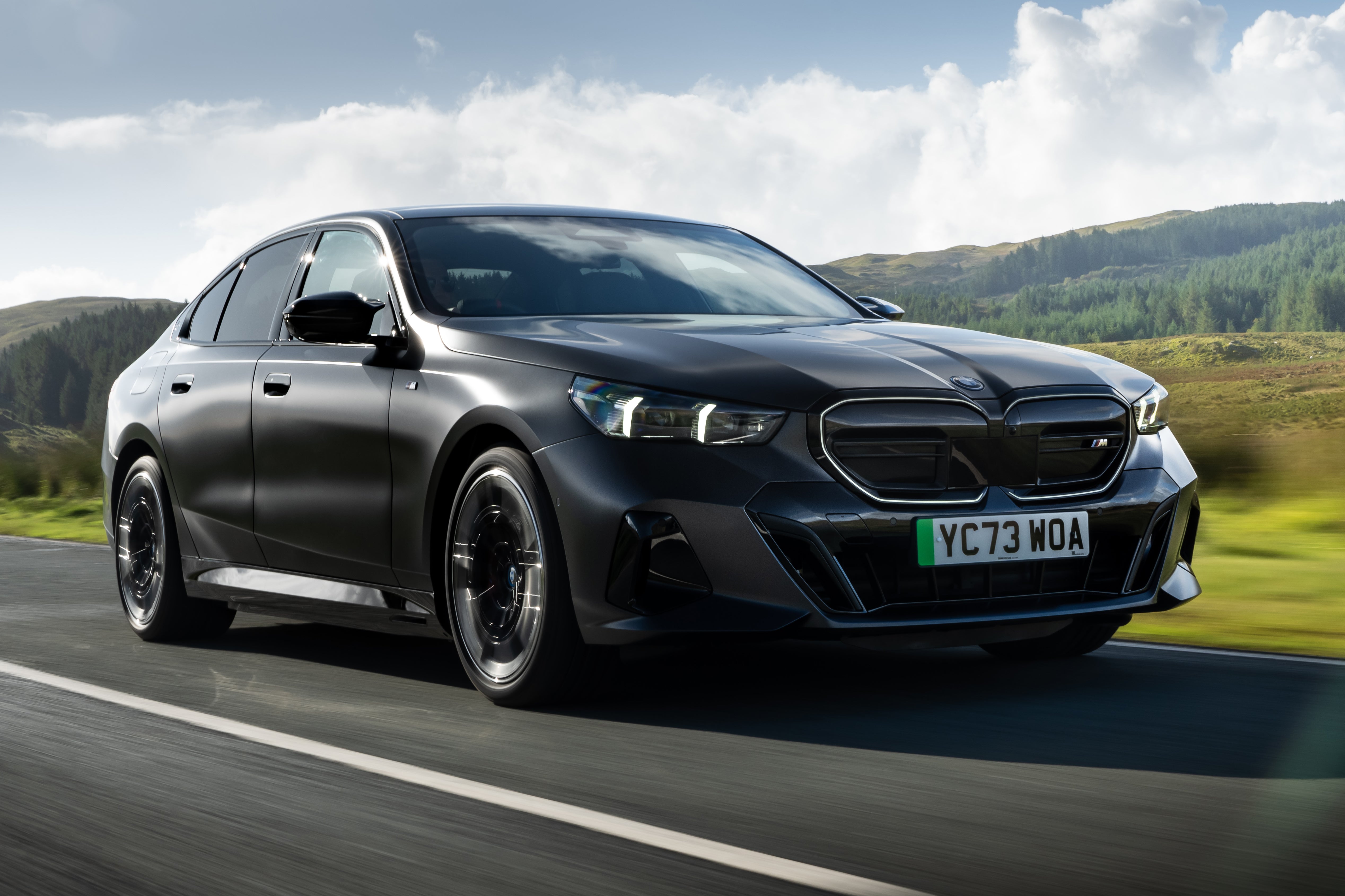
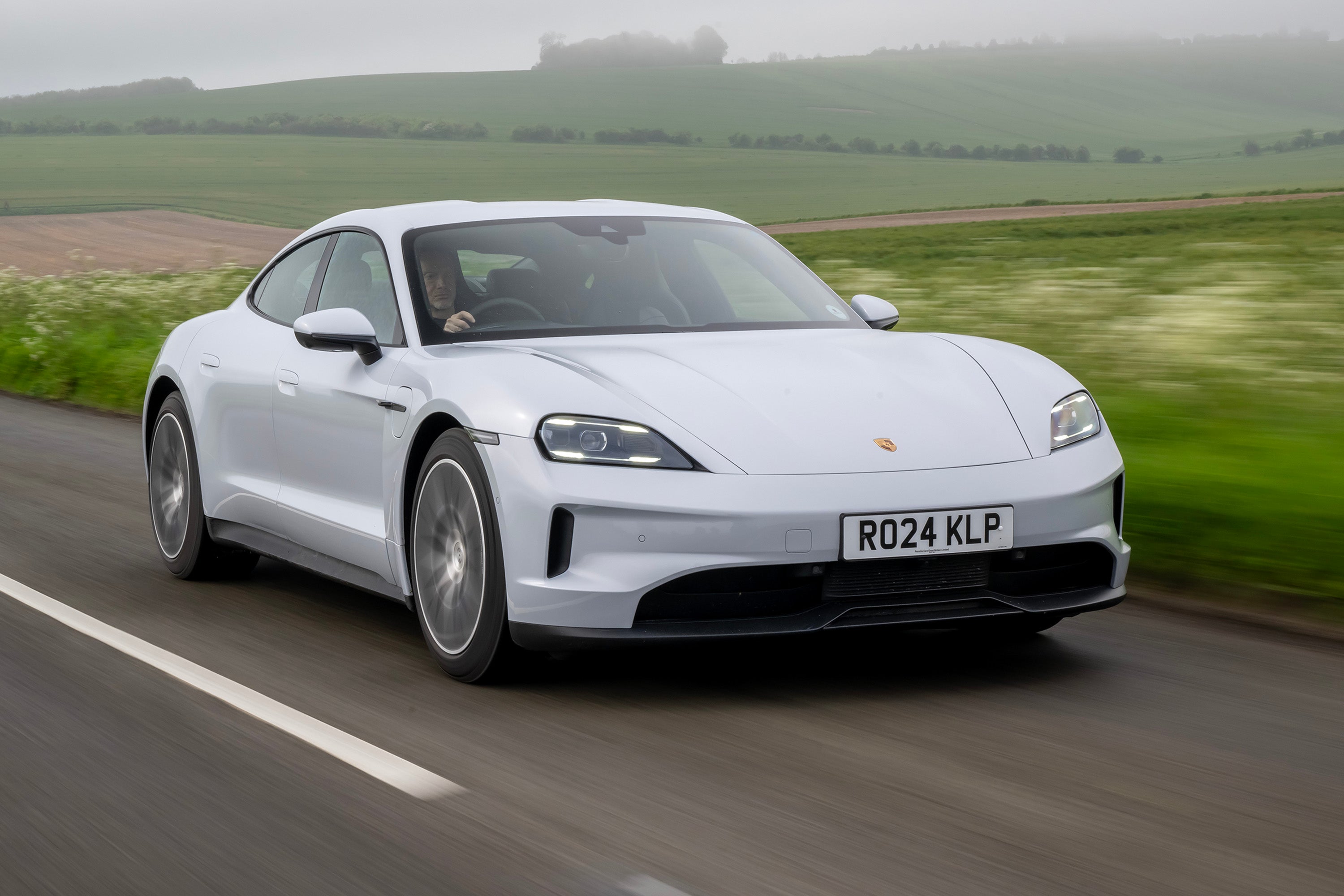
The Porsche Taycan was a hugely important car when it arrived in 2019 because it had to prove that a pure-electric Porsche could feel like a real Porsche rather than just a very quick fast exercise. It managed that. More than that, it set a benchmark for how enjoyable an EV could be to drive when the road stopped being straight.
That’s still the Taycan’s real appeal today. There are now plenty more premium electric rivals than there were when it launched, and the EV world has moved quickly enough that the Taycan no longer has the field to itself. But the 2024 facelift has kept it highly relevant by improving official range, upping charging performance and adding more standard equipment to make the car feel less meanly specified before you even start opening the options list.
Browse used Porsche Taycans for sale →
The result is that the Taycan still occupies a very appealing middle ground. It’s a genuine performance car, but not one that asks you to sacrifice usability in the name of lap times or headline acceleration. It looks special, feels expensive inside and has enough range and charging capability to work as an everyday EV. The main thing to watch is what you tick in the configurator, because a Taycan can become a very expensive car very quickly once you start adding the extras Porsche is so adept at tempting buyers with.
The range is also now broad enough that there is a clear version for almost every type of buyer. The basic rear-wheel-drive Taycan has a lot going for it because it’s the lightest, simplest and, in some ways, the sweetest car to drive. Further up the range, the all-wheel-drive versions and the Turbo models add astonishing pace, but there is a point where the numbers become more bragging rights than meaningful real-world benefit. That’s why the Taycan works best when you think of it as a premium electric sports saloon rather than just a drag-race machine.
Making the Taycan range more versatile is the Cross Turismo, which we’ve covered separately.
What's the best Porsche Taycan trim and battery option?
There's something to be said for sticking to the base model Taycan with the larger Performance Battery Plus (made standard across the range part-way through 2025) if you think you'll make use of the additional range. It still feels extremely quick, and its rear-wheel drive nature will be appreciated by those seeking driving fun.
You'll certainly save a lot of money by ignoring the faster models - with the Weissach Package added, the Turbo GT is more than two times the price of the entry-level Taycan. Sure, it's two and a half times as powerful, but really, you don't need all that performance. The most you might want to do is upgrade to the 4S, which isn't drastically more expensive than the base Taycan but a decent amount quicker and more capable owing to its all-wheel drive system.
What’s the price of the Porsche Taycan?
The Porsche Taycan range starts at £88,200 for the standard rear-wheel-drive saloon. Taycan Black Edition starts at £95,700, the 4S at £96,200, 4S Black Edition at £102,000, GTS at £118,200, Turbo at £135,200, Turbo S at £162,200 and Turbo GT at £189,200.
That spread tells you a lot about the Taycan range. At one end, the standard car is expensive but still broadly in line with what you might expect for a Porsche-badged performance EV. At the other, the top cars are operating in a very rarefied part of the market where price starts to matter less than simply having the fastest, wildest version. There are also plenty of used Porsche Taycans for sale for considerably less.
The above prices aren’t where it ends, though. There are myriad cost options to pick in the configurator, ranging from genuinely useful equipment to cosmetic additions, with some costing thousands of pounds.
Alternatives to the Porsche Taycan
The most obvious rival is the Audi e-tron GT, which shares much of the Taycan’s hardware but takes a slightly more laid-back, less overtly sports-car-like approach. It’s still very fast and very good-looking, but the Porsche has the sharper edge dynamically. The BMW i5 is the more conventional executive EV option and makes a stronger practicality case, while the Mercedes-Benz EQS majors on comfort, rear space and high-tech luxury rather than driver involvement.
There’s also the Tesla Model S, which still has enormous straight-line pace and a lot of EV credibility, but it cannot match the Taycan for cabin quality, steering feel or overall sense of engineering precision.
What's the interior like in the Porsche Taycan?
The Porsche Taycan’s cabin does a very clever job of feeling recognisably Porsche while still looking modern enough to suit an electric flagship. You sit low, it feels driver-focused and the layout has enough Porsche DNA in it that it never feels generic or detached from the rest of the brand.
Porsche Taycan boot space and practicality
The Taycan might adopt a cockpit-like, low down driving position like its sports car relations in the Porsche line-up but it also shares another of their facets.
There are two luggage compartments, one in the front, and another conventional one in the rear. That front (frunk if you like) boot, offers 81-litres of luggage space, which is enough for a decent-sized squashy bag, though it’s more likely to be used to store charging cables etc, leaving the rear boot free, and cleaner, for luggage.
There’s 407 litres of space in the rear boot of the RWD and 4S Taycan models, with the Turbo and Turbo S losing a bit of boot space with a 366-litre compartment. The back seats do fold down in a 60/40 split if you need more space, or for longer loads, and don’t need the space for passengers. It’s practical enough then, if not as spacious as that Model S from Tesla.
The Taycan is quite a large car, but you’re still snug in the front. However, that's not due to a lack of space, just that connection with the car. It's also pretty snug in the rear, but that's more to do with less space back there.
Porsche has gone as far as mining some recesses out of the battery to provide foot space for rear-seat passengers, but if you’re taller than five-foot 10 you’ll find it pretty cramped back there. It’s absolutely fine for children, though, and there are ISOFIX mounts on the outer rear seats too. As standard, there’s seating for four, with Porsche offering an optional 2+1 rear seat package, which squeezes another seat belt between the rear seats.
It’s tight back there if you do pick that, but it does add the advantageous 40/20/40 rear seat back split if you want to drop the middle and sling skis or suchlike through the cabin. There are a pair of large cup holders, a lidded cubby in the centre console, a good-sized glove box and door bins in all four doors, making the Taycan a genuine day-to-day proposition.
Porsche Taycan dimensions
The Porsche Taycan measures 4,963mm long, 1,966mm wide and 1,379mm high. That gives it the footprint of a substantial executive car, but the low roofline and seating position make it feel much more sporting than most cars of a similar size.
Tech and infotainment in the Porsche Taycan
The Taycan’s cabin is full of screens, but the technology mostly works well. Ahead of the driver is a curved 16.8-inch digital instrument display that still manages to feel unmistakably Porsche in the way it’s shaped and presented. In the centre of the dashboard sits a 10.9-inch infotainment touchscreen, and there’s an optional 10.9-inch passenger display alongside it. Lower down, the climate-related controls are handled through a separate touchscreen panel.
That all sounds a lot, but the layout is easier to learn than it first appears. The instrument display is clear and configurable, the central screen is crisp and responsive, and the optional passenger display adds some extra theatre without being essential. The weak point is the lower climate screen, because it’s less intuitive to use on the move than proper physical buttons would be.
The newer Taycan also benefits from Porsche’s updated infotainment software, which is faster and more polished than before. It now includes the Porsche App Center, improved voice assistant functionality with Amazon Alexa support, and broader connected-service integration. So while the central display itself is not especially large by modern standards, the software and functionality behind it are stronger than they used to be.
Materials available on the Porsche Taycan
As standard, the Taycan has a part leather, part fabric interior available in one of free colours. There’s a leather-free ‘Race-Tex’ with two finishes available, seven full leather options, and three enhanced ‘Club Leather’ trims to choose from.
Further options to enhance the interior include contrast stitching, and a choice of carbon fibre, textured aluminium or wood inlays.
What's the Porsche Taycan like to drive?
This is where the Porsche Taycan still separates itself from most of the EV market. It’s not just quick. Plenty of electric cars are quick. The difference is that the Taycan is genuinely rewarding to drive when you stop caring about acceleration numbers and start focusing on steering, body control and the way the car flows down a road.
Porsche Taycan range and performance
The current Taycan range is broad. The standard rear-wheel-drive Taycan is now stronger than before, with up to 435PS in Black Edition form, and it can officially cover Up to 421 miles. That makes it the range champion in the saloon line-up and also the version with the clearest real-world appeal.
The 4S steps up to 598PS with and offers 352 to 394 miles of range. The GTS sits above it with 700PS and 389 miles at best, while the Turbo brings 884PS and 381 miles. The Turbo S goes to 952PS and still manages up to 393 miles, which is impressive. Then there’s the Turbo GT, which now sits at the top as the range’s most extreme expression with 1,034PS on tap.
The important thing, though, is that the standard car never feels slow. In fact, it’s arguably the most satisfying version because it combines more than enough pace with a slightly lighter, more adjustable feel. Higher-powered models are deeply impressive, but there’s a point where the Taycan’s performance stops feeling useful and starts feeling theatrical.
Half way through 2026, Porsche also announced the inclusion of an ‘E-Shift’ system with simulated gears, a similar concept to what’s found on a Hyundai Ioniq 5 N. It’s optional on all models apart from the Turbo GT, which has it fitted as standard.
Performance data
| Model | Engine/battery size | Power | 0-62mph | Range/MPG |
|---|---|---|---|---|
Taycan | 105kWh | 435PS | 4.8 sec | Up to 421 miles |
Taycan 4S | 105kWh | 598PS | 3.7 sec | Up to 394 miles |
Taycan GTS | 105kWh | 700PS | 3.3 sec | Up to 389 miles |
Taycan Turbo | 105kWh | 884PS | 2.7 sec | Up to 381 miles |
Taycan Turbo S | 105kWh | 952PS | 2.4 sec | Up to 393 miles |
Taycan Turbo GT | 105kWh | 1034PS | 2.3 sec | Up to 345 miles |
Porsche Taycan driving and refinement
The best-driving Taycan is probably the cheapest. That's because it only has a single motor which sits at the rear axle, making it the only version which is rear-wheel drive. That makes for at times lively handling, even with the electronics fully on (not that we can recommend partially or fully disengaging them on the road, of course).
That's not to say it's scary to drive. It always feels like it has your back, and just requires the driver to pay a little more attention than in other versions of the Taycan, and be a little more careful about applying the throttle.
Although the base Taycan does feel a little pointier than the all-wheel drive models, they're all agile cars that shrug off their 2.2-tonne weight figures. We see this often with EVs, which typically mount their batteries very low in the car, lowering the centre of gravity, meaning you don't feel that weight as much when in corners.
This is especially true of the Taycan, but with the added benefit of what Porsche calls 'foot garages' - gaps in the battery pack for your legs to sit in, enabling a low-slung, sports-car-like seating position. This is fitting given that the Porsche genuinely feels like a sports car to drive, and more like one than the only actual electric sports car currently on sale - the MG Cyberster. The steering helps - only a handful of supercar manufacturers can make as natural-feeling steering as Porsche can.
What we especially like is the ride/handling balance. Body roll is all but absent, and yet, the suspension effortlessly soaks up all but the worst imperfections in the road surface. Making that more impressive still is that our test vehicle didn't have Porsche's trick adaptive dampers fitted.
The all-wheel drive models don't feel quite as nimble, but really, there's precious little in it, especially where the clever rear-wheel steering system is fitted.
How safe is the Porsche Taycan?
The Porsche Taycan received a five-star Euro NCAP rating in 2019. Euro NCAP recorded 85% for adult occupant protection, 83% for child occupant protection, 70% for vulnerable road users and 73% for safety assist. That is still a strong result, although it’s now considered expired by Euro NCAP, whose ratings last for a maximum of six years.
The active-safety story is stronger than before because adaptive cruise control is now standard across the range, helping the Taycan feel less meanly specified in daily use than earlier cars did.
Running costs: What it's like to live with a Porsche Taycan
The Porsche Taycan is expensive to buy, but the running costs more favourable than you might expect if you can charge at home. Official efficiency is strong for a car this fast, charging performance is excellent and company-car tax remains one of the Taycan’s biggest attractions for business users.
Porsche Taycan charging times and costs
The Taycan’s 800-volt electrical system gives very fast charging ability. It can charge from 10 to 80% in as little as 18 minutes at up to 320kW. The catch is that you need the right charger and the right conditions to achieve that.
At home, a full charge from a 7kW wallbox takes around 14 hours, so overnight charging is possible but not especially quick because the battery is large. Home charging is where the Taycan makes the most financial sense, especially if you can get on a variable tariff with cheaper off-peak periods and time your charging sessions to suit. Rapid public charging can be expensive enough that a big top-up costs far more than many buyers expect.
Porsche Taycan warranty and servicing
Porsche’s standard vehicle warranty is three years with unlimited mileage. The high-voltage battery is covered for eight years or 100,000 miles, as is mandated. Current UK-spec data also points to service intervals of 24 months or 20,000 miles, which is broadly what you would expect at this level.
Porsche Taycan insurance groups
Insurance is never going to be cheap. The entry-level Taycan sits in group 48, while almost everything else in the range rises to group 50. That places it right at the sharp end of the scale, exactly as you would expect for a very fast and very expensive performance EV.
How much does it cost to tax a Porsche Taycan?
The Porsche Taycan is expensive to tax after the first year because every version sits comfortably above the expensive-car threshold of £50,000 when new. That means standard EV VED plus the expensive-car supplement in years two to six, adding £440 a year on top of the standard annual rate during that period.
What trims are available with the Porsche Taycan?
The base Taycan is simply called the Taycan. It comes with 19-inch alloy wheels, eight-way electrically adjustable seats, adaptive dampers, matrix LED headlights, a reversing camera, lane-keeping assistance, a driver awareness monitor, adaptive cruise control two-zone climate control and a 10-speaker sound system.
The 4S is broadly the same in terms of equipment as the Taycan, with its main differentiating factor being an extra motor to provide more power and an all-wheel drive system. If you want a bump in equipment without ticking boxing in the configurator, you'll need to upgrade to the Taycan GTS, which is more powerful and has a sportier suspension tune, along with a healthy uplift in equipment.
Before it was rolled out as standard across the range, the GTS added the larger Performance Battery Plus. As before, this derivative also includes torque vectoring (this varies the torque output between each side of the car to improve cornering performance), 18-way electrically adjustable sport seats, a heated steering wheel, upgraded matrix LED headlights, different bumper designs, air suspension 20-inch alloy wheels, the Sport Chrono package, a Bose surround sound system and upgraded brakes.
The Taycan Turbo isn't all that different in terms of equipment other than its 14-way electrically adjustable sports seats. It mostly differentiates itself through additional performance. The Turbo S, meanwhile, adds 21-inch alloy wheels, 18-way adjustable sports seats, carbon ceramic brakes and rear-axle steering.
Turbo GT adds 21-inch lightweight forged wheels, bucket seats, an aerodynamics package, carbon fibre interior trim and acoustic glass, while the Turbo GT with Weissach package features an even more lairy aero pack with a fixed carbon fibre rear wing and a rear seat delete.
Ask the Drive experts: common questions
Is the Porsche Taycan still one of the best electric cars to drive?
Which Porsche Taycan has the longest range?
Is the Porsche Taycan practical?
Which Porsche Taycan should you buy?
Get our latest advice, news and offers
Keep me updated by email with the latest advice, news and offers from Drive.
.jpg)