Volkswagen Arteon Shooting Brake Review

Written By Ivan Aistrop
- 2020
- Estate
- Petrol, diesel, plug-in hybrid
What we love
Still looks sleek and distinctive
Huge boot and excellent rear space
Comfortable and refined over long distances
Things to consider
Rear seats do not fold completely flat
Cabin design is more restrained than the exterior
Hybrid version loses a bit of boot space
The DRIVE take on the Volkswagen Arteon, is it the right car for you?
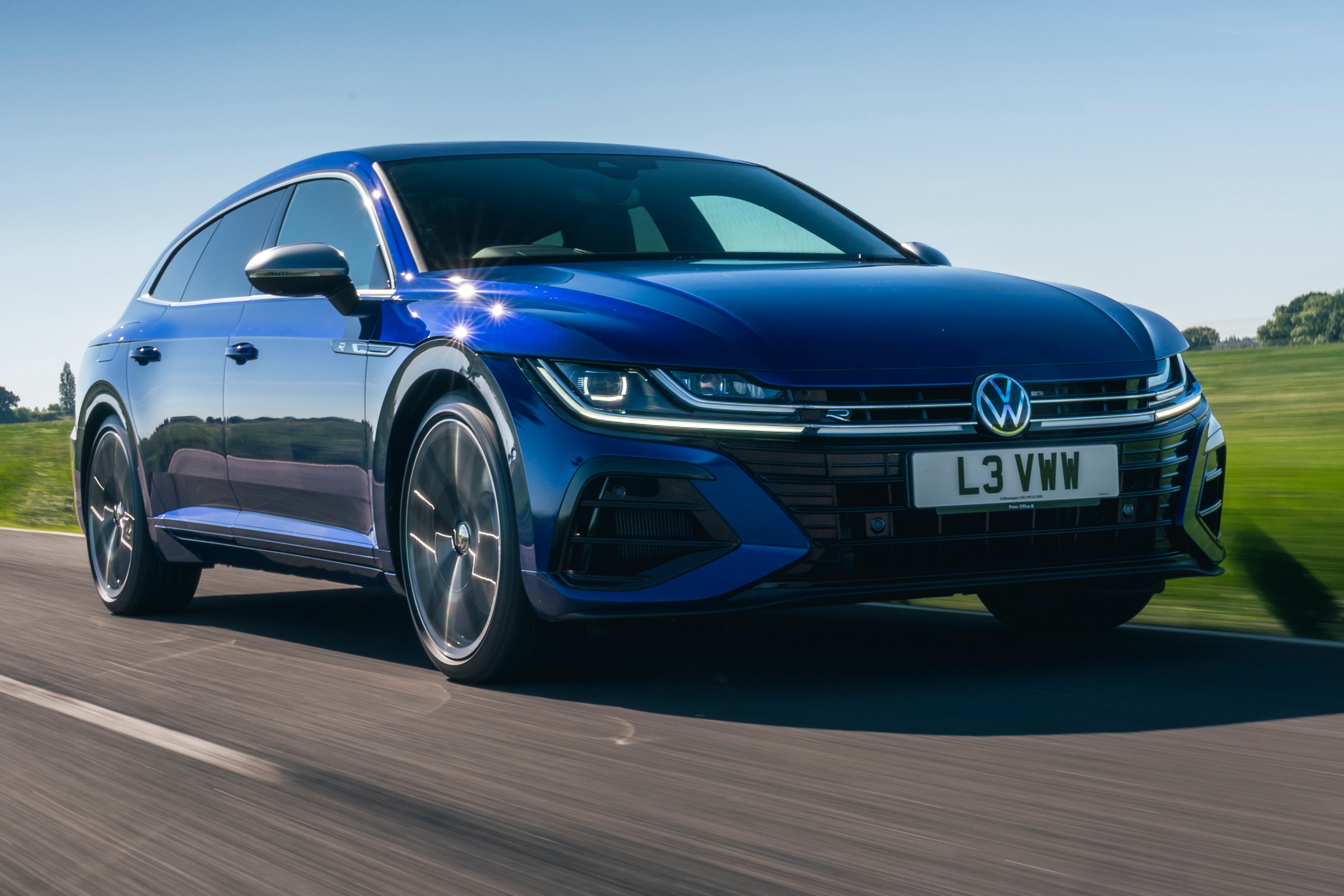
The Volkswagen Arteon Shooting Brake is a super-stylish estate car that rivals midsize premium wagons from Audi, BMW and Mercedes-Benz. It’s a compelling package, with sleek, individual looks and a surprising amount of practicality, while it also delivers big on quality, equipment and driving comfort. The main thing that held it back when new was price, because the badge never gave it quite the same pull as some rivals. As a used buy, though, that matters much less, and the Arteon Shooting Brake becomes a much more persuasive left-field choice.
The Volkswagen Arteon in more detail
If you see the words ‘Shooting Brake’ written across the top of this page and you haven’t got the foggiest idea what they mean, then don’t worry, you’re totally forgiven.
Allow us to enlighten you. ‘Shooting Brake’ is a phrase used by geeky car types (like us) to describe a car that’s essentially an estate, but more stylish, with a curvier, slinkier, more rakish roofline. Most Shooting Brakes sacrifice some practicality at the altar of style as a result, because they don’t have quite such a boxy, spacious shape. However, that’s where the Volkswagen Arteon Shooting Brake might surprise a few folk; despite being a rival for compact premium estate cars like the BMW 3 Series Touring, the Arteon’s whopping 590-litre boot capacity is actually more than you get in the BMW 5 Series Touring in the class above.
It’s just as generous for passenger space, with bags of headroom and legroom in any of the five seats. The cabin feels impressively posh and sophisticated, if perhaps not quite as lustrous as its best premium German rivals, and it’s stuffed with a generous amount of luxury equipment as standard.
Driving the Arteon is as pleasant as sitting in it, too. With a comfortable ride, strong refinement, smooth gearboxes and nicely weighted controls, the Arteon is a really sophisticated way to get around no matter what your speed or what type of road you happen to be on. It’s not the most thrilling car of its type – you’ll have more fun in a 3 Series – but for every buyer who cares about that, we’ll show you five more that don’t.
There’s a broad choice of powertrains on offer, including smooth and powerful petrols, muscular and economical diesels, and even a fire-breathing R model with hot-hatch-harassing performance. There’s also a plug-in hybrid version that’ll run for up to 36 miles on electric power alone, giving you the potential to save money on both fuel and tax, especially if you’re a company car driver.
If you want a car that’s stylish and practical, but you can’t face being one of the legions of family car buyers who opt for an SUV, then the Arteon Shooting Brake could be a very neat solution. It has bags of interior space and practicality, and it looks stylish in a refreshingly unique kind of way. It also delivers impressive quality, lots of standard equipment and a good range of choice when it comes to powertrains. It’s comfortable and refined to drive, too.
What's the best Volkswagen Arteon trim and engine option?
As a used buy, the strongest all-round choice is usually a facelift-era Volkswagen Arteon Shooting Brake 2.0 TDI DSG in Elegance or R-Line trim. That powertrain suits the car’s long-legged, relaxed character very well, and it gives you the kind of real-world economy and effortlessness that make sense in a big estate.
The plug-in hybrid is worth a look if your routine genuinely suits it. It can make sense for buyers doing shorter, charge-friendly trips, and it gives the Arteon a more modern, tax-friendly flavour. The drawback is that it loses a meaningful chunk of boot space, which matters more in an estate than it might in a saloon.
Trim choice is largely down to taste. Elegance feels a little more understated, while R-Line gives the car more visual attitude. Both work, but later facelifted cars in either trim feel more desirable than the earliest examples.
What’s the price of the Volkswagen Arteon?
As a used or nearly-new proposition, the Volkswagen Arteon Shooting Brake now starts from around £19,000, with newer, lower-mileage examples climbing significantly from there depending on engine, trim and condition.
That is where the car finally starts to make a really convincing case. At used prices, you are no longer asking it to justify a Volkswagen badge against a brand-new premium estate. Instead, you are getting a lot of style, equipment and practicality for the money.
Plug-in hybrid and Arteon R models still command stronger prices, and late low-mileage facelifted cars sit well above the bottom of the market. Even so, the Arteon Shooting Brake is generally far easier to justify used than it ever was new.
Alternatives to the Volkswagen Arteon
The Audi A4 Avant is one of the most obvious alternatives. It feels classy, familiar and carries the premium badge many buyers naturally want, but the Volkswagen counters with more visual individuality and a bigger sense of occasion.
The BMW 3 Series Touring is the sharper car to drive, and it remains one of the default picks in this class. The Arteon Shooting Brake cannot quite match it for driver appeal, but it fights back with a bigger boot and a calmer, more relaxed character.
The Mercedes-Benz C-Class Estate is another natural rival, while the Kia ProCeed offers a more affordable slant on the sleek-estate idea. The Jaguar XF Sportbrake is worth a glance as a used alternative too, though it feels more conventional in shape than the Volkswagen.
The Arteon Shooting Brake’s real strength is that it feels more special than a regular premium estate without becoming less useful in the process.
What's the interior like in the Volkswagen Arteon?
Volkswagen Arteon boot space and practicality
Getting comfy at the helm of the Arteon Shooting Brake is easy. Every version gets an electrically adjusting driver’s seat as standard, and there’s a massive range of movement for both that and the manually adjustable steering column.
Once you’re comfy, you’ll notice pretty good all-round visibility due to mostly large windows and relatively slim pillars either side of the windscreen and the rear screen, although that rear screen is a touch shallow. For further help with parking, front and rear sensors come as standard on all versions except, bizarrely, top-spec R-Line versions.
The dashboard layout is fairly conventional and most of the controls sit where you’d expect to find them, not least the ventilation controls, which sit slap-bang in the middle of the centre console below the touchscreen. These dedicated controls mean that you don’t have to go rooting around in distracting submenus within the infotainment system to change the temperature or fan speed.
The bad news is that these dedicated controls are touch-sensitive icons and sliders, which are much more of a faff to use than proper buttons and dials, because they don’t always register a command at the first time of asking and it’s more difficult to be accurate with your desired inputs. There are more touch-sensitive controls on the steering wheel, and it’s too easy to hit these by mistake.
As a Shooting Brake rather than a traditional estate car, you might expect the Arteon to offer more loadspace than your average family car, but also that some concession in overall practicality will be made in the pursuit of style. If so, you might be pleasantly surprised on that score: the 590-litre load bay is very competitive with those of many similarly-sized estate cars, and it’s actually bigger than you get in the (much pricier) BMW 5 Series Touring.
The large boot opening makes the space easy to access, but things aren’t entirely perfect. The boot lip doesn’t quite sit flush with the boot floor, so you’ll have to lift items over it and drop them in on the other side. The rear seats fold in a 60/40 split, rather than the more versatile 40/20/40 layout employed by some rivals, and the seatbacks lie at an angle, meaning that half your load bay is sloped rather than flat. Bear in mind, too, that if you go for the plug-in hybrid version, your boot space will drop very significantly to just 455 litres because of the batteries stored under the boot floor.
Whichever version you go for, though, you get plenty of space inside. It’ll come as no surprise that the front seats have room to spare, but the back seats might well surprise you with how roomy they are. There’s absolutely loads of rear legroom, and there’s also very generous headroom despite the car’s swoopy roofline.
Volkswagen Arteon dimensions
The Volkswagen Arteon Shooting Brake measures 4,866mm long, 1,871mm wide and 1,447mm high. That gives it a low, wide stance that helps it look more expensive and more distinctive than many conventional family estates.
The upside is style without giving away much space. The downside is that it is a fairly big car by everyday standards, but it never feels especially awkward to place on the road.
Tech and infotainment in the Volkswagen Arteon
All versions of the Shooting Brake get the same basic infotainment system as standard. This takes the form of an 8.0-inch central touchscreen that operates a wide variety of functions, including Bluetooth phone connectivity, DAB, navigation, wireless Apple CarPlay and wired Android Auto. On top of early SE Nav cars, Elegance and R-Line cars also added voice control activation.
The touchscreen looks a bit small by the latest standards, but as it’s running VW’s older software it’s not as glitchy or as convoluted as the company’s latest infotainment efforts, and it’s actually a doddle to use. It also looks great and is quick to respond to prods. You can optionally upgrade the system to a bigger 9.2-inch screen, and this works just as well. There’s another optional infotainment upgrade, which replaces the standard stereo’s eight speakers with a ten-speaker Harman Kardon sound system, complete with 16-channel digital amplifier and 700W output.
All versions get a 10.25-inch digital driver’s display behind the steering wheel. This looks good and works well, not least because it can be configured in a variety of ways.
Materials available on the Volkswagen Arteon
On the face of it, the Arteon’s interior looks very pleasant indeed. The materials used are of a generally high standard throughout, and there are a variety of jazzy trim inserts to liven up the cabin a little further.
Compare it with your average family estate car, and the Arteon is head-and-shoulders above for the feeling of poshness it delivers. However, when Volkswagen pitches the car at premium competition from the likes of Audi, BMW and Mercedes, the standards are rather higher. In truth, it trails those rivals in terms of how substantial it feels, but it certainly doesn’t feel disgraced in such illustrious company.
What's the Volkswagen Arteon like to drive?
Volkswagen Arteon range and performance
Used buyers will mainly be choosing between 1.5- and 2.0-litre petrols, 2.0-litre diesels, the 218PS eHybrid and the range-topping Arteon R. There is enough choice here that it is worth being clear about what you actually want from the car.
For most drivers, the 2.0 TDI remains the best fit. It has enough shove to keep the Arteon feeling effortless, and it suits the DSG automatic gearbox and the car’s relaxed character very well.
The eHybrid is brisk enough and useful if your routine suits it, while the Arteon R is seriously quick. But for most private buyers looking at used values, the more conventional diesel still looks the smartest option.
Performance data
| Model | Engine/battery size | Power | 0-62mph | Range/MPG |
|---|---|---|---|---|
1.5 TSI DSG | 1.5-litre petrol automatic | 150PS | 8.9 seconds | 44.1mpg |
2.0 TDI DSG | 2.0-litre diesel automatic | 150PS | 8.9 seconds | 57.6mpg |
2.0 TDI DSG | 2.0-litre diesel automatic | 200PS | 7.9 seconds | 51.4mpg |
eHybrid DSG | Plug-in hybrid automatic | 218PS | 7.8 seconds | 235.4mpg |
R DSG 4MOTION | 2.0-litre petrol automatic | 320PS | 4.9 seconds | 34.9mpg |
Volkswagen Arteon driving and refinement
The Arteon is a very relaxed and easy-going car on the road, and that’s no bad thing. Iit may feel a little less dynamic and agile than premium rivals such as the Audi A4 Avant and BMW 3 Series Touring, but there’s a lot to be said for a premium-feeling estate car that wafts you along as serenely as the big Volkswagen.
The suspension is on the softer side of average, so it’s good at mopping up lumps and bumps at all speeds with minimal impact on those inside the car. This also makes it a comfortable car whether you’re plodding along city streets or belting along a motorway. That softness can have the body pitching up and down a bit when the road takes on an undulating nature, but while this does have a slightly adverse effect on comfort levels, the effect is far from catastrophic. Again, when negotiating corners, the Arteon doesn’t have the sharpness of premium German rivals, it never feels anything less than stable and secure, while the steering feels precise and well-weighted.
Choose the hybrid or the R, and you get Dynamic Chassis Control (or DCC) as standard, while it’s optional on other versions. This brings adaptive suspension dampers that alter the firmness of the suspension at the touch of a button. This does help rein in the wayward body control on a twisty road, but ultimately, it doesn’t make the car much more comfortable.
All of the engines in the Arteon range do a good job in this regard. Even the diesels are pretty quiet and smooth compared with the equivalent engines in rivals, while the petrol are a step on still. Charge the hybrid up with electricity on a regular basis to maximise your electric-only running potential, and you’ll have the quietest Arteon of the bunch.
Whichever version you pick, wind and road noise is well suppressed at all speeds, making the Arteon a very civilised cruiser, and that really complements the car’s generally very laid-back nature. The gearboxes also stay pretty smooth in their operation, too.
How safe is the Volkswagen Arteon?
The Arteon Shooting Brake hasn’t itself been tested by the safety experts at Euro NCAP, but the five-door hatchback version has, and the result applies to the estate version as well. It scored the full five-star rating, although the test was carried out in 2017 and testing standards have become more stringent since then.
Nevertheless, a good amount of standard safety kit is provided. Short-lived SE Nav models had seven airbags and an active bonnet to help better protect pedestrians, along with active driver aids such as adaptive cruise control, automatic emergency braking, automatic high-beam headlights and lane assist.
Elegance and R-Line models add blind-spot monitoring and rear cross-traffic alert, along with a slightly cleverer adaptive cruise that provides a greater level of autonomous driving assistance.
Running costs: What it's like to live with a Volkswagen Arteon
The Volkswagen Arteon Shooting Brake should be fairly straightforward to live with if you buy carefully. It uses familiar Volkswagen Group mechanicals, has a cabin that feels robust enough for long-term use and offers the kind of practical everyday usefulness that makes ownership easy.
Volkswagen Arteon fuel economy
The Shooting Brake’s running costs are similar to those you’d get in premium estate rivals, so it’s competitive. According to official figures, the plug-in hybrid version is the star of the show in that regard, with an average figure of up to 235mpg.
Don’t be taken in by this laboratory figure, though, because what you’ll actually get in the real world will depend entirely on how you use the car. Charge it up religiously and limit yourself exclusively to short urban journeys that can be done purely on electric power, and you won’t use any petrol at all. Fail to charge it, or do long journeys that require regular prolonged use of the engine, and you’ll use absolutely loads of fuel because the petrol engine is hauling around heavy batteries as well as the rest of the car.
Go for one of the more conventionally powered versions, and the official figures say you’ll get around 55mpg from the diesels, while the 1.5 petrol does 43mpg and the 2.0 petrol does 35mpg. The R has an official figure of 30mpg, but use the performance as the makers intended and you’ll get far less.
Volkswagen Arteon warranty and servicing
Any remaining manufacturer warranty will depend on the car’s age and mileage, but Volkswagen Approved Used examples are still the safest place to start. They come with a 12-month unlimited-mileage warranty, 12 months of roadside assistance, history and mileage checks, plus a multi-point inspection.
From new, the Arteon Shooting Brake was covered by Volkswagen’s three-year warranty, with two years of unlimited-mileage cover and a third year capped at 60,000 miles. Servicing can be on either a fixed or flexible schedule, so it is worth checking which regime the car has followed and whether maintenance has been carried out on time.
Volkswagen Arteon insurance groups
If you weren’t aware, all cars fall into a specific 1-50 group for insurance, with group 1 cars being the cheapest to insure and group 50 cars being the most expensive. Most versions of the Arteon Shooting Brake sit either side of average on that scale. The 1.5 petrol and the lower-powered diesel sit between groups 21 and 23 depending on trim level, while the more powerful 2.0-litre petrol and diesel, plus the plug-in hybrid, sit between groups 27 and 29. The R, meanwhile, incurs a group 35 rating, so premiums on that version will be a lot more costly.
How much does it cost to tax a Volkswagen Arteon?
The Shooting Brake was released in 2021, so all versions are taxed according to the post-2017 Vehicle Excise Duty regulations. This means a flat rate of £200 per year for petrol and diesel cars, with a £10 deduction for the plug-in hybrid.
That’s not the full story, though, because cars that cost over £40,000 when new are subject to an additional ‘luxury car’ surcharge, which adds £440 to the cost of your annual road tax for five years, coming between years two and six of the car’s life, taking your annual outlay up to £640. While some versions of the Shooting Brake were priced below that threshold, some were priced above, so it pays to know the situation before you buy.
Bear in mind, too, that the threshold includes the price of any optional extras fitted. So, if the car you're considering cost £39,999 when new, but had an optional extra worth £2, it would still be liable for the surcharge.
What trims are available with the Volkswagen Arteon?
Very early on in the Volkswagen Arteon Shooting Brake’s life, it was offered in SE Nav trim, which sat at the foot of the range structure. These versions were still pretty generously equipped, though, with 17-inch alloy wheels, LED lights all round, keyless entry and go, four powered windows, three-zone climate control, automatic lights and wipers, front and rear parking sensors, and heated, power-folding door mirrors. That’s on top of all the infotainment and safety features we’ve already talked about. However, it didn’t take long before this trim was discontinued.
That made Elegance trim the new entry point into the range, and this brought 18-inch alloys, heated front seats, part-leather upholstery, a powered tailgate and a reversing camera. On top of that, there is the R-Line model, which adds 19-inch alloys, extra styling elements inside and out, and an electrically opening panoramic roof.
Ask the Drive experts: common questions
Is the Volkswagen Arteon Shooting Brake a good car?
Is the Volkswagen Arteon Shooting Brake practical?
Is the Volkswagen Arteon Shooting Brake still available new in the UK?
Get our latest advice, news and offers
Keep me updated by email with the latest advice, news and offers from Drive.
.jpg)
.jpg)
.jpg)