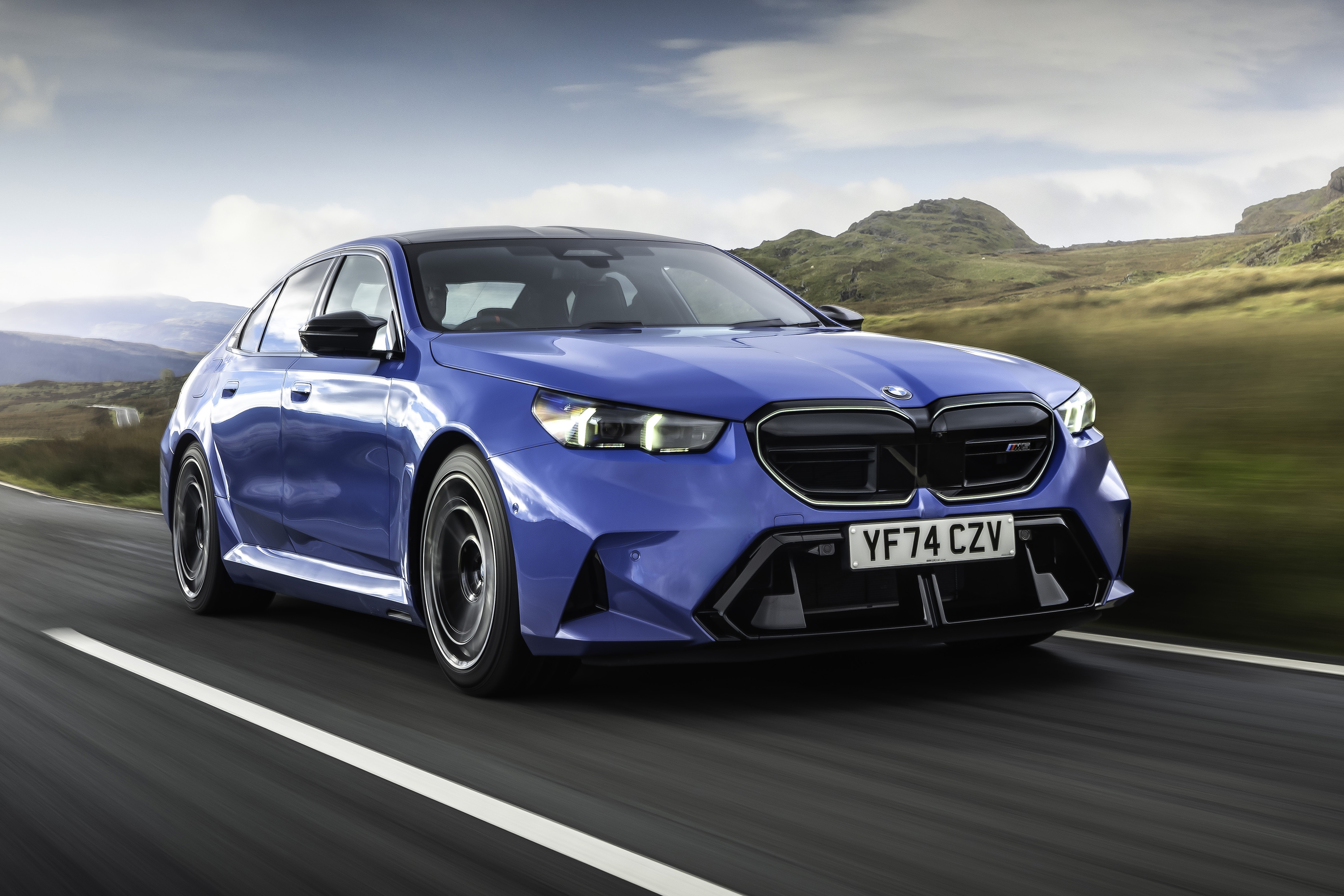
BMW M5 Review

Written By Matt Robinson
- 2024
- Salooon
- Plug-in hybrid petrol
What we love
Outrageous real-world pace
Shockingly capable for something this heavy
Hybrid powertrain adds useful flexibility
Things to consider
It is extremely heavy
Setup options can feel excessive
M3 still feels more focused and playful
The DRIVE take on the Bmw M5, is it the right car for you?
The BMW M5 is for buyers who want a super-saloon that can do almost everything at an absurd level. It is ferociously fast, hugely capable and refined enough to cover long distances in real comfort. It no longer feels like a compact, mischievous sports saloon in the old mould, though. This is a bigger, heavier and more GT-like M5, with plug-in hybrid power adding flexibility as much as outright pace. If you want the sharpest, most playful option, the M3 still has the edge. If you want towering performance with genuine executive-car polish, the M5 makes a compelling case.
The Bmw M5 in more detail
We might as well get this out of the way now – the new BMW M5 weighs the best part of 2.5 tonnes. That's a lot for a big SUV, let alone a mid-sized saloon car. The latest M5 marks a clear shift in character. This is the first M5 to use a plug-in hybrid powertrain, and that changes the conversation around the car straight away. It adds weight and complexity, but it also adds a useful layer of electric running, more low-speed response and an even broader spread of ability.
That matters because the M5 has always been at its best when it feels like more than just a fast saloon. Older cars built their reputations by combining huge pace with everyday usability, and the new one still follows that formula, just in a more modern and more elaborate way. It can creep along in electric silence, settle into a motorway cruise like a luxury car and then hit back with acceleration that feels outrageously violent for something this big.
It is also worth being clear about what this M5 is not. It is not a lighter, simpler, purer continuation of the old formula. It is a heavier and more mature car that leans harder into grand-touring muscle than sports-saloon delicacy. Some buyers will miss that. Others will appreciate the sheer breadth of what it can do.
The current UK saloon range is straightforward. There is one mainstream M5 Saloon, and it already comes with all the powertrain, traction and chassis hardware most buyers could ever need. More focused variants may follow, but the standard car already feels like a fully formed flagship rather than a stepping stone to something better.
What's the best Bmw M5 trim and engine option?
This is one of the simpler sections because the answer is really just the BMW M5 as BMW currently sells it.
There is no sprawling trim ladder to decode and no lower-powered version muddying the waters. You get the M Hybrid V8 plug-in hybrid powertrain, xDrive, the eight-speed automatic and the current M5’s full performance brief in one go.
That suits the car, because this M5 feels like a single, fully formed idea rather than a range in search of a sweet spot. The important question is not really which version to have. It is whether the M5’s particular blend of immense power, relentless traction and grand-touring polish is what you want from a super-saloon in the first place.
For buyers who do want that, the current M5 delivers it in full. There is no obvious weak link in the package, and no sense that you need to wait for a more expensive derivative to get the right one.
What’s the price of the Bmw M5?
The BMW M5 currently starts at £113,145 in the UK. That is a vast amount of money for any 5 Series-shaped car, but that is where this part of the market now sits.
The M5 does at least feel like a lot of car for the money. The powertrain, the cabin, the technology and the sheer breadth of ability all make it obvious this is not some mildly warmed-over executive saloon with a big badge and a louder exhaust.
The real danger is the options list. BMW gives you every opportunity to add more luxury, more visual aggression and more performance-themed theatre, and it would not take much to push the final figure into territory where the question becomes less “is this good value?” and more “why am I not just buying something even more extreme?”
Still, judged against similarly rapid and similarly lavish alternatives, the M5 is not outlandishly priced. It is simply playing in a very expensive league.
Alternatives to the Bmw M5
The Audi RS 6 Performance is one of the most obvious alternatives, even if it is an estate rather than a saloon. It remains a hugely impressive all-weather performance car and still makes a strong case if you want the same sort of pace with more load-lugging appeal.
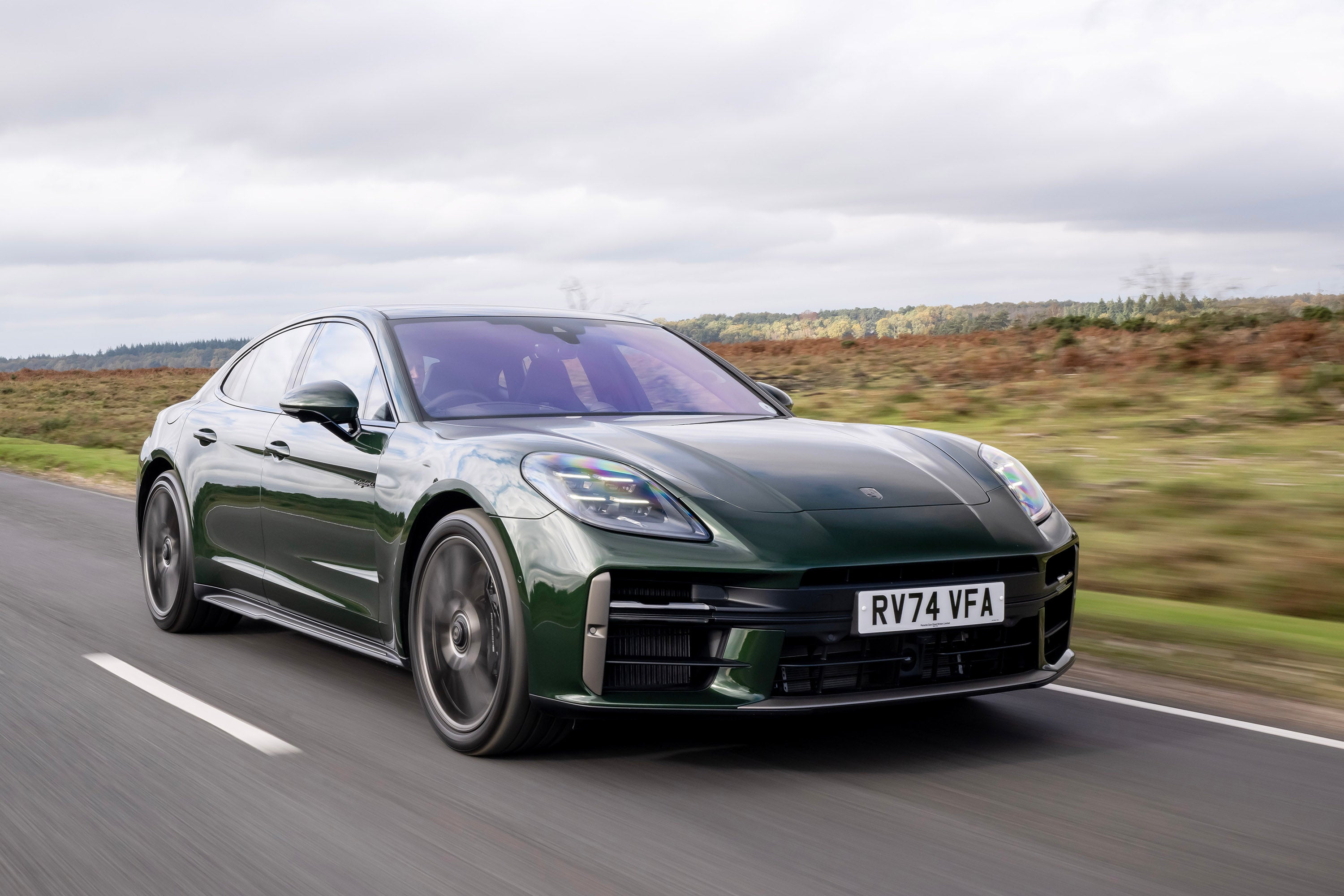
The Porsche Panamera is another key rival, especially in higher-powered E-Hybrid forms. It offers a more overtly premium and more overtly prestigious take on the same broad idea, but you will also pay more for it.
Closer to home, the BMW M3 remains relevant. It is smaller, lighter and more playful, and for some keen drivers it will actually be the more appealing car. The M5 counters with more theatre, more cabin space and a more effortless sense of overwhelming pace.
The Mercedes-AMG E 63 used to be the natural benchmark here, but until a direct successor properly arrives, the M5 has a slightly clearer run at buyers wanting a traditionally shaped super-saloon with an expensive engine and no interest in subtlety.
What's the interior like in the Bmw M5?
The M5’s cabin broadly follows the latest 5 Series template, which is no criticism because that gives it a strong starting point. It feels expensive, technical and suitably dramatic without descending into gimmickry for its own sake.
Bmw M5 boot space and practicality
This is one of the areas where the plug-in hybrid packaging brings a clear compromise. The saloon’s boot capacity falls to 466 litres, down from the 520 litres you get in lesser 5 Series versions. That is still useful enough, but it is worth knowing because buyers may reasonably expect a large saloon like this to offer more luggage space than it does.
Passenger space is more convincing. There is loads of room up front, and rear legroom is good enough for adults to travel comfortably. Headroom is slightly less generous than you might expect because of the roofline, but for most buyers it will not be a problem.
Cabin storage is fine rather than exceptional. There is a useful central bin, cupholders and enough general storage to make the M5 feel believable as a daily car, even if it is not a packaging masterclass.
So yes, the M5 is practical enough. It just does not feel quite as roomy in boot terms as you might expect from something this large.
Bmw M5 dimensions
The BMW M5 measures 5,096mm long, 1,970mm wide and 1,510mm high. It is a big car by any normal measure, and the width in particular gives it serious road presence.
That size matters because it explains part of the M5’s character. It no longer feels like a compactish executive saloon with a monster engine. It now feels like a large, imposing performance flagship that happens to wear a 5 Series badge.
Tech and infotainment in the Bmw M5
The M5 uses BMW’s current curved-display setup with a 14.9-inch central touchscreen and a 12.3-inch driver display. It looks slick, the graphics are sharp and the overall presentation is suitably high-end.
BMW’s retained rotary controller is still a major plus because it makes the system easier to use on the move than touchscreen-only alternatives. That matters in a car with this much going on, because you do not want to be diving through menus while also managing 727hp.
The built-in navigation is good, Apple CarPlay and Android Auto are standard, and the Bowers & Wilkins audio system is excellent. Climate controls being absorbed into the screen is still not ideal, but that is a complaint shared with a lot of current premium cars.
Materials available on the Bmw M5
The materials are as rich as they need to be at this price. The M5 feels properly premium, with plush surfaces, careful assembly and enough M-specific detailing to lift it above a regular 5 Series without making it feel overdone.
There is still too much glossy black plastic in some areas, which remains a weak point in many modern cabins because it scratches and marks too easily. Beyond that, the cabin quality is exactly where it should be.
What's the Bmw M5 like to drive?
This is the part that will matter most to many buyers, because the M5’s weight figure has dominated so much of the early conversation around the car. In practice, the most striking thing is how little it defines the driving experience once you are actually moving.
Bmw M5 range and performance
The M5 uses a 4.4-litre twin-turbo V8 combined with an electric motor integrated into the eight-speed automatic gearbox. Total system output is 737PS, while torque stands at 1,000Nm. BMW quotes 0-62mph in 3.8 seconds, or 3.5 seconds using the brand’s 1-foot rollout metric.
The M5 can also cover a little over 40 miles on electric power alone in ideal conditions, which is useful not because anyone will buy an M5 for EV commuting alone, but because it broadens the car’s character and improves its company-car appeal.
Figures aside, the important thing is how the hybrid system changes the M5’s character. The electric motor fills in the lower reaches of the power delivery, so the car feels outrageously responsive even before the V8 fully asserts itself. That makes it viciously quick in the real world.
Performance data
| Model | Engine/battery size | Power | 0-62mph | Range/MPG |
|---|---|---|---|---|
M5 | 4.4-litre | 737PS | 3.8 seconds | Up to 43 miles |
Bmw M5 driving and refinement
It defies belief how the M5 is able to shrug off its considerable weight figure. Given the way it changes direction, you'd swear it weighs several hundred kilograms less than it actually does. The steering is nicely weighted, depending on the mode (more on that soon), and it even delivers meaningful feedback from the road surface, which is a rarity these days.
There's barely any body roll, and traction from the all-wheel drive system is phenomenal, allowing you to aggressively accelerate out of a bend much earlier than a lot of cars are happy with. It still feels like a traditional BMW with a noticeable bias toward the rear, which is exaggerated further in the 4WD Sport mode.
Body roll is pretty much nonexistent, as you'd expect for a car so stiff. Even with the adaptive suspension in its softest mode, the ride can get a bit choppy over some surfaces, robbing you of a bit of confidence in the car. The two firmer modes are unusable on all but the smoothest of roads.
And yes, the modes. There must be thousands upon thousands of different combinations (you're welcome to do the maths), with multiple settings for the traction control, suspension, steering, engine, gearbox, energy recovery, the hybrid system, the 'M sound' and the all-wheel drive system. There are also overarching Road, Sport and Track modes that are more about what the displays look like and how many driver assistance systems are turned on.
Exactly how you set the car up is going to depend on personal preference, but for sporty driving, we reckon we've cracked it. And that's to turn pretty much everything up to full apart from the steering and suspension, while activating the M Dynamic Mode (MDM). The latter is more lenient but still has a big safety net, and also activates the more playful 4WD Sport mode. Oh, and we tended to turn off 'M Sound', as the fake V8 noise this pumps through the speakers is a bit rubbish.
Refinement is more mixed. Wind noise is well suppressed, but tyre roar is more prominent than you might expect in a six-figure executive car. The V8 itself is also more muted than some buyers may hope, especially if you switch off the synthetic enhancement, which improves the car rather than weakens it.
How safe is the Bmw M5?
Euro NCAP has not separately crash-tested the M5, but the related BMW 5 Series scored five stars in 2023, with strong results for adult and child occupant protection.
Standard M5 safety equipment includes lane assistance, autonomous emergency braking, blind-spot detection and speed-limit recognition, while BMW also offers a more comprehensive Driving Assistant Professional package that adds extra systems such as evasion assistance and wrong-way warning.
That is exactly the level of safety and driver-assistance coverage you would expect in a modern flagship performance saloon.
Running costs: What it's like to live with a Bmw M5
Nobody should kid themselves that an M5 will be cheap to own. The interesting part is that the hybrid system at least gives it a broader running-cost story than older M5s ever had.
Bmw M5 fuel economy
The official combined fuel figure of up to 176.6mpg should be treated with extreme caution, because like most PHEV economy claims it depends heavily on the battery being charged and used regularly. BMW’s more revealing figure for the car with a depleted battery is 27.7mpg, which is a better reflection of what you are dealing with once the electric running is gone.
If your journeys suit it and you charge often, the M5 can do a decent amount of lower-speed running without waking the V8. That is useful, and it also helps explain why the car works so well for some company-car users. Use the performance properly, though, and fuel consumption will fall hard.
Bmw M5 warranty and servicing
BMW covers the M5 with a three-year, unlimited-mileage warranty, while the plug-in hybrid battery receives separate cover for six years or 60,000 miles.
Servicing, tyres and consumables will all be expensive, and this is not a car to buy on the assumption that hybridisation will somehow make ownership cheap. It will not.
Bmw M5 insurance groups
The M5 sits in insurance group 49, which is exactly the sort of number you would expect for a six-figure performance saloon with 727hp.
In other words, this is not going to be a cheap car to insure, and it is worth shopping around aggressively.
How much does it cost to tax a Bmw M5?
For 2026 to 2027, the standard annual VED rate after the first year is £200. Because the M5 is a plug-in hybrid rather than a pure EV, the usual £40,000 Expensive Car Supplement threshold applies, and the M5 is comfortably above it.
That means buyers should budget for the standard annual VED rate plus the £440 Expensive Car Supplement for five years from the second licence. In practice, that leaves most owners facing £640 a year during that surcharge period.
What trims are available with the Bmw M5?
The current M5 is effectively a single-model proposition. You choose the M5, and then decide how much further you want to go with options.
Standard equipment is already generous, including the staggered alloy wheels, adaptive LED lights, four-zone climate control, the curved-display cabin, adaptive suspension and the key convenience kit you would expect at this price.
BMW then allows you to spend more through option packs and individual extras. That is typical for the brand, but in the M5’s case it is easy to push the price into territory where you need to keep a firm grip on your enthusiasm.
The upside is that the standard car already feels very complete. You do not need to go wild with the configurator to end up with a seriously impressive M5.
Ask the Drive experts: common questions
Is the BMW M5 a good super-saloon?
Which BMW M5 is best?
Is the BMW M5 too heavy?
Does the BMW M5 have a big boot?
Get our latest advice, news and offers
Keep me updated by email with the latest advice, news and offers from Drive.
.jpg)
.jpg)