Porsche Panamera Review

Written By Matt Robinson
- 2024
- Hatchback
- Petrol, plug-in hybrid
What we love
Extremely capable and fun to drive
Relaxing when you just want to cruise
Even the slower versions feel properly fast
Things to consider
No more Sport Turismo estate
Panamera is a four-seater as standard
Plug-in hybrids have slightly less boot space
The DRIVE take on the Porsche Panamera, is it the right car for you?
The Porsche Panamera is one of the most complete luxury cars on sale because it manages to feel genuinely special in several different ways at once. It rides beautifully, corners with remarkable precision for something this large and heavy, and feels expensive in the right places throughout. It is not cheap, and Porsche makes it absurdly easy to spend even more on options, but the Panamera backs up its price with real engineering depth. If you want a luxury car that leans harder into driving enjoyment than most rivals, it makes a very strong case.
The Porsche Panamera in more detail
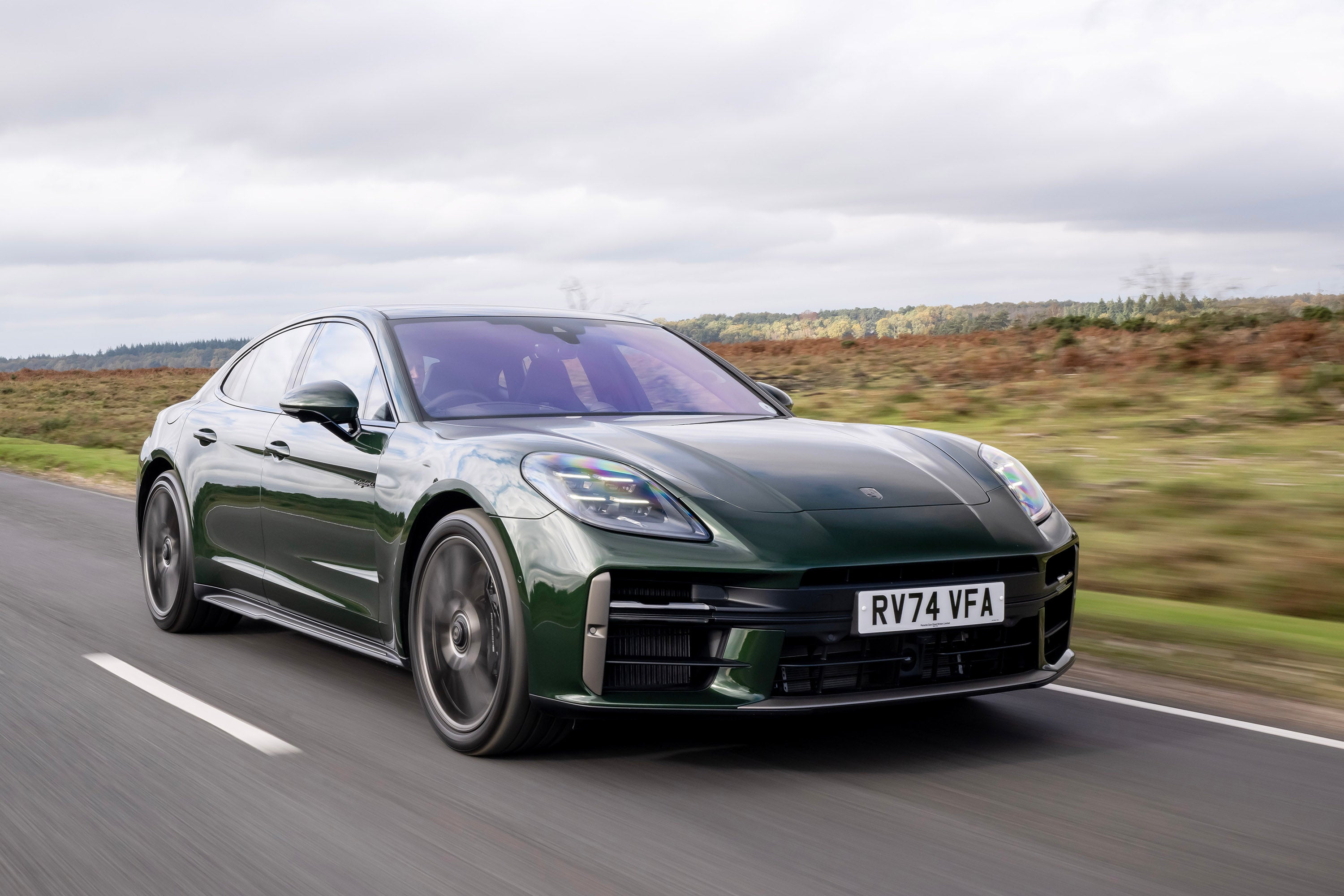
You might think that you're looking at a facelifted car, but as far as its manufacturer is concerned, this Porsche Panamera is an all-new car with a fresh chassis code.
Proportionally, it's not all that different, and while the styling isn't what you'd call a radical departure, only the door skins are carried over from the outgoing second-generation model.
Browse used Porsche Panameras for sale →
Plenty has been reused this time, but that's not necessarily a bad thing. What is a bad thing is the lack of Sport Turismo estate. Sadly, citing a lack of demand, Porsche decided to drop it for this new model.
There have been improvements across the board, including the presence of even more potent hybrid powertrains, incredibly clever technology, including the new Porsche Active Ride system, and even, to our eyes at least, better looks.
No, it's not cheap, and Porsche is more than happy to offer a dizzying array of ways to extract even more money from you before taking the order. But the Panamera feels worth it given just how impressive it is to drive, and not just from when it comes to driving on a nice, twisty road. It rides brilliantly on its standard-fit air suspension, and refinement is first-rate.
The quicker versions are almost painfully fast off the line, but you shouldn't feel short-changed by the performance of any Panamera, as even the entry-level versions aren't sluggish.
The current Porsche Panamera may not look radically different from the car it replaced, but it is a more substantial update than the styling first suggests. Porsche treats it as a new generation with a fresh chassis code, and while there is obvious continuity in the design, there has been meaningful work underneath to improve the powertrains, chassis systems and overall polish.
That is important because the Panamera has always had a slightly unusual brief. It is not just a luxury hatchback, and it is not just a Porsche with more doors. It has to do both jobs at once. It needs to feel properly plush and accomplished enough to justify six-figure pricing in some versions, but also sharp and engaging enough to deserve the Porsche badge on the bonnet. That balancing act is where the Panamera remains so impressive.
The breadth of the line-up helps. At one end, there are the regular petrol Panamera and Panamera 4 models, which are already brisk and expensive-feeling enough not to seem like entry-level compromises. Then come the E-Hybrid versions, which now play a much bigger role in the range than before, thanks to stronger electric performance and much-improved EV-only capability. At the top end, the Turbo-badged cars become staggeringly fast, but the basic feel of the car does not really change. Every Panamera is trying to be a luxury car first and a high-speed Porsche second.
What's the best Porsche Panamera trim and engine option?
A lot of this will depend on how you intend to use the car. If your commute is within the electric-only range of the plug-in hybrid models, for instance, one of those could be worth a look. And then, you just need to decide how fast you want to go - is the V6 enough for you, or do you want the might of one of the electrified V8s?
The entry-level V6s will be enough for most, but keener drivers should look no further than the GTS. It has the V8 of the Turbo and Turbo S E-Hybrid models without the heavy battery and motor, making for a sharper-handling car. It's easily the best looking of the lot, too.
What’s the price of the Porsche Panamera?
The Porsche Panamera range now starts at £91,100 for the rear-wheel-drive Panamera. The Panamera 4 is £94,200, the Panamera 4 E-Hybrid £100,800, the Panamera 4S E-Hybrid £111,900, the Panamera GTS £134,200, the Panamera Turbo E-Hybrid £154,400 and the Panamera Turbo S E-Hybrid £178,500. There are also plenty of used Porsche Panameras for sale for considerably less.
That’s serious money even before you start adding options, and Porsche is still one of the easiest brands to get carried away with in the configurator. The Panamera can feel worth it because the engineering depth and breadth of ability are both so strong, but this is not a value-led proposition. Buyers need to go in with a clear idea of what they actually need, because the options list can get very expensive very quickly.
Alternatives to the Porsche Panamera
This particular bit of the market is looking very different from when the previous-generation Porsche Panamera was launched. There currently isn't a Mercedes-AMG E63 for the car to do battle with, although if you're eying up the spicier end of the Panamera range, you might also want to give the Mercedes-AMG GT63 S 4 Door a look. It starts at £156,555, in similar territory to the Panamera Turbo and Turbo S.
At the time of writing, we were still waiting for an all-new Audi A7 to replace the recently discontinued model, and the Aston Martin Rapide hasn't been a thing for a while, but in any case, that was always a niche option. Speaking of which, the Maserati Quattroporte was a rival for the Panamera, but wasn't a popular choice either, with only a handful sold in the UK every year before it was discontinued.
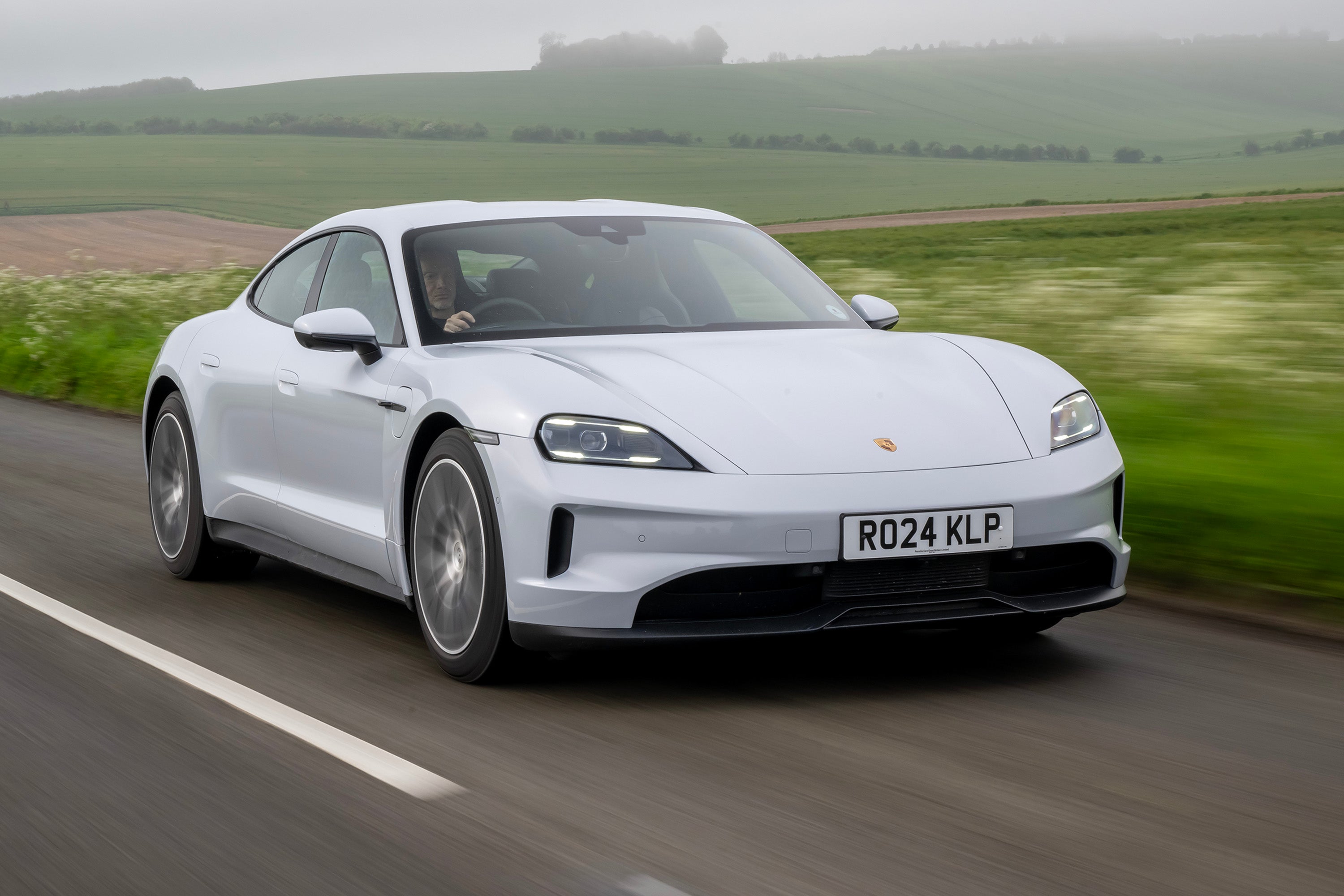
There is a rival from the same stable in the form of the Porsche Taycan. Yes, it's all electric, but the sizing of each Porsche model is reasonably comparable, and the Taycan range has an even broader spread of performance, with range-topping versions punting out over 1,000PS.
What's the interior like in the Porsche Panamera?
The Porsche Panamera’s interior may not look wildly different from the old car’s at first glance, but it remains a lovely place to spend time. It is subtle rather than showy, very solidly built and still carries plenty of 911-like Porsche character in the way the dashboard and screens are laid out.
Porsche Panamera boot space and practicality
The official boot capacity figure for the base Panamera models is broadly similar to that of the old model at 494 litres, or 1,328 litres with the rear seats folded. Meanwhile, the GTS manages 478 litres, or 1,321 litres with the rear bench folded.
As before, the plug-in hybrid models feature less boot space, owing to the packaging constraints of their big battery, but the drop isn't as big this time. The 4 E-Hybrid and 4S E-Hybrid each have 430 litres of space (expanding to 1,255 litres), while the Turbo E-Hybrid and Turbo S-E Hybrid models can take up to 421 litres (up to 1,264 litres) of clobber.
Previously, specifying the rear electric seats meant it wasn't possible to fold them, but that's no longer the case, with the 40/20/40 split-folding arrangement retained. The Panamera has a practicality edge over its saloon-based rivals with a hatchback-style boot opening, but there's quite a tall lip to load items over, and the load space itself is fairly narrow.
It's worth noting that the Panamera is a four-seater as standard. If you want it specced with five seats, or as a '4+1' as Porsche puts it, you'll have to tick an option in the configurator. However many people you're loading in, they'll have an easier job of it if the Active Ride system is fitted, as it dramatically raises the suspension to make ingress and egress a breeze.
Porsche Panamera dimensions
The Porsche Panamera measures 5,054mm long, 1,937mm wide and 1,421mm high. That makes it a very large car by normal standards, but its low roofline and driving position still give it a much more sporting feel than most luxury cars with a similar footprint.
Tech and infotainment in the Porsche Panamera
The infotainment screen is no bigger than before, measuring 12.3 inches across. That's on the smaller size by modern standards, with some rivals fitting ever-larger screens (just look at some of the screen-fests seen inside various new Mercedes-Benz models).
It isn't angled towards the driver, either, and some of the icons are on the small side. It's generally an easy unit to use, though, and the graphics look sufficiently crisp. Plus, unlike Panamera models of old, there's Android Auto in the model, because Porsche finally started offering this a few years ago, having previously only had Apple CarPlay in its vehicles. Both now come as standard.
The optional Burmester 3D sound system, which was excellent, as it probably should be for something that costs several thousand pounds, varying depending on which version of the Panamera it’s being fitted to. If that's a bit extravagant for you, some derivatives have a Bose sound system fitted as standard, which is available optionally on lower grades for just over £1,000.
In terms of USB ports, you get two Type-C sockets in the front and a further pair of Type-Cs in the boot.
Materials available on the Porsche Panamera
The Panamera comes with a partial leather interior as standard, with a choice of three finishes. Optionally available is either a mix of a microfibre-like 'Race-Tex' and artificial leather, six full leather trims and a choice of two plusher 'Club Leather' upholsteries.
Also in the configurator are various contrast stitching options, plus different inlay packs including wood, brushed aluminium and several kinds of carbon fibre.
What's the Porsche Panamera like to drive?
The Porsche Panamera remains the sportiest car in the luxury segment to drive, but the really impressive part is that it no longer asks you to sacrifice comfort to get that. The standard air suspension already gives the car a very wide bandwidth, and the optional active-chassis systems take that to another level.
Porsche Panamera range and performance
Even the entry-level Panamera and Panamera 4 now have enough performance to avoid feeling basic. Both use a 2.9-litre V6 with 353PS, with the rear-drive Panamera reaching 0-62mph in 5.1 seconds and the Panamera 4 cutting that to 4.8 seconds thanks to its extra traction.
The Panamera 4 E-Hybrid is where the line-up becomes especially compelling. It combines a total output of 470PS with 0-62mph in 4.1 seconds and up to 60 miles of electric range, making it both very fast and potentially cheap to run if you charge it regularly. The 4S E-Hybrid raises combined output to 544PS and cuts the 0-62mph time to 3.7 seconds.
Then came the GTS, Turbo E-Hybrid and Turbo S E-Hybrid. The GTS sticks with petrol power and brings 500PS and a 3.8-second 0-62mph time, while the Turbo E-Hybrid and Turbo S E-Hybrid move to 680PS and 782PS respectively, with the range-topper now demolishing 0-62mph in 2.9 seconds. Those numbers are immense, but the point is not that the Panamera can now rival supercars in a straight line. It is that every version feels muscular enough that you never wish you had bought more power.
Performance data
| Model | Engine/battery size | Power | 0-62mph | Range/MPG |
|---|---|---|---|---|
Panamera | 2.9-litre | 353PS | 5.1 sec | Up to 29.2mpg |
Panamera 4 | 2.9-litre | 353PS | 4.8 sec | Up to 27.8mpg |
Panamera 4 E-Hybrid | 2.9-litre | 470PS | 4.1 sec | Up to 92.5mpg |
Panamera 4S E-Hybrid | 2.9-litre | 544PS | 3.7 sec | Up to 86.8mpg |
Panamera GTS | 4.0-litre | 500PS | 3.8 sec | Up to 24.4mpg |
Panamera Turbo E-Hybrid | 4.0-litre | 680PS | 3.2 sec | Up to 79.5mpg |
Panamera Turbo S E-Hybrid | 4.0-litre | 782PS | 2.9 sec | Up to 69.4mpg |
Porsche Panamera driving and refinement
A huge part of the Panamera’s dynamic breadth comes from the optional Porsche Active Ride system. It is one of those pieces of technology that sounds almost too clever to be worthwhile, but on the road, it is genuinely impressive. It can keep the body flatter, reduce pitching and rolling and generally make the car feel calmer and more composed than something this heavy ought to.
It also improves everyday comfort. The standard air suspension is already very good, but Active Ride brings a remarkable sense of control over poor surfaces and big body movements, with only the occasional thump making it through over really nasty potholes. In its gentler modes, the Panamera rides with real sophistication.
What is so impressive is that this does not come at the cost of agility. The Panamera changes direction much more neatly than a near-2.5-tonne luxury hatchback has any right to, and the combination of strong front-end grip, well-judged steering and excellent traction means it remains deeply satisfying to drive quickly. The more powerful hybrid models are brutally fast, but even they do not overwhelm the rest of the chassis. The Panamera still feels like it has been engineered as a Porsche first and a luxury car second, just without forgetting how to do the luxury-car part properly.
How safe is the Porsche Panamera?
The Porsche Panamera achieved a five-star Euro NCAP rating in May 2024. Standard safety equipment across all models includes traffic sign recognition, lane-keeping assistance, autonomous emergency braking, which can send a warning 'jolt' to the driver through the brake pedal before activating, a driver awareness monitor and a wide range of airbags.
A 'lane change assist' package, including blind spot monitoring and rear cross traffic alert, is a cost option. It’s worth pointing out that many cheaper cars have such technology as standard.
Running costs: What it's like to live with a Porsche Panamera
Petrol-only Panameras like a drop of fuel, as do the plug-in hybrid models if you drive them hard. Rely more on their electric-only running, though, and keep them charged at home, and day-to-day driving could be quite cheap. On the other hand, insurance, servicing and tyre bills will be high, and there’s the government’s expensive car tax supplement to bear in mind as well.
Porsche Panamera fuel economy
The regular Panamera can officially manage 29.2mpg, the Panamera 4 27.8mpg and the GTS 24.4mpg. Those figures are straightforward enough by the standards of a big, fast luxury car.
The hybrids tell a different story. Officially, the 4 E-Hybrid can return 92.5mpg, the 4S E-Hybrid 86.8mpg, the Turbo E-Hybrid 79.5mpg and the Turbo S E-Hybrid 69.4mpg. In reality, your figure will vary hugely depending on whether you keep the battery charged and how much of your driving can be done on electric power.
The electric-only range is now genuinely useful, though. pack. The 4 E-Hybrid offers up to 60 miles, the 4S E-Hybrid up to 57 miles, the Turbo E-Hybrid 59 miles and the Turbo S E-Hybrid 53 miles. That makes the Panamera’s plug-in hybrid versions much easier to justify than older Porsche PHEVs and their smaller batteries were.
Porsche Panamera warranty and servicing
Porsche’s standard vehicle warranty is three years with unlimited mileage. The high-voltage battery on the Panamera plug-in hybrids is covered for eight years or 100,000 miles, as is mandated. Current UK-spec data also points to service intervals of 24 months or 20,000 miles, which is in line with expectations at this level.
Porsche Panamera insurance groups
As an expensive, high-performance luxury car, it should come as no surprise that the Panamera's insurance groups are of the lofty variety. In fact, every model is in the top group of 50, although you can expect the lower-powered/lower value versions to cost a bit less to insure. For a car like this, it might be worth trying specialist insurers as well as more mainstream options to try and get your premiums down.
How much does it cost to tax a Porsche Panamera?
The Porsche Panamera is expensive to tax after the first year because every version sits comfortably above the expensive-car threshold. That means standard annual VED plus the £440 expensive-car supplement in years two to six.
What trims are available with the Porsche Panamera?
Each trim level of the Panamera is tied to a specific powertrain, which makes the range reasonably easy to understand. The specs between each aren't vastly different, with Porsche, for the most part, leaving it up to customers to pick from a vast array of options available on most models. Be warned, some of them are pretty pricey, so those base prices can quickly inflate by five-figure sums.
The Panamera 4 and Panamera 4 S each feature 19-inch alloy wheels, adaptive air suspension, matrix LED headlights, a powered tailgate and two-zone climate control. The Hybrid models build on this with the Sport Chrono package, which includes an analogue/digital stopwatch, a fruitier Sport Plus model and a track data recording function. The 4 S E-Hybrid also receives 20-inch alloy wheels.
The GTS features a raft of aesthetic upgrades, including 21-inch wheels shared with the Turbo S. Inside, there are 18-way electrically adjustable sports seats, a heated 'GT Sports' steering wheel and a Bose surround sound system.
The Turbo is broadly the same but misses out on the sporty aesthetic bits and uses a 20-inch set of alloy wheels. Finally, the Turbo S bumps the rims back up to 21s, and adds the fancy Porsche Active Ride system.
Ask the Drive experts: common questions
Is the Porsche Panamera a good luxury car?
Which Porsche Panamera is the best one to buy?
Is the Porsche Panamera practical?
Why is there no Porsche Panamera Sport Turismo anymore?
Get our latest advice, news and offers
Keep me updated by email with the latest advice, news and offers from Drive.
.jpg)