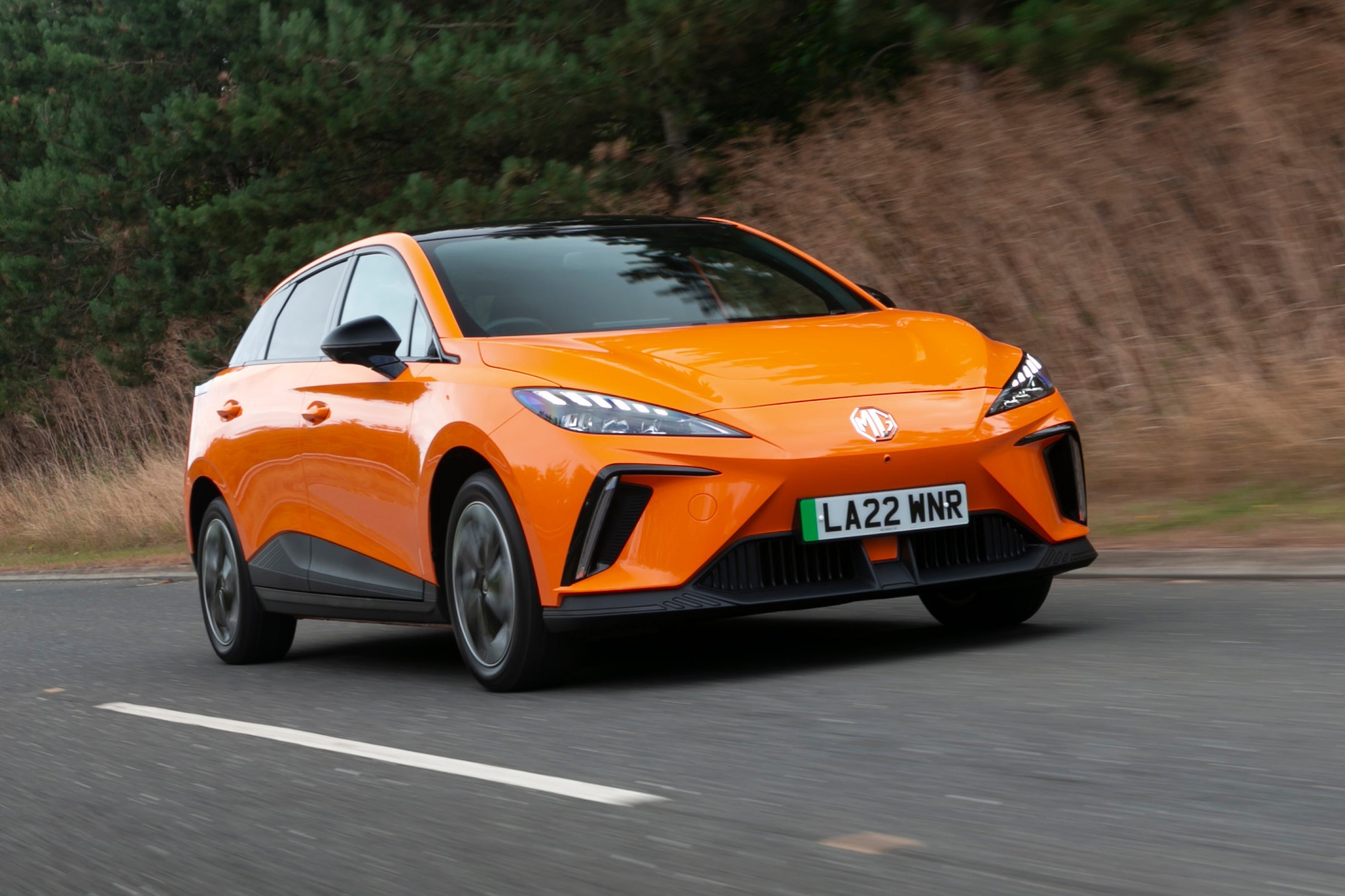
Kia EV4 Review

Written By Matt Robinson
- 2025
- Electric hatchback
- Electric
What we love
Comfortable and refined on the road
Long range from the larger battery
High-quality and spacious interior
Things to consider
Performance is only modest
GT-Line models ride more firmly
Some rivals cost less
The DRIVE take on the Kia Ev4, is it the right car for you?
The Kia EV4 is an appealing alternative for drivers who want a practical electric family car without buying another SUV. It combines the space and range expected of a modern EV with a lower, more conventional hatchback body, and prioritises comfort and refinement over artificial sportiness.
That approach works. The EV4 rides well, stays quiet at motorway speeds and provides significantly more rear legroom than its exterior dimensions suggest. The larger 81.4kWh battery also gives the entry-level Air model an official range of up to 388 miles, making it one of the longer-legged electric hatchbacks in its price bracket.
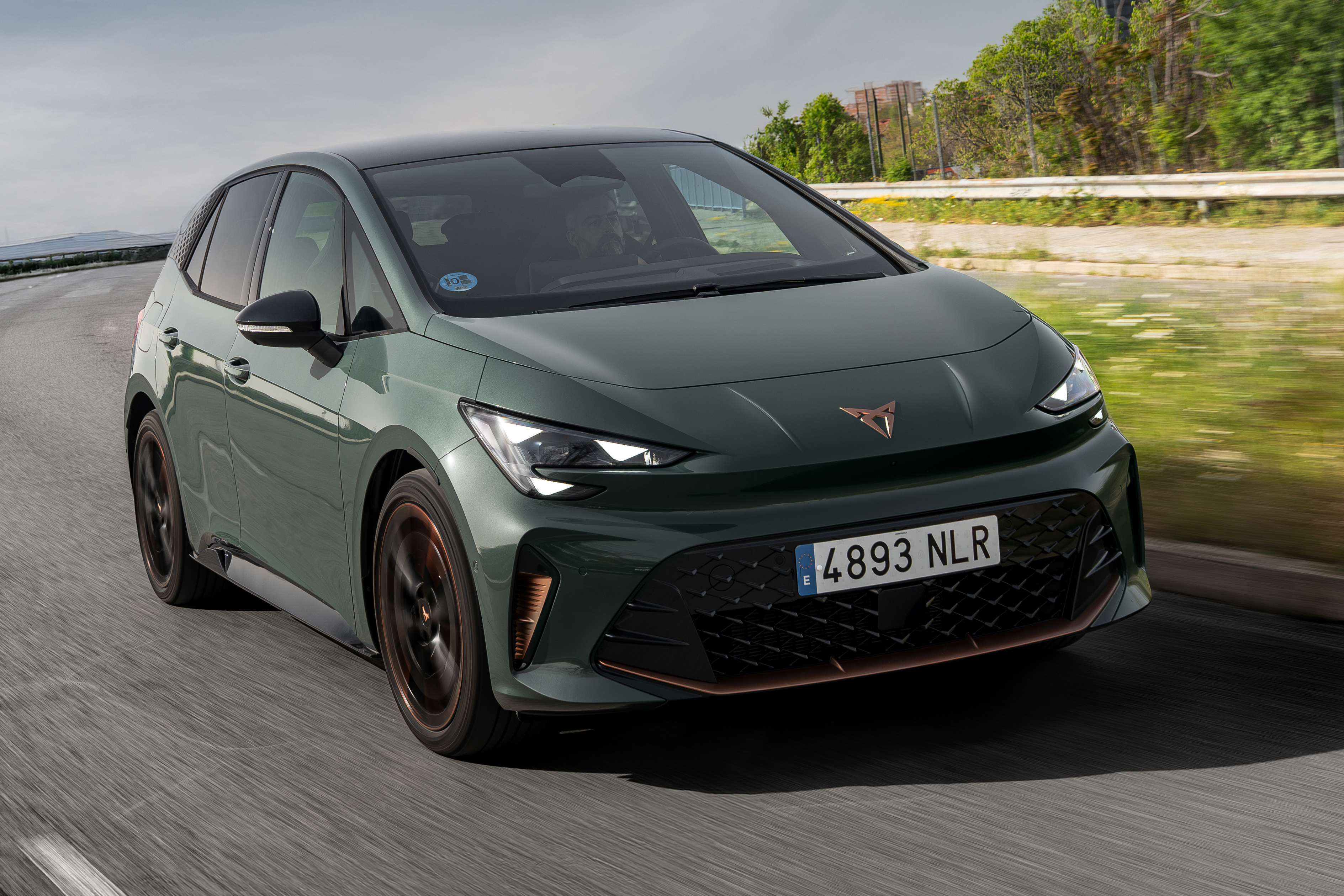
It is not a particularly exciting car to drive, and the single 204PS motor delivers adequate rather than startling performance. Nor is the EV4 an obvious bargain once you move into the higher trim levels. The Volkswagen ID.3, Cupra Born and Renault Megane E-Tech can all make strong cases depending on the price and finance offer available.
The Kia fights back with its spacious cabin, sensible physical controls, strong material quality and seven-year warranty. Buyers who prioritise comfort, range and ownership reassurance over outright pace should find plenty to like.
The Kia Ev4 in more detail
Kia’s electric range is expanding so quickly that the numbered model names can take some unravelling. The EV4 sits above the compact EV3 and below the larger EV5, EV6 and EV9.
Unlike most of those cars, the EV4 hatchback is not an SUV. It sits lower to the road and has more conventional family-hatchback proportions, giving buyers an alternative to the growing number of high-riding electric crossovers.
There is also an EV4 Fastback with a longer body, tapered rear end and conventional saloon-style boot lid. It is distinct enough in styling and practicality to warrant separate consideration, so this review focuses on the five-door hatchback.
The EV4’s closest rivals include the Volkswagen ID.3, Cupra Born and Renault Megane E-Tech. It is longer than all three, and Kia has used much of that extra length to create generous passenger space and a useful boot.
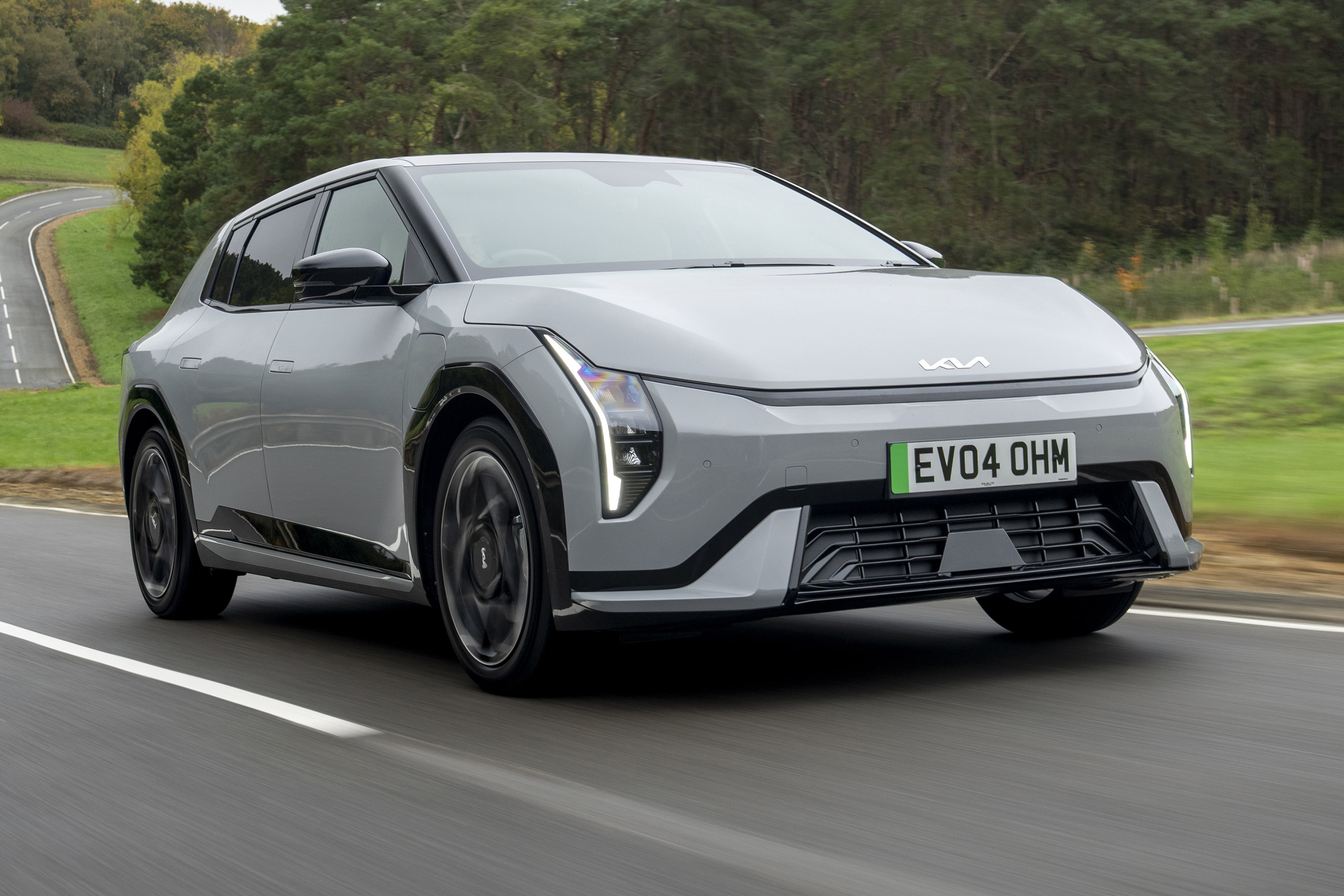
Its styling is unlikely to disappear into a car park. The upright front, angular lighting and sharply defined surfaces link it closely to Kia’s other recent electric cars, while the contrasting rear pillars and unusual tail-light treatment give it an identity of its own.
The hatchback is the more cohesive of the two EV4 body styles. It still looks unconventional, but its proportions are easier to understand than those of the stretched Fastback, whose long rear overhang and tapered tail will divide opinion more strongly.
Inside, the EV4 follows the design established by the EV3. The dashboard combines two 12.3-inch displays with a smaller climate-control screen between them, but Kia has resisted the temptation to move every function into the touchscreen.
Physical temperature switches remain, along with proper steering-wheel controls and several useful shortcuts. That makes the EV4 easier to operate than many rivals and reduces the need to look away from the road for basic adjustments.
Buyers can choose between 58.3kWh and 81.4kWh batteries. Both use the same front-mounted electric motor, producing 204PS and driving the front wheels through a single-speed transmission.
The smaller battery is available only with Air trim and offers 273 miles of official range. The 81.4kWh version can travel up to 388 miles in Air form, while the larger wheels and additional equipment fitted to GT-Line and GT-Line S reduce the figure to 362 miles.
Motion also uses the larger battery and sits between GT-Line and GT-Line S in the range. Kia has yet to add a final WLTP range figure for this derivative to its UK price guide.
A faster dual-motor EV4 GT is due to broaden the line-up, but confirmed UK power, performance and pricing details were not available at the time of writing. Until it arrives, every regular EV4 uses the same 204PS motor and front-wheel-drive layout.
What's the best Kia Ev4 trim and battery option?
The long-range EV4 Air is the strongest version in the range.
Its 81.4kWh battery gives it the maximum 388-mile official range, while its 17-inch wheels help preserve ride comfort and efficiency. It costs £2,250 more than the short-range Air before any grant or finance contribution is considered.
Air trim comes with most of the equipment buyers are likely to need. Standard features include heated front seats, automatic LED headlights, climate control, electrically folding and heated door mirrors, wireless Apple CarPlay and Android Auto, and the full three-screen dashboard.
The short-range Air is worth considering for drivers who cover mostly local journeys and can charge at home. Its 273-mile official range remains useful, while the smaller battery reduces the purchase price and makes the car marginally quicker from 0 to 62mph.
The long-range Air is likely to be easier to recommend for most buyers, though. The additional range gives it more flexibility on motorway journeys and should make it easier to sell later, without introducing the larger wheels fitted to the sportier trims.
GT-Line adds more assertive styling, 19-inch wheels, flush door handles, artificial-leather trim, an electrically adjustable driver’s seat, wireless phone charging and ambient lighting. It looks more expensive, but the larger wheels reduce range to 362 miles and introduce a little extra brittleness to the ride.
Motion sits between GT-Line and GT-Line S on price and uses the same 81.4kWh battery and 204PS motor. It is primarily positioned as a grant-eligible alternative in the upper half of the range rather than a different powertrain choice.
GT-Line S brings the most complete equipment list. It includes ventilated front seats, heated outer rear seats, electrically adjustable relaxation seats, a powered tailgate, a head-up display, Vehicle-to-Load capability and a Harman Kardon sound system.
It is a well-equipped car, but its price rises to £43,945, or £44,845 with the optional heat pump. Unless those additional comfort and technology features are priorities, the long-range Air offers a better balance of cost, comfort and range.
What’s the price of the Kia Ev4?
The Kia EV4 starts at £34,745 for the Air SR with the 58.3kWh battery.
The long-range Air with the 81.4kWh battery costs £36,995. That £2,250 step buys an additional 115 miles of official range, making it one of the easier upgrades in the range to justify.
GT-Line costs £39,445, while Motion is £40,495. GT-Line S is £43,945, increasing to £44,845 when fitted with the optional heat pump.
The current Electric Car Grant reduces the advertised price of eligible Air and Motion versions, but the headline figures above are the full on-the-road prices before the grant. Manufacturer contributions and grant eligibility can change, so monthly finance comparisons may produce a different picture from the list prices alone.
The EV4 is competitively positioned, although it is not an outright bargain. The Volkswagen ID.3 and Cupra Born can cost less after available discounts, while the Renault Megane E-Tech is also attractively priced.
The Kia’s generous equipment and long warranty strengthen its value case, but buyers should compare the total payable amount and finance terms rather than focusing solely on the advertised monthly figure.
The long-range Air remains the standout. It combines the largest battery and longest official range with the smaller wheels and simpler trim, avoiding the cost and reduced efficiency of the more heavily equipped models.
Alternatives to the Kia Ev4
The Volkswagen ID.3 is the most obvious alternative. It is easy to drive, spacious for its size and available with a broad choice of battery and power outputs. Its interior has improved since launch, although the Kia’s physical controls and longer warranty are meaningful advantages.
The Cupra Born shares much of its engineering with the ID.3 but has sharper styling and a more engaging driving character. It is the better choice for buyers who find the EV4 too soft or restrained, although it cannot match the Kia’s seven-year warranty.
The Renault Megane E-Tech has a smart interior, an excellent Google-based infotainment system and similarly refined road manners. Its 440-litre boot is fractionally larger than the EV4’s, although the Kia offers more maximum capacity with its rear seats folded.
The MG4 is cheaper and more entertaining to drive. It does not feel as upmarket or as polished inside, but remains a compelling value choice.
Kia’s own EV3 is shorter and more SUV-like. It offers a similarly user-friendly cabin and competitive range, but feels more compact in the rear. The EV4 is the stronger choice for buyers who regularly carry adults or older children.
What's the interior like in the Kia Ev4?
The EV4 has a smart, solidly built and surprisingly spacious cabin. It feels modern without becoming needlessly difficult to use, and entry-level versions do not feel like poor relations to the more expensive trims.
Kia Ev4 boot space and practicality
The Kia EV4’s extra length pays off in both rear-seat space and luggage capacity.
The hatchback has a 435-litre boot with its rear seats in place. That is around 50 litres more than the Volkswagen ID.3 and Cupra Born, while the Renault Megane E-Tech is only fractionally larger at 440 litres.
The difference is unlikely to be decisive in everyday use. All four can cope with a weekly shop, several suitcases or a folded pushchair, but the EV4’s broad opening and useful depth make its space straightforward to access.
Folding the 60:40-split rear seatbacks increases capacity to 1,415 litres. That is more than the Renault Megane E-Tech’s 1,332-litre maximum and comfortably ahead of the Volkswagen ID.3’s 1,267 litres.
The rear seats do not provide the flexibility of a three-part 40:20:40 split, so carrying a long item while retaining both outer rear seats is not as straightforward as it would be in some larger family cars.
There is also no substantial storage compartment beneath the bonnet. Drivers will therefore need to keep charging cables in the main boot or its underfloor section.
Passenger space is one of the EV4’s biggest strengths. Rear legroom is generous, helped by the car’s long wheelbase and flat floor, and adults can stretch out more comfortably than they can in several direct rivals.
Rear headroom is less impressive. Taller passengers may find the roof sits closer than expected, particularly in models fitted with darker trim. Even so, the hatchback is more accommodating than the Fastback is likely to be given the latter’s more heavily tapered roofline.
Up front, the seats provide plenty of adjustment and the driving position is easy to tailor. Storage is well considered, with three trays around the centre console and a pair of cupholders whose retaining arms deploy at the press of a button.
The cupholder arrangement is a small detail, but it demonstrates the everyday thought that has gone into the cabin. Bottles and cups are held securely without leaving permanent circular holes in the console when the holders are not needed.
Families should find the rear doors open widely enough for child-seat access, and Isofix mounting points are provided on the outer rear seats. It remains sensible to check your own child seat for access and compatibility before ordering.
Kia Ev4 dimensions
Air and Motion versions of the Kia EV4 hatchback measure 4,430mm long, 1,860mm wide and 1,485mm high.
GT-Line and GT-Line S versions are 4,450mm long because their different bumper designs add 20mm to the overall length. Width and height remain unchanged.
That makes the EV4 longer than the Volkswagen ID.3, Cupra Born and Renault Megane E-Tech, although it remains compact enough to be manageable in town.
The EV4 Fastback stretches to 4,730mm and is 1,480mm high, but that version is covered separately. Buyers comparing dimensions should make sure they are looking at figures for the correct body style.
The hatchback’s width is typical for the class, while its relatively low height contributes to a more conventional driving position than you get in an electric SUV. Parking sensors and a reversing camera are included, helping with tight spaces and restricted rear visibility.
Tech and infotainment in the Kia Ev4
Every Kia EV4 has a 12.3-inch infotainment touchscreen, a 12.3-inch digital instrument display and a smaller 5.3-inch climate-control panel arranged in one wide unit.
The infotainment screen responds quickly and uses a clear menu structure. Wireless Apple CarPlay and Android Auto are standard, and both connect without the need for a cable.
The climate display can be partly hidden by the steering wheel depending on the driver’s seating position. Kia has reduced the problem by retaining physical temperature controls lower on the dashboard, so most routine adjustments do not require the touchscreen.
There are two USB-C ports in the front. One can switch between data connectivity and charging-only use, preventing a passenger’s device from replacing the driver’s smartphone interface unintentionally. Two further USB-C ports are provided in the rear.
The digital instrument display is clear and provides the expected range, energy and driver-assistance information. Higher-specification versions also include a configurable head-up display, reducing the need to look away from the road.
The standard six-speaker audio system is better than expected, while GT-Line S upgrades to an eight-speaker Harman Kardon setup. The premium system is stronger and richer, but the standard arrangement should satisfy most users.
Driver-assistance alerts can be intrusive, particularly the lane-support functions. The lane-keeping system can intervene more aggressively than some drivers will like, encouraging them to switch it off on narrower or poorly marked roads.
Materials available on the Kia Ev4
The EV4’s interior is another reminder that Kia has moved far beyond its value-brand origins.
Material quality is consistently good, with a convincing blend of soft-touch surfaces, robust fabrics and neatly finished harder plastics. The dashboard and doors feel solid, and the main controls operate with a reassuring sense of precision.
Entry-level Air models still feel well presented. They do not appear deliberately stripped out, and the same basic dashboard architecture and screen layout are used across the range.
GT-Line introduces more decorative trim and artificial-leather upholstery, while GT-Line S adds further comfort and technology equipment. Neither is essential to make the cabin feel suitably upmarket.
The overall design is minimalist without becoming stark. There are enough physical controls to provide a clear sense of familiarity, while the screens are integrated into the dashboard rather than appearing to have been attached as an afterthought.
What's the Kia Ev4 like to drive?
The EV4 is tuned for comfort rather than excitement. Its soft suspension, quiet cabin and predictable controls make it relaxing to use, although drivers looking for sharp responses will find several rivals more engaging.
Kia Ev4 range and performance
The EV4 is available with 58.3kWh and 81.4kWh batteries. Both use the same front-mounted electric motor, producing 204PS and 283Nm.
The short-range Air is the quickest version because its smaller battery weighs less. It reaches 62mph in 7.5 seconds and has an official range of 273 miles.
The long-range Air reaches 62mph in 7.7 seconds and can cover up to 388 miles. GT-Line and GT-Line S use the same battery and motor, but their larger wheels and additional equipment increase the 0-62mph time to 7.9 seconds and reduce range to 362 miles.
Every version has an electronically limited top speed of 105mph.
The EV4 does not deliver the hard initial acceleration associated with many electric cars. Progress is smooth and measured, and the car can feel leisurely when accelerating onto a motorway or attempting a quick overtake.
It is not slow in ordinary terms, though. The motor responds immediately, and even the heavier long-range versions are quicker from 0 to 62mph than many conventional petrol family hatchbacks.
Performance data
| Model | Engine/battery size | Power | 0-62mph | Range/MPG |
|---|---|---|---|---|
EV4 SR | 58.3kWh battery, automatic, front-wheel drive | 204PS | 7.5 seconds | Up to 273 miles |
EV4 | 81.4kWh battery, automatic, front-wheel drive | 204PS | 7.7 seconds | Up to 388 miles |
Kia Ev4 driving and refinement
Kia has resisted the temptation to give the EV4 unnecessarily firm suspension. The result is one of the more comfortable electric hatchbacks in the class.
Air and Motion models are the best-riding versions. Their 17-inch wheels have taller tyre sidewalls, allowing the car to absorb broken surfaces and sharp edges more effectively.
GT-Line and GT-Line S move to 19-inch wheels. These introduce a little more brittleness over potholes and patched surfaces, although the EV4 remains comfortable by electric-car standards.
The suspension is soft, but the damping prevents the car from continuing to float or bounce after a large bump. It controls longer undulations well and rarely feels loose or poorly tied down.
The trade-off is body lean in corners. The EV4 rolls more than a Cupra Born or some versions of the Volkswagen ID.3, and its steering is vague around the straight-ahead position.
Grip is sufficient and the responses remain predictable, but there is little encouragement to drive it hard. Buyers seeking a sportier feel should consider the Cupra Born or wait for the EV4 GT.
The EV4 is more convincing as a quiet motorway car. Wind and tyre noise are well suppressed, despite there being no combustion engine to disguise them, and the cabin remains calm at higher speeds.
Visibility is generally good in the hatchback. The Fastback’s unusual rear styling and small rear window create more significant problems, which is another reason to treat it as a separate proposition.
Regenerative braking can be adjusted through several levels using the steering-wheel paddles. Drivers can choose a lighter setting for open roads or stronger deceleration in urban traffic, including a one-pedal mode.
How safe is the Kia Ev4?
The Kia EV4 was tested by Euro NCAP in 2025 and received two separate ratings.
Cars with the standard European safety specification received four stars. The rating increases to five stars when the optional DriveWise safety pack is fitted.
DriveWise adds front and rear corner radars, improving the car’s response to vehicles crossing its path and adding technology designed to warn occupants before a door is opened into the path of a cyclist.
The distinction is important because the five-star result does not automatically apply to every EV4. Buyers wanting the highest-rated safety specification should make sure their chosen car includes the DriveWise pack.
The underlying crash protection was broadly strong. The passenger compartment remained stable in the frontal-offset test, while protection of the knees and femurs of the driver and front passenger was good.
The driver’s airbag did not maintain sufficient pressure to prevent the head from making contact with the steering wheel through the airbag, which reduced the frontal-impact score.
The EV4 performed strongly in the side-barrier and more severe side-pole assessments, where protection of all critical body areas was good and the car scored maximum points.
Child protection was also strong. Protection was good for the six-year-old dummy and good or adequate for the ten-year-old in the frontal assessment, while all critical areas were well protected in the side impact.
Standard safety equipment includes autonomous emergency braking, lane support, speed-limit assistance, driver monitoring and seatbelt reminders for the front and rear seats. Additional blind-spot, cross-traffic and Safe Exit functions depend on trim and the fitted assistance package.
Running costs: What it's like to live with a Kia Ev4
The Kia EV4 has the potential to be inexpensive to run when charged at home. Its strong efficiency and long warranty help, although public rapid-charging costs and insurance still need to be considered.
Kia Ev4 charging times and costs
Both EV4 batteries use a 400-volt electrical system and support DC rapid charging at up to approximately 150kW.
Kia quotes 29 minutes for a 10 to 80 per cent charge of the 58.3kWh battery under suitable conditions. The larger 81.4kWh battery takes 31 minutes for the same top-up.
Those figures are competitive rather than exceptional. The EV4 cannot match the charging speeds of 800-volt cars such as the Kia EV6, but its stops should still be short enough for a coffee or comfort break.
The car must be connected to a charger capable of providing the necessary output, and battery temperature, charger performance and weather conditions can all reduce the charging rate in practice.
A 7.4kW home wallbox takes around eight hours to charge the 58.3kWh battery from empty. The larger pack requires approximately 11 hours.
Owners using an off-peak domestic tariff can reduce charging costs significantly by scheduling the car overnight. The precise cost of a full charge will depend on the household electricity rate and the amount of energy lost during charging.
The long-range EV4’s efficiency is particularly appealing. More than 300 miles of real mixed use may not always be achievable, especially in cold weather or sustained motorway driving, but the large official range gives owners a useful buffer.
GT-Line S includes an internal three-pin socket and a Vehicle-to-Load adaptor, allowing the high-voltage battery to power suitable external devices.
Kia Ev4 warranty and servicing
The Kia EV4 is covered by a seven-year or 100,000-mile manufacturer warranty.
That is substantially longer than the three-year cover provided with several direct rivals and remains one of the EV4’s strongest ownership arguments.
Kia separately covers the high-voltage battery for seven years or 100,000 miles under its standard vehicle warranty terms, with capacity conditions applying. Buyers should refer to Kia’s full warranty documentation for the precise exclusions and capacity threshold.
Electric cars have fewer routine mechanical service items than petrol or diesel models, but the EV4 will still require periodic inspections, brake-fluid changes, cabin filters and replacement tyres.
The official service interval is every 24 months or 20,000 miles, whichever comes first.
Kia has an extensive UK dealer network, which should make maintenance and warranty support more straightforward than it is with some less established electric-car brands.
Kia Ev4 insurance groups
The EV4 Air SR sits in insurance group 33D, while the long-range Air, GT-Line and GT-Line S are in group 35D.
Kia had not confirmed the insurance group for Motion at the time of writing.
Those ratings are not unusually high for an electric family car with more than 200PS, but premiums can still vary significantly according to postcode, driver history and repair costs.
How much does it cost to tax a Kia Ev4?
For 2026 to 2027, a new electric car pays £10 in Vehicle Excise Duty during its first year and the £200 standard annual rate from the second year.
The Expensive Car Supplement threshold for electric cars is £50,000 for vehicles registered from 1 April 2026.
Every current EV4 hatchback has a standard list price below that threshold, so none should attract the supplement unless factory-fitted options push the original list price above £50,000.
The original list price is used rather than any Electric Car Grant deduction, finance contribution or dealer discount. Buyers specifying a high-end EV4 should therefore check the final official list price before ordering.
What trims are available with the Kia Ev4?
The current Kia EV4 hatchback range includes Air, GT-Line, Motion and GT-Line S.
Air is available with both the 58.3kWh and 81.4kWh batteries. It includes 17-inch alloy wheels, automatic LED headlights, heated front seats, climate control, a six-speaker stereo, heated and electrically folding door mirrors, wireless smartphone connectivity and the full dashboard display arrangement.
GT-Line is available with the larger battery. It adds 19-inch wheels, flush exterior door handles, dark-tinted rear glass, two-tone artificial-leather trim, a three-spoke steering wheel, wireless phone charging, an electrically adjustable driver’s seat and customisable ambient lighting.
Motion also uses the 81.4kWh battery and 17-inch wheels. It sits between GT-Line and GT-Line S on price while remaining eligible for Kia’s advertised Electric Car Grant offer, making it an alternative for buyers who want more equipment without the range and ride compromises associated with the larger GT-Line wheels.
GT-Line S adds adaptive LED headlights, heated outer rear seats, ventilated and electrically adjustable front relaxation seats, a powered tailgate, a three-pin internal socket, Vehicle-to-Load capability, an eight-speaker Harman Kardon stereo and a head-up display.
The long-range Air remains the best choice for most buyers. It provides the longest range, the most comfortable wheel and tyre combination and a generous standard specification without pushing the price too high.
Ask the Drive experts: common questions
Is the Kia EV4 an SUV?
How big is the Kia EV4 boot?
How quickly can the Kia EV4 charge?
Get our latest advice, news and offers
Keep me updated by email with the latest advice, news and offers from Drive.
.jpg)
.jpg)