Skoda Kodiaq vRS Review

Written By Richard Aucock
- 2025
- SUV
- Petrol
What we love
Stylish vRS makeover outside and in
Characterful engine sound
Extremely practical with seven-seat flexibility
Things to consider
vRS performance comes with a price premium
Large wheels need care around kerbs
Sportier suspension is noticeable on rough roads
The DRIVE take on the Skoda Kodiaq, is it the right car for you?
The Skoda Kodiaq vRS is a good choice if you want all those things that make a Kodiaq easy to live with, but with an extra injection of fun. It’s not a hard-edged performance car dressed up as a large family SUV, but you wouldn’t want it to be, because then, it would lose too much of its family-friendly comfort. Think of it more as a regular Kodiaq, with a bit of extra accelerative punch, and some racier styling thrown in. You still get a very versatile seven-seat cabin, exemplary quality and a heaving standard kit list. It’s pricey, and lesser Kodiaqs will make more sense for more people, but for the right buyer, it'll be just the job.
The Skoda Kodiaq in more detail
The Skoda Kodiaq vRS is the high-performance version of the popular Skoda Kodiaq seven-seat large SUV. It’s aimed at families who want an added dose of speed, style and dynamism, but without compromising on three-row practicality and a big boot.
Whereas some older Skoda Kodiaq vRS versions had a diesel engine, the latest model uses a 2.0-litre TSI turbo petrol engine. It’s actually the same engine used in the Volkswagen Golf GTI (and the Octavia vRS for that matter), even down to matching its 265PS power output. Skoda pairs it with a DSG automatic gearbox and all-wheel drive 4x4 running gear.
Browse used Škoda Kodiaqs for sale →
That makes it quick: let’s just say that doing 0-62mph in 6.4 seconds is probably as fast as you’ll ever want to go in something the size of the Kodiaq. And don’t go worrying that Skoda will have tightened up the suspension for sporty handling to a point where the ride becomes unbearable for the family: the vRS also comes with Dynamic Chassis Control adaptive suspension that can provide some edge if you want it, but that maintains comfort levels well in its softer modes. The character is very much like that of the regular Kodiaq, just with a bit more punch.
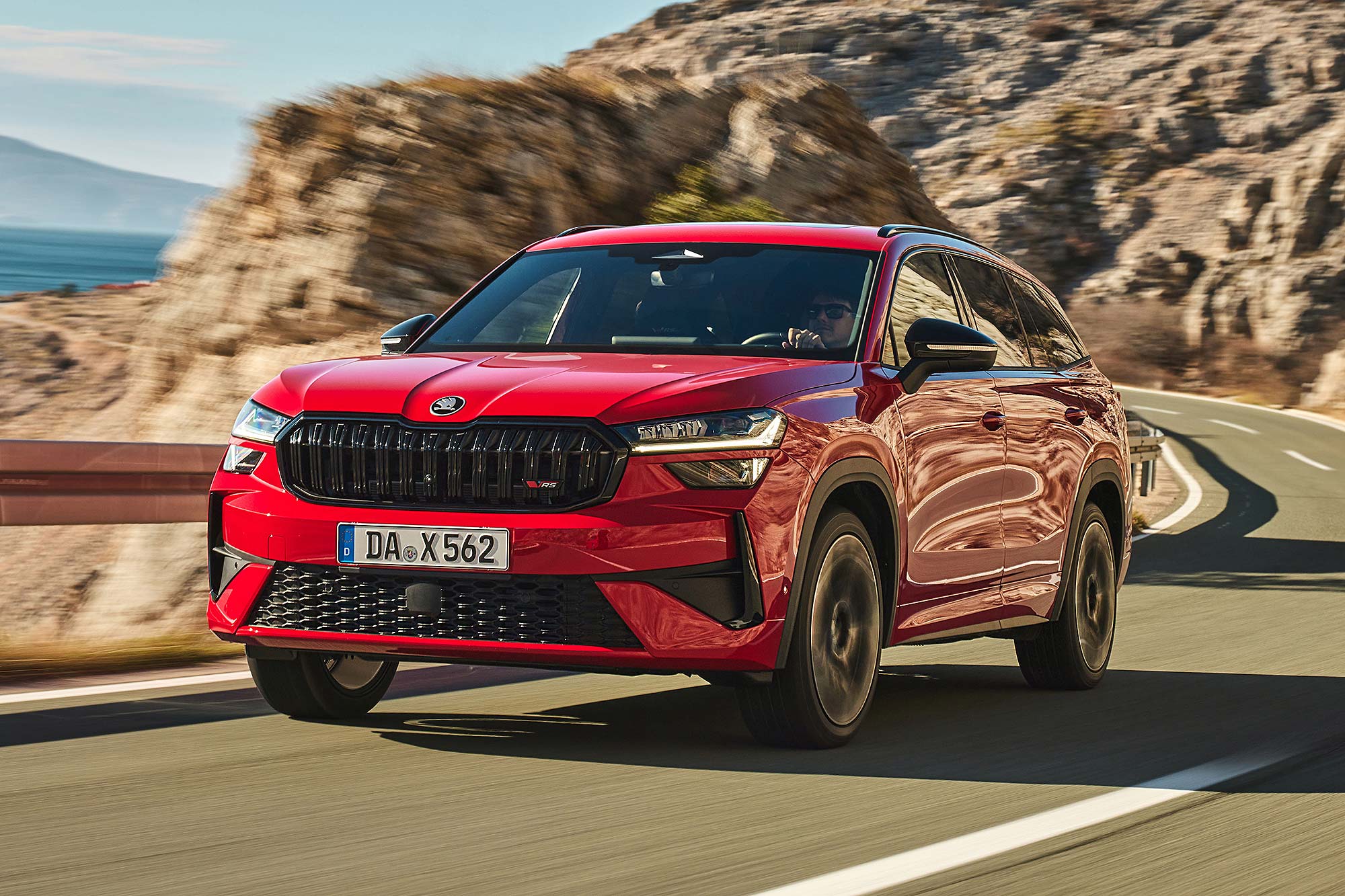
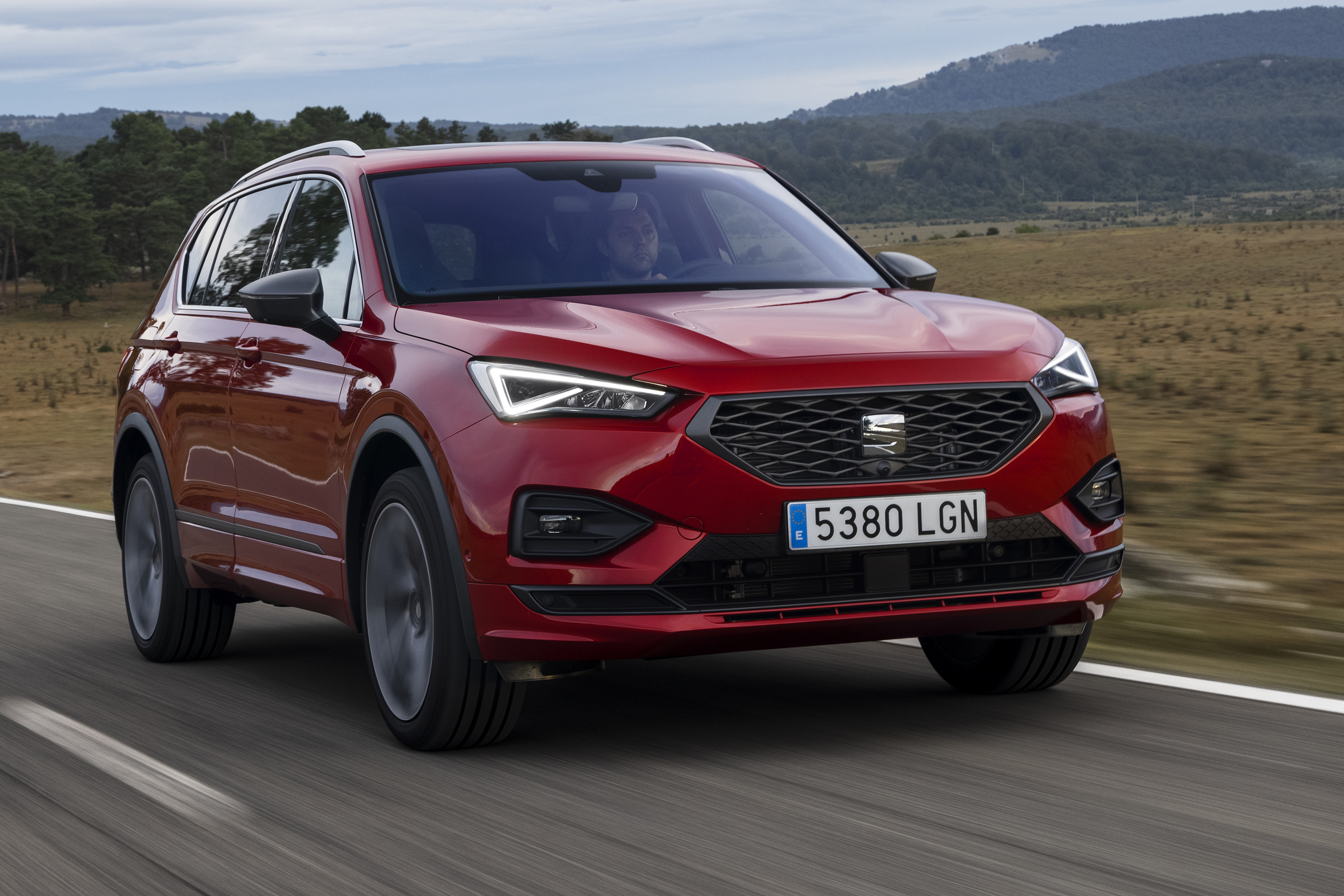
Compared to regular models, the Skoda Kodiaq vRS stands out with a unique design package that includes a gloss black finish for the front grille – which includes a horizontal light strip – and other exterior parts as well The front bumper is more aggressive and, like all Skoda vRS models, there’s a full-width reflector strip at the rear. The rear bumper and side sills are body-coloured, while the Skoda lettering and model designation is in black. Polished stainless steel exhaust tips and 20-inch ‘Elias’ polished black, alloy wheels complete the look.
The Skoda Kodiaq vRS gets a full makeover inside, too. This includes some of the best sports seats we have ever sat on in a family-focused model. Yet this doesn’t come at the expense of practicality, with the Kodiaq vRS offering the same ample space across all three rows of seats as any regular Kodiaq, and a boot that’s bigger than almost any rival’s, too.
Of course, the Kodiaq vRS isn’t completely without compromise. It’s expensive for one thing, and the fuel economy is predictably poor given the car’s ample size and power. And with a character that’s still rather sedate for a performance model, it’s probably not the thrill ride that some buyers might want it to be. We see its sedate nature as a strength, but some might disagree,
The high price and running costs alone mean that a regular Kodiaq will be a more sensible option for most buyers, but for the right buyer, we reckon the vRS will be just what they’re looking for.
What's the best Skoda Kodiaq trim and engine option?
If you know you want a Kodiaq vRS, the decision is refreshingly simple because there is only one powertrain and trim combination. You get the 2.0-litre TSI petrol with 265PS, a seven-speed DSG gearbox and four-wheel drive, plus seven seats as standard.
That means the real buying decision is not which vRS to choose, but whether the vRS is the right Kodiaq in the first place. For keen drivers who still need a large family SUV, it is the most appealing version in the range. The extra shove over the 204PS petrol version is noticeable, and the standard equipment level is generous enough to at least partially justify the price, provided that the vRS is a must-have for you.
If you cover high mileages, the 193PS diesel Kodiaq remains the more sensible long-distance choice, and it’s still fast. If low company-car tax is your main concern, the plug-in hybrid is the version to look at instead. The vRS is a very niche choice, in truth, but still a very likeable one.
What’s the price of the Skoda Kodiaq?
The current Skoda Kodiaq vRS starts at £54,655 on the road. That places it clearly above the rest of the Kodiaq range and pushes it into territory where buyers will also start looking at more premium-badged seven-seat SUVs, even if many of those are slower or less well equipped in equivalent form. There are also plenty of used Škoda Kodiaqs for sale for considerably less.
This lands buyers with something of a dilemma: a big part of the Kodiaq’s core appeal is affordability and value for money, and you can argue that this version doesn’t provide that. You might argue, however, that it’s the most fun, most desirable and best equipped version of the car, yet just as practical as any other version, and is therefore worth paying handsomely for. It’s your view on this argument that’ll determine whether you’ll want the vRS or not.
Alternatives to the Skoda Kodiaq
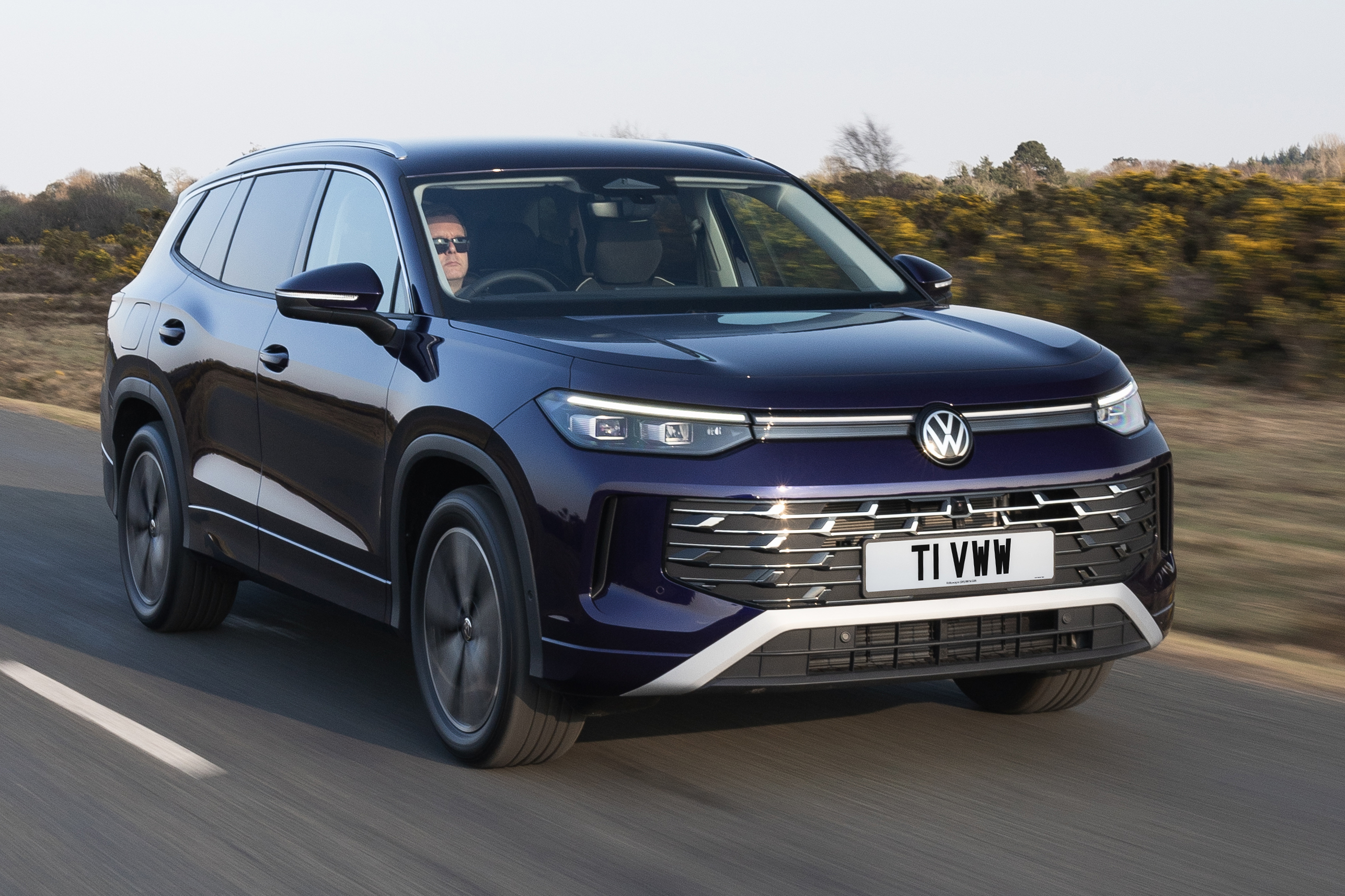
The Skoda Kodiaq vRS is a rather unique product, and as a result, there’s a shortage of direct rivals. Sure, we can think of plenty of seven-seater SUVs that are offered with plenty of power and toys - cars such as the Volkswagen Tayron, Kia Sorento and Hyundai Santa Fe, for example - but none of them have the same overtly sporting intent that the Kodiaq vRS has.
As we’ve said, the price of the Kodiaq vRS pushes it into territory where you might - if you don’t absolutely need seven seats - also be considering premium-badged SUVs, some of which are pretty darned quick and feel very handy in a set of bends. No car we can think of does it all in quite the same way as the Kodiaq vRS, though.
What's the interior like in the Skoda Kodiaq?
The Kodiaq vRS has a cabin that feels expensive enough for the price and practical enough for family life. The sporty touches add a bit of theatre, but the real appeal is that it still delivers the space, storage and usability that make the standard Kodiaq one of the best large SUVs in the class.
Skoda Kodiaq boot space and practicality
One of the Kodiaq vRS’s biggest strengths is that it doesn’t compromise its seven-seat practicality in any way. You get a 340-litre boot with all seven seats in place, which is enough for a few soft bags or a supermarket run. The space expands to 845 litres when the third row is folded, which is massive. That’s important, because many large seven-seat SUVs spend most of their lives in five-seat mode.
Space in the first two rows is generous, with plentiful headroom and legroom for adults to travel in comfort, with space to spare. There’s even enough width in the middle room for three adults to sit in reasonable comfort, which is certainly not a given even in cars of this size.
The third-row seats are a lot tighter: adults will just about fit if they’re not too tall, but they won’t want to stay there for long. That’s the case in most cars of this type, though, and kids will be okay back there for longer journeys.
The driving position has lots of adjustment, the sport seats up front are really comfortable and supportive, and visibility is good for a car of this size. There’s enough cabin storage to keep most family clutter out of sight, too.
Skoda Kodiaq dimensions
The Kodiaq vRS is 4,761mm long and 1,682mm tall. In width, it’s 2,133mm if you include the door mirrors, or 1,864mm if you don’t. It’s a properly large family SUV, then, and this helps give it its impressive interior space, but you will feel this bulk when negotiating tighter parking spaces and multi-storey car parks. Light controls, excellent visibility and standard parking sensors and cameras help on that score, though.
Tech and infotainment in the Skoda Kodiaq
All versions of the Kodiaq - the range-topping vRS included - get the same basic infotainment system, although the vRS does get an upgraded Canton sound system on top. The standard roster includes wireless smartphone integration via Apple CarPlay and Android Auto, wireless charging for two phones (other devices are taken care of by four USB-C ports, two in the front, two in the back), DAB radio, Bluetooth, native navigation and voice control.
The system is based around a 13.0-inch central touchscreen and 10.25-inch ‘Virtual Cockpit’ digital instrument panel behind the steering wheel. The cabin feels much more up to date than the previous Kodiaq’s as a result.
Importantly, however, this is not one of those interiors where every function has to be operated through the central screen (something that some other Skoda models are guilty of). That’s because the Kodiaq has Skoda’s ingenious Smart Dials: these are three rotary dials on the dashboard that can be configured to perform a variety of functions without having to bother with the screen. They look cool, they work really well, and they’re one of our favourite features of the entire car.
On those occasions where you do need to interact with the touchscreen, you’ll find that it makes life a little less easy. The home screen is slightly cluttered with on-screen icons, and because some of those icons are designed rather ambiguously, it’s even more difficult to pick out the one you want. Things do become a little easier as you become more familiar with the system, largely because once you’re into the meat of the menu structure, the layout is actually pretty logical.
Materials available on the Skoda Kodiaq
The Kodiaq vRS uses a more overtly sporty interior treatment than the regular Kodiaq, with upholstery that uses a combination of black perforated microsuede and artificial leather with red stitching. There is also black microsuede across parts of the dashboard and door trims, plus a sports steering wheel and more supportive front seats. That gives the Kodiaq vRS’s cabin the visual separation it needs from less expensive Kodiaq models.
Importantly, though, the materials used in the regular Kodiaq are already good enough to feel like they work in a car as expensive as the Kodiaq vRS. The surfaces directly in your eyeline are plush and tactile, and even those that are more hidden away look smart and substantial. Build quality is something that you probably won’t have a single complaint about with the Kodiaq.
What's the Skoda Kodiaq like to drive?
The Kodiaq vRS is quick, secure and easy to cover distance in. Don’t go thinking that it feels like a pumped-up hot hatch, because it doesn’t, but it does deliver enough pace and composure to feel special, without undermining its family-car brief.
Skoda Kodiaq range and performance
There is only one engine in the current Kodiaq vRS, and it suits the car well. It is a 2.0-litre turbocharged petrol producing 265PS and 400Nm, paired with a seven-speed DSG automatic gearbox and four-wheel drive. Officially, it reaches 62mph from a standstill in 6.4 seconds and goes on to 143mph.
Those figures probably mean very little to you, and that’s totally understandable. What they mean in reality is that the vRS feels very brisk - rather than searingly fast - both off the line and when picking up speed on the move. Fast overtakes are the work of a moment, and motorway journeys are dispatched with the kind of muscular ease that ensures a relaxed time. The performance isn’t of the proper firecracker level that some might be expecting, then, but there’s no denying that the vRS is still a rapid point-to-point machine.
Performance data
| Model | Engine/battery size | Power | 0-62mph | Range/MPG |
|---|---|---|---|---|
2.0 TSI 265PS vRS | 2.0-litre | 265PS | 6.4 seconds | Up to 33.8mpg |
Skoda Kodiaq driving and refinement
The vRS badge presents a slight conundrum for Skoda, especially where the Kodiaq is concerned: how do you make the car feel sporty enough to deliver on the promise of the badge, yet still deliver all the practicality, comfort and civility that the Kodiaq needs to. With this car, we reckon Skoda has got the balance just about right, as it usually does.
To achieve that, the Czech firm has utilised Dynamic Chassis Control adaptive suspension, which can be firmed up or softened off according to the drive mode you select, or the parameters you select in Individual mode. And it’s largely very effective.
In the cushier modes, the ride stays utterly acceptable for a family car: there’s a touch more jitter than you feel in the regular Kodiaq, but it’s nothing that’ll have the kids complaining, and the Kodiaq vRS is still a comfortable way of ferrying around the family.
Select one of the sportier settings, meanwhile, and things tighten up appreciably: it never turns into a scalpel-sharp precision instrument - it’s too big and heavy for that - but it feels planted, assured and controlled. The standard four-wheel-drive system generates bags of traction and grip, making direction changes feel utterly stable, if not all that playful. This shortage of playfulness might be a drawback for some more hardcore drivers, of course, but for most people, we think that’ll be a sacrifice worth making.
All in all, the Kodiaq vRS doesn’t feel vastly different in character to the regular Kodiaq - it’s still comfortable, polished and relaxing on any sort of road - but it also has a small amount of extra dynamism that you can dial in when you want it.
In terms of refinement, the Kodiaq vRS’s surprisingly rorty sports exhaust will be an immediate talking point. It gives this family-friendly SUV a muscle-car soundtrack. It’s not over-the-top, but is distinctive and obvious. There’s even a speaker that enhances the noise from the outside. However, those who prefer peace and quiet can disable it by selecting a more easy-going drive mode.
The Skoda Kodiaq vRS has acoustic laminated side windows at both the front and rear. This enhances sound insulation and keeps wind noise at bay. While the big 20-inch wheels generate a bit of roar at higher speeds, it’s otherwise reasonably refined, with the engine fading into the background.
How safe is the Skoda Kodiaq?
The wider second-generation Kodiaq achieved a five-star Euro NCAP rating in 2024, with scores of 89% for adult occupant protection, 83 per cent for child occupant protection, 82% for vulnerable road users and 78% for safety assist. Euro NCAP also notes standard features such as autonomous emergency braking, driver monitoring, lane support and speed assistance on the tested Kodiaq. That gives the vRS a strong safety foundation, although buyers should still check the precise UK equipment list at point of order.
As part of the latest Skoda Kodiaq range the vRS has a five-star rating from Euro NCAP following tests in 2024. It achieved strong scores in each area, with 89% in Adult Occupant tests, 83% in Child Occupant tests, 82% for its protection of Vulnerable Road Users, and 78% in the Safety Assist category.
Standard safety kit includes features such as autonomous emergency braking, front cross traffic alert, lane assist, blind-spot detection, driver fatigue monitoring, traffic sign recognition adaptive cruise control, emergency e-call, and three Isofix child seat mounting points.
Running costs: What it's like to live with a Skoda Kodiaq
You wouldn’t expect a massive, performance-focused seven-seater SUV to be cheap to run, and it duly isn’t. You’ll get through a fair amount in petrol, and pay a fair amount to tax and insure it, none of which is a surprise. It’s undeniably pricey to buy, although in fairness, it’s fairly obvious that this isn’t the Kodiaq to buy if affordability is your priority.
Skoda Kodiaq fuel economy
Official WLTP combined economy figures for the Kodiaq vRS is given at between 33.3mpg and 33.8mpg. That’s pretty juicy, obviously, but it’s also no surprise given that this is a nigh-on-two-tonne SUV with a 265PS petrol engine and four-wheel drive. Bearing all that in mind, the official figures actually look fairly respectable. However, bear in mind that your real-world fuel bills will depend largely on how often you make use of the car’s impressive performance.
Skoda Kodiaq warranty and servicing
Skoda’s new-car warranty is three years as standard. The first two years have no mileage limit, but the third year is capped at 60,000 miles. That looks pretty mean when rivals fro Hyundai and Kia come with warranties of five- and seven years, respectively, and some manufacturers offer even longer cover.
Servicing your Kodiaq is dealt with in one of two ways. There’s a fixed regime of a service every one year or 10,000 miles, and this is recommended for those who drive less than 10,000 miles per year, and who mainly operate in low-speed urban environments. It’s also recommended for those who tow regularly.
For those that do higher mileages at more constant speeds (in other words, more motorway driving), there’s the option of a flexible servicing regime. With this, the car lets you know when it needs maintenance, and this can happen anywhere between 9,000 miles and 20,000 miles, and up to a maximum of two years between services.
Skoda Kodiaq insurance groups
The Kodiaq vRS sits in insurance group 31. That is hardly cheap, but it is also not absurd for a 265PS seven-seat SUV.
How much does it cost to tax a Skoda Kodiaq?
Any combustion-engined car that costs more than £40,000 when brand new is liable for higher-rate VED road tax, meaning that on top of the regular flat rate of tax, currently charged at £200 per year, owners also pay an additional sum of £440 per year for a five-year period, between years two and six of the car’s life.
The Kodiaq vRS’s price doesn’t just exceed that threshold, it proper blows it out of the water, so tax is another area where Kodiaq vRS ownership will cost you a pretty penny.
What trims are available with the Skoda Kodiaq?
The Kodiaq vRS effectively sits as its own standalone flagship trim, above the Kodiaq SportLine. It is offered exclusively as a seven-seater with the 265PS petrol engine, DSG gearbox and four-wheel drive.
And being the range-topper, it’s absolutely stuffed with standard kit. vRS-specific items include blingy 20-inch alloy wheels, the sporty styling inside and out, powered front seats and a handsfree powered bootlid. Kit shared with other cars in the Kodiaq range includes heated front seats, three-zone climate control, front- and rear parking sensors, a rear-view camera, a variable boot floor, keyless entry and start, metallic paint, adaptive cruise control, Dynamic Chassis Control, and the full infotainment package with the upgraded Canton sound system.
Ask the Drive experts: common questions
How much does the Skoda Kodiaq vRS cost?
Is the Skoda Kodiaq vRS a seven-seater?
What engine does the Skoda Kodiaq vRS use?
How fast is the Skoda Kodiaq vRS?
Get our latest advice, news and offers
Keep me updated by email with the latest advice, news and offers from Drive.