Toyota Land Cruiser Review

Written By Matt Robinson
- 2024
- SUV
- Diesel
What we love
Strong visual identity
Huge off-road capability
Spacious, versatile five-seat cabin
Things to consider
Expensive to buy and tax
Diesel engine is still noisy when worked hard
On-road manners trail more car-like luxury SUVs
The DRIVE take on the Toyota Land Cruiser, is it the right car for you?
The Toyota Land Cruiser is not a mainstream luxury SUV, even if the latest one is pricier and more plush than any Land Cruiser most UK buyers will remember. It remains, first and foremost, a serious off-roader built around the sort of body-on-frame toughness most rivals abandoned years ago. That gives it a unique appeal, because very few vehicles now combine this level of genuine off-road ability with a modern cabin, strong equipment levels and Toyota’s excellent durability reputation. The trade-off is that it still does not drive like a more road-biased premium SUV, and for the money you could have something more refined and more efficient if you rarely venture off tarmac. But if you want the real thing, the Land Cruiser still very much is.
The Toyota Land Cruiser in more detail
The Land Cruiser has always been a slightly different proposition to the typical large SUV. While many rivals have spent the past decade becoming softer, more luxurious and more road focused, Toyota has kept the Land Cruiser tied to the qualities that made it famous in the first place. It is still engineered to cope with hard use, difficult terrain and the kind of long-term ownership that would expose weaknesses quickly in softer alternatives.
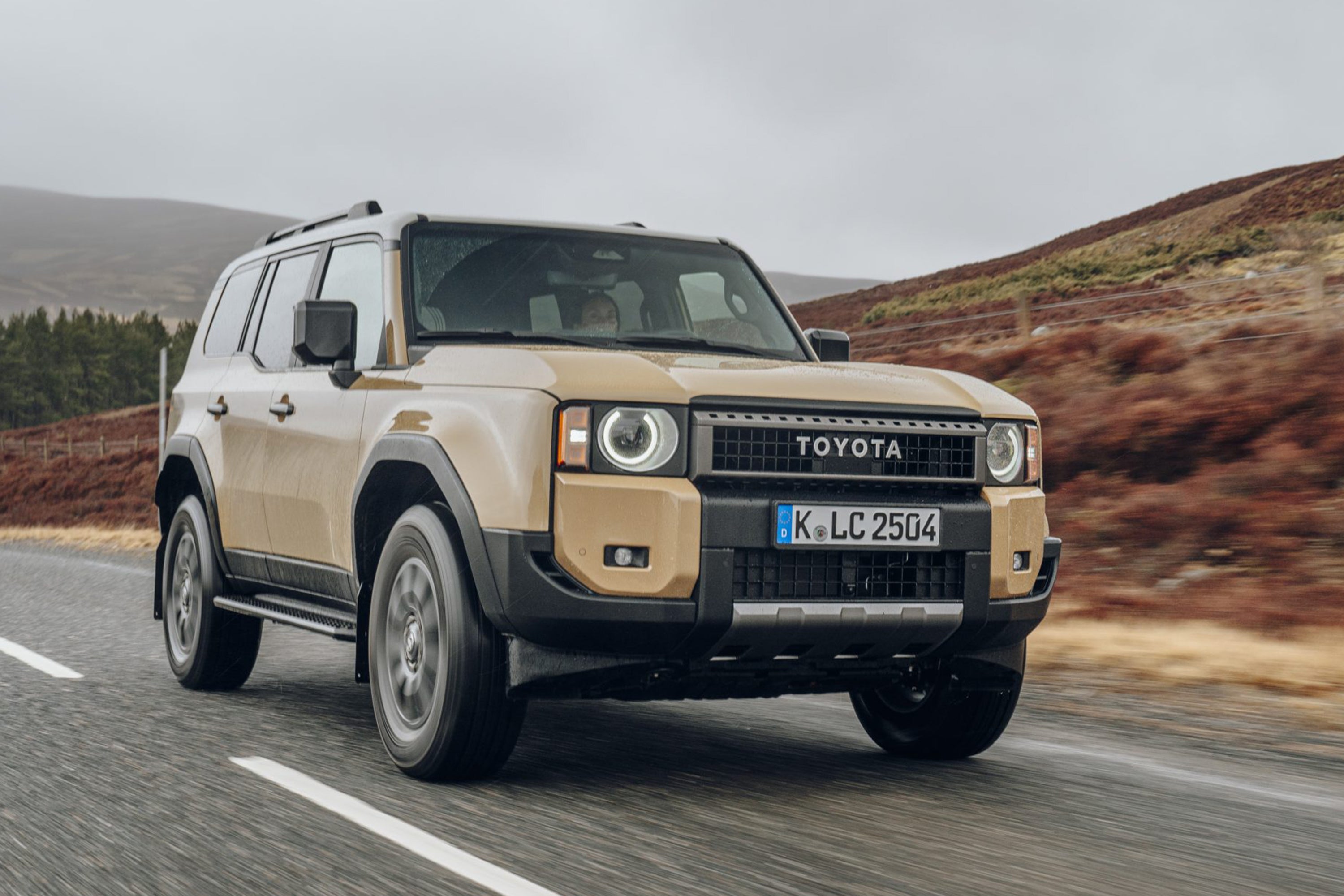
That heritage is a big part of the appeal, and Toyota has been smart enough not to throw it away. The latest Land Cruiser looks modern and expensive, but it still has the boxy profile, upright glasshouse and rugged stance buyers expect. It feels like a Land Cruiser should.
What has changed is the level of polish. The current UK model is much better equipped and much more upmarket than older versions, while the 2026 revision also introduces a 48V electrified version of the 2.8-litre diesel. This is not a full hybrid and it does not turn the Land Cruiser into a low-emissions choice, but it does promise smoother stop-start operation and a more responsive feel off the mark.
The UK range has also become simpler. Rather than a broad spread of trims and seating layouts, the current Land Cruiser is now effectively a single-model proposition: Invincible trim, five seats, one engine. That makes the buying decision very straightforward, even if it does underline how niche the vehicle has become.
This is important because the Land Cruiser no longer sits in quite the same market space it once did. It now overlaps with premium SUVs on price, while still appealing to buyers who care more about durability, towing and off-road confidence than outright on-road polish. That is a narrow brief, but it is one the Land Cruiser still answers better than almost anything else.
What's the best Toyota Land Cruiser trim and battery option?
There is not much choice to agonise over here, because the current UK Land Cruiser is offered only as the 2.8D 48V in Invincible trim.
That means your decision is really about whether the Land Cruiser itself is the right vehicle, rather than which version of it to buy. The good news is that Toyota has not skimped on specification. Invincible is properly loaded, with the sort of equipment list buyers would expect at this price.
The 2.8-litre four-cylinder diesel remains the sole engine option, now with 48V electrification. It still prioritises torque, toughness and durability over outright smoothness or sparkle, but the mild-hybrid assistance should at least make it feel a little less agricultural in low-speed driving.
In simple terms, the only Land Cruiser you can buy in the UK is also the one you should buy.
What’s the price of the Toyota Land Cruiser?
The Toyota Land Cruiser currently starts at £80,945 in current UK form.
That is a hefty figure, and it shifts the Land Cruiser into territory where buyers will inevitably compare it with more luxurious and more road-focused SUVs. The value argument therefore depends entirely on whether you actually need what the Toyota offers. If you do, the price is easier to defend. If you do not, it looks steep.
This is not a value SUV in the traditional sense. It is a specialist product with a premium price, and it needs to be judged that way.
Residual values should remain a help, though. Limited UK supply, a strong reputation and the Land Cruiser’s enduring appeal all point towards healthy used values, which softens the blow somewhat.
Alternatives to the Toyota Land Cruiser
The Land Rover Defender remains the Land Cruiser’s most obvious rival because it combines serious off-road ability with a more polished and more premium on-road experience. It also offers far more choice, from body styles to engines, and will make more sense for many private buyers.
The Ineos Grenadier is the more hard-core alternative in spirit. It is all about ruggedness, utility and old-school mechanical honesty, which gives it a very similar ethos to the Toyota. It is also rougher around the edges and lacks the Toyota badge’s long-earned reassurance.
Beyond those two, you could look at something like a Discovery or even a Volkswagen Touareg if you care more about towing, space and comfort than extreme off-road ability. But neither feels quite as purpose-built as the Land Cruiser. The Toyota makes most sense if you want one of the few remaining large SUVs that still feels engineered for genuine hard use rather than primarily for image.
What's the interior like in the Toyota Land Cruiser?
The Land Cruiser’s cabin is more modern and more luxurious than before, but it still majors on robustness over glamour.
Toyota Land Cruiser boot space and practicality
The current UK Land Cruiser is now a five-seater only - the early seven-seater set-up is now no longer available.
There is loads of room in the cabin, helped by the upright shape and the generous glass area. Front-seat occupants sit high with a commanding view out, while rear passengers get plenty of legroom and a generally airy feel.
Boot space is strong too. You get 742 litres with the rear seats up, and up to 2,000 litres with them folded. That gives the Land Cruiser real usefulness as a family SUV, a long-distance gear carrier or a tow-car companion.
The shape of the load area also helps. The Land Cruiser’s boxy proportions make it much easier to load awkward or bulky items than in a more style-led SUV. If practicality matters, the Toyota’s unapologetically square shape works in your favour.
Toyota Land Cruiser dimensions
The Toyota Land Cruiser measures 4,925mm long, 1,980mm wide & 1,935mm high. That makes it a big vehicle by any normal standard, even if it is not quite as imposing as the largest luxury SUVs on the market.
Those dimensions explain both its presence and its compromises. There is loads of room inside and a strong sense of command behind the wheel, but you do need to think about parking, narrow lanes and town use in a way you would not in something smaller or more road focused.
Tech and infotainment in the Toyota Land Cruiser
The Land Cruiser gets a 12.3-inch touchscreen infotainment screen which will feel familiar if you’ve spent time with any recent Toyota vehicles. It’s almost disarmingly simple, meaning it’s both easy to use and perhaps lacking in features a little.
There’s nothing strictly wrong with the in-built navigation, but our preference was to use the standard-fit wireless Android Auto connectivity and display Google Maps instead. Wireless Apple CarPlay is also included.
One odd quirk we found was how ferociously bright the screen is at night - although the option for it to automatically change the brightness (both using light sensors and the time of day) and invert white to black to go easier on your eyes, this didn’t seem to work. We ended up having to switch on night mode automatically.
There’s a 14-speaker JBL sound system, which is decent enough, but not the best we’ve heard at this price. Meanwhile, connecting and charging devices is easy enough, with a wireless charging pad and no less than three USB-C ports included in the front of the car. And, weirdly, a HDMI port. There are a further two USB-Cs in for the middle row and a pair for the third row, plus a 12-volt socket for the middle.
Materials available on the Toyota Land Cruiser
Material quality is strong, though perhaps not quite as plush as the price might lead some buyers to expect. Soft-touch surfaces, leather upholstery and a generally sturdy feel all help, but the overriding impression is of durability first, luxury second.
That is not a criticism so much as a statement of character. The Land Cruiser feels built to last, and that matters more here than decorative flashiness. Even so, buyers cross-shopping high-end German SUVs may still find the Toyota a little short of true luxury-SUV richness.
What's the Toyota Land Cruiser like to drive?
The Land Cruiser feels exactly like what it is: a highly capable off-roader that has been made more civilised, rather than a luxury SUV that happens to have some off-road talent.
Toyota Land Cruiser range and performance
The sole engine is a 2.8-litre four-cylinder turbodiesel with 48V electrification, producing 205PS and 500Nm. It is paired with an eight-speed automatic gearbox and permanent four-wheel drive.
Performance is adequate rather than swift. Toyota quotes 0-62mph in 12.3 seconds and a top speed of 105mph.
Those numbers underline what the Land Cruiser is about. This is not an SUV bought for speed. It is bought for torque, durability and the ability to keep going where many softer rivals would have stopped a long time earlier.
Performance data
| Model | Engine/battery size | Power | 0-62mph | Range/MPG |
|---|---|---|---|---|
2.8D 48V | 2.8-litre | 205PS | 12.3 seconds | Up to 26.4mpg |
Toyota Land Cruiser driving and refinement
We have to get a bit boring and technical here and talk about how the Land Cruiser is constructed, because it has a big effect on what it's like to drive. These days, the normal way to make a car is to produce a shell which serves as the car's structure as well. It makes the vehicle more rigid and more refined on the road. But that's not how the Land Cruiser is made.
Instead, it has a separate shell which is placed on a frame that's basically a giant, steel ladder. This is great for off-roading, when you want the car to flex a bit and generally be quite tough, but it makes the vehicle less comfortable on the road. And so it is with the Land Cruiser, which shimmies and shakes over rougher pieces of asphalt. Rougher pieces of asphalt which are all too common in the UK.
It's not all that bad on the road, though. The car settles OK at speed, and the suspension generally does a good job of soaking up imperfections in the road surface. When it comes to driving around a corner, the Land Cruiser grips just fine, and although there's a fair bit of leaning going on if you're a bit too enthusiastic, the roll isn't alarming.
It's all about adjusting your expectations. You can't drive the Land Cruiser like a similarly sized, more car-like SUV, for example a Volkswagen Touareg, but it's more than competent enough on solid ground. And on less-than-solid ground, it's extremely capable.
Thus far we've only had the chance to take the Land Cruiser on some lighter green lanes, but the way it negotiated those gave us bags of confidence as to how it might handle something a lot rougher. The raw numbers certainly suggest it'll do well on chunky terrain, with 215mm of ground clearance and a 32-degree approach angle, which is how steep an incline you can go up before the front end drags along the floor.
The departure angle of 17 degrees (that's how steep an incline you can negotiate before the rear hits the deck) is disappointing, though, particularly when even the lengthy Land Rover Defender 130 manages 28.5 degrees. The road-biased tyres will also be the limiting factor over particularly sloppy ground, but an electronically locking rear differential and a clever Multi-Terrain Select system with various modes including Mud should help keep you moving in most situations. There's also a low-range gearbox.
Speaking of which, the eight-speed automatic gearbox generally works fine, but its shifts aren't the snappiest, and it's a bit too keen to hold onto gears. This makes for noisy progress, as the 2.8-litre, four-cylinder engine makes quite a racket at high revs. It's not the most premium soundtrack for a vehicle costing the best part of £80,000.
The problem is, you do need to rev it fairly hard to get up to motorway speeds, with a fairly modest 204PS and 500Nm of torque expected to haul nearly 2.5 tonnes of car. The 0-62mph time is a less-than-impressive 10.9 seconds.
How safe is the Toyota Land Cruiser?
The current Toyota Land Cruiser has not yet been rated by Euro NCAP.
That does not mean it is sparsely equipped, though. Quite the opposite. Standard safety kit is generous and includes Toyota Safety Sense with pre-collision system, intelligent adaptive cruise control, road sign assist, lane departure alert and lane trace assist.
You also get blind-spot monitoring, front cross-traffic alert, rear cross-traffic alert with auto braking, safe exit assist and a driver monitoring camera. So while the official crash-test result is still absent, the equipment list itself is reassuringly comprehensive.
Running costs: What it's like to live with a Toyota Land Cruiser
Running costs are never going to be a Land Cruiser strong point in the way they are for a Corolla. This is a large, heavy diesel SUV and it behaves like one when it comes to fuel, tax and insurance.
Toyota Land Cruiser fuel economy
Toyota quotes up to 26.4mpg for the Land Cruiser 2.8D 48V, with a WLTP range underpinned by an 80-litre fuel tank.
That is not especially frugal, but it is about what you would expect for a full-size ladder-frame 4x4 with this much weight and this much capability. Buyers looking for economy or low emissions will need to look elsewhere.
Toyota Land Cruiser warranty and servicing
Toyota’s warranty setup remains a major plus. The Land Cruiser gets a three-year or 60,000-mile manufacturer warranty, and Toyota then adds a further 12 months or 10,000 miles of cover after each qualifying service at an approved dealer, up to 10 years or 100,000 miles.
Toyota Land Cruiser insurance groups
Insurance is expensive, as you would expect. The Land Cruiser sits in groups 48 to 49, which places it right towards the top end of the scale.
That means premiums are likely to be substantial, especially compared with more ordinary family SUVs.
How much does it cost to tax a Toyota Land Cruiser?
The Toyota Land Cruiser now costs £200 a year in VED after year one, which is the current standard annual rate for petrol and hybrid cars.
Because the Land Cruiser is well above the £40,000 threshold, it also attracts the Expensive Car Supplement in years two to six. Under the current 2026 rates, that adds £440 a year, taking the total annual VED bill to £640 during that period.
What trims are available with the Toyota Land Cruiser?
The Toyota Land Cruiser is currently offered only in Invincible trim.
That may sound limiting, but Toyota has made sure the single-spec approach does not feel mean. Invincible includes a panoramic opening roof, powered tailgate, heated and ventilated front seats, heated and ventilated outer rear seats, leather upholstery, the 14-speaker JBL sound system, the 12.3-inch touchscreen, head-up display and the full suite of off-road hardware.
It also gets 20-inch matt grey alloy wheels, digital rear-view mirror, wireless charger, panoramic view monitor and power-folding rear seats. In other words, it is not lacking much.
In simple terms, the Land Cruiser is effectively fully loaded from the outset.
Ask the Drive experts: common questions
Is the Toyota Land Cruiser a good SUV?
How many seats does the Toyota Land Cruiser have?
Is the Toyota Land Cruiser good off road?
Does the Toyota Land Cruiser get the Expensive Car Supplement?
Get our latest advice, news and offers
Keep me updated by email with the latest advice, news and offers from Drive.
.jpg)
.jpg)
.jpg)