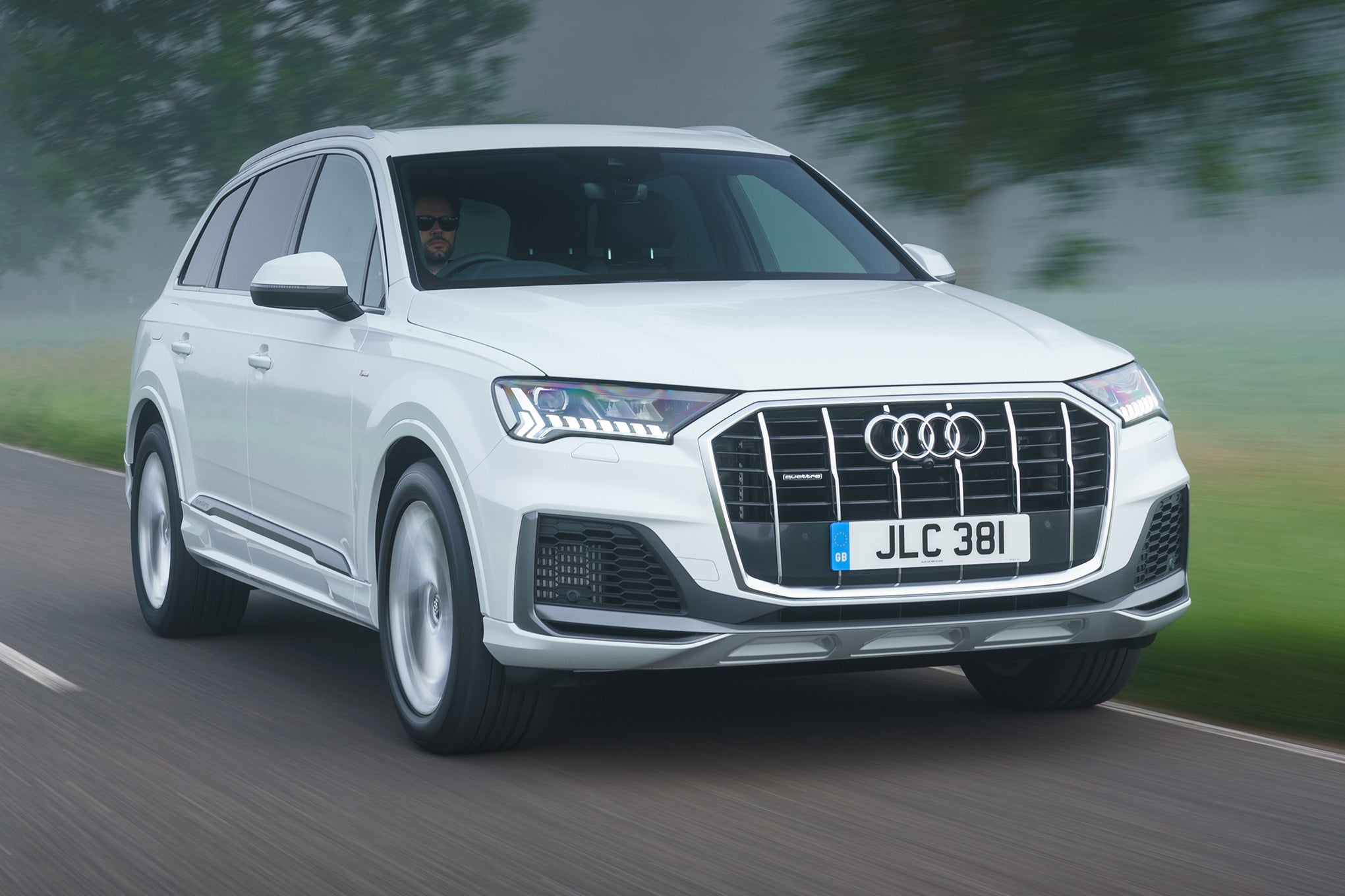
Audi Q7 Review

Written By Andrew Brady
- 2015
- SUV
- Petrol, diesel and plug-in hybrid
What we love
Comfortable and quiet on the road
Cabin is practical and great on quality
Lots of luxury equipment
Things to consider
Infotainment takes some familiarisation
Plug-in hybrid version only has five seats
Large dimensions can make urban driving tricky
The DRIVE take on the Audi Q7, is it the right car for you?
The Audi Q7 remains one of the most complete large family SUVs because it does so many things well. It is spacious, comfortable, quiet and genuinely practical, with the sort of cabin quality and long-distance refinement that still make it feel properly premium. It is not the freshest or most fashion-forward choice in this class, and the touchscreen-heavy interior is not as intuitive as it could be, but the Audi Q7’s breadth of ability is hard to argue with. If you need a luxury seven-seat SUV that works brilliantly for family life, it’s one of the safest choices.
The Audi Q7 in more detail
The Audi Q7 isn't a car that'll win favour with environmentalists. They'll look at its huge size and muscular design and think you don't care about climate change or, worse still, might be overcompensating for something. That's the main drawback out of the way, however, and certainly not one unique to the Q7. You see, there isn’t a single area in which Audi’s big seven-seater SUV doesn’t do a thoroughly brilliant job. That’s what makes it the best all-rounder in the class, and - even though it's getting on a bit - one of the best SUVs on sale. Our Audi Q7 review will tell you exactly why.
Key rivals for the Audi Q7 include its biggest competitor, the BMW X5. But there is also close competition in the form of the excellent Land Rover Discovery and Volvo XC90, plus the Mercedes-Benz GLE.
Browse used Audi Q7s for sale →
First and foremost, it’s a brilliant car for a big family. It’s among the roomiest cars of its type, with generous space surrounding each of its seven seats, and with so many different options over how much of the space is used for seating and how much is used for cargo, it’s also incredibly versatile. Those on board will also feel spoiled due to the impressive cabin quality and generous luxury kit.
Just as importantly, it’s an ideal family car in the way it drives. On all sorts of roads, the Audi Q7 stays comfortable and quiet, keeping life relaxed and peaceful on every journey.
And despite its impressive comfort, it’s still impressively agile in corners, keeping things safe and settled for passengers, and surprisingly entertaining for the driver. One quick caveat here: the best Audi Q7s ride on air suspension. This was standard on post-facelift cars of 2019 onwards, but optional before that. If you’re buying an earlier car, check it has air suspension fitted, because you definitely want it.
The engines, meanwhile, give an impressive blend of performance, economy and refinement, while lots of safety equipment and a five-star Euro NCAP rating means your family will be well looked after. Any complaints? Well the touchscreen infotainment system on post-facelift cars is a bit fiddly and distracting, and the automatic gearbox could be quicker to respond at times, but other than that, there’s very little to grumble about.
When this car was first launched back in 2015, some members of the motoring press criticised it for being dull, and lacking character. We disagree, but everyone’s entitled to their opinion. Besides, who needs character when it's absolutely brilliant at everything else?
What's the best Audi Q7 trim and engine option?
For most buyers, the best Audi Q7 is likely to be a diesel in S line or Black Edition trim. The diesel still suits the Audi Q7’s long-distance, heavy-duty family-SUV brief best, and S line is the stylish and well-specced baseline that comes with plenty of kit as standard. Black Edition adds more visual attitude if you want the darker look.
The plug-in hybrid is more niche. It’s quick, and an official electric range of up to 50 miles makes it more useful than older plug-in hybrids, but it only has five seats. That means it works well if you want a large luxury SUV and can charge at home, but it doesn’t make sense as the default family recommendation in the same way a seven-seat diesel does.
The performance SQ7 has lots of power and a sportier look, but costs serious money.
What’s the price of the Audi Q7?
The Audi Q7 ranges from £72,400 to £99,495, depending on engine and trim. The plug-in hybrid Q7 TFSI e starts at £78,855. There are also plenty of used Audi Q7s for sale for considerably less.
That's serious money, but the Audi Q7 isn’t trying to be a value-led seven-seater. The argument for it is that it feels expensive in the right ways, has the engineering depth to back up the badge and remains one of the most complete luxury SUVs if you genuinely need the space. Still, the upper trims and higher-powered versions push the numbers into territory where a buyer should be very clear about what they are paying extra for.
Alternatives to the Audi Q7
The clearest rivals are the BMW X5, the Volvo XC90, the Land Rover Discovery and Mercedes-Benz GLE. The BMW is the one to consider if you want a slightly sharper, more driver-focused luxury SUV, while the Volvo XC90 makes a stronger case if you prefer understated design and a calmer image. The Land Rover Discovery remains the more overtly practical and rugged-feeling alternative, especially if you regularly use all seven seats.
The Audi Q7 makes most sense as the polished all-rounder. It is not the most fashion-forward choice in the class, and it is not as utilitarian as the Discovery, but it blends cabin quality, comfort, seven-seat versatility and long-distance refinement more neatly than most alternatives. That balance remains its biggest strength.
What's the interior like in the Audi Q7?
The Audi Q7’s cabin quality is one of its biggest selling points. It feels properly solid, expensive and spacious, and even though the dashboard has changed significantly over this generation’s life, the underlying sense of quality has remained strong. What version you buy matters, though, because the pre- and post-2019 interiors are very different in layout.
Audi Q7 boot space and practicality
Even in the context of large, luxurious seven-seat SUVs, the Audi Q7 is about as good as it gets in practicality terms. Perhaps that's no surprise given the sheer size of the thing.
Inside the Audi Q7 there's loads of space up front, obviously, and the three individual chairs in the middle row are very generous on both headroom and legroom, so tall adults will fit comfortably. There’s enough shoulder space to sit three adults across the rear bench, too, and the middle seat is almost as wide as those either side, but whoever’s in the middle will have to sit with their legs splayed either side of a bulky transmission tunnel.
Each one of the middle-row chairs slides and reclines independently, and the outer ones tip and tumble far enough out of the way to allow pretty easy access to the third row. The space surrounding these rearmost seats is among the most generous in the class: not quite as much as in a Land Rover Discovery or a BMW X7, but it easily has the beating of a BMW X5 or Mercedes GLE. Adults of a reasonable size will fit, but those much over six foot will probably want to bagsy one of the chairs further forwards on long journeys.
With seven seats in place, there’s more boot space in the back of an Audi Q7 than in many rivals at 295 litres, which is enough for a few large shopping bags. The rearmost chairs drop flush into the floor to give you a massive 780-litre boot in regular five-seat mode, enough for pushchairs, kids’ bikes, or anything else a family could think to carry. The middle row also drops flat into the floor, leaving you with an extended load-bay that’s level and true, not to mention massive.
The Audi Q7 is a bit more useful with all seats in place compared to a Volvo XC90, which offers between 244 to 247 litres in seven-seat form. The Land Rover Discovery is still the more luggage-led option if outright carrying capacity is your priority, but the Audi Q7 remains one of the most practical luxury SUVs in this class. Elsewhere and a Mercedes-Benz GLE offers 630 litres in standard five-seat form, while a BMW X5 offers 500 litres.
The plug-in hybrid is the important exception. The Audi Q7 TFSI e only has five seats, and its 563-litre boot is usefully large, but it loses one of the standard Audi Q7’s biggest advantages in the process. If you need seven seats regularly, or want the most versatile version of the Audi Q7, the plug-in hybrid isn’t the one to choose.
Audi Q7 dimensions
The Audi Q7 is 5,072mm long, 2,212mm wide and 1,734mm high. That makes it a genuinely large SUV, which pays off in cabin space and seven-seat usability, but also means it needs a bit more care in tighter town streets and car parks than a smaller family SUV. The Audi Q7 disguises its size well on the move, but it is still a substantial car.
Tech and infotainment in the Audi Q7
The current Audi Q7 uses Audi’s dual-screen MMI Touch Response infotainment setup rather than the older pop-up display and button-heavy dashboard fitted to pre-facelift cars. In today’s Q7, the main system centres on a 10.1-inch upper touchscreen with MMI Navigation Plus, while a second lower touchscreen handles climate and shortcut functions. The driver also gets Audi Virtual Cockpit as standard, so the Q7 feels properly modern from behind the wheel even if the overall design is no longer brand new.
On paper, the setup is strong. Audi’s MMI Navigation Plus system is standard, Audi Connect services are available for live updates, and smartphone integration is built in through Audi’s smartphone interface. Higher-spec versions and option packs can also add a head-up display and Bang and Olufsen audio, which are the sort of upgrades that make sense in a luxury SUV designed for long family trips.
The main criticism is still usability. The screens look smart and the system has plenty of functionality, but the lower display is not as easy to use on the move as proper physical ventilation controls would be. That means the current Audi Q7 feels more contemporary and more impressive in the showroom than earlier versions, but not necessarily more intuitive in everyday driving. The good news is that the graphics are clear and the core navigation and media functions are easy enough to understand once you have spent a little time with it.
Materials available on the Audi Q7
Material quality remains a clear Audi Q7 strength. The cabin uses high-grade finishes and has the sort of fit and solidity buyers expect from a luxury Audi. Even several years into this generation’s life, it still feels like a premium interior rather than one that's simply expensive on paper.
Vorsprung trims push that feeling further with items such as Valcona leather, extra seat bolstering and heated outer rear seats, although you can’t order them from new any more with a brand-new model on the way in mid-2026. Overall, the range always feels well finished, but can be made increasingly plush depending on trim.
What's the Audi Q7 like to drive?
The Audi Q7’s core trick is that it feels both more comfortable and more agile than something this big probably should. It is quiet at speed, smooth over long distances and easy to settle into, which is exactly what you want from a large family SUV. Yet it also has much better body control than many rivals.
Audi Q7 range and performance
The Audi Q7 range has offered a mix of diesels, petrols and plug-in hybrid powertrains over time, and that spread remains one of the car’s strengths. The current Q7 TFSI e plug-in hybrid will give you 394PS, 600Nm and a 0-62mph time of 5.7 seconds, along with up to 50 miles of electric range. That gives the Audi Q7 genuine pace rather than merely acceptable plug-in hybrid performance.
The diesel engines remain the more natural fit for most buyers. There are two versions – one with 231PS that promises 0-62mph in 7.1 seconds, and a more powerful 286PS model that reduces that acceleration time to 6.1 seconds. That lines up with the Audi Q7’s character as a refined, torquey long-distance family SUV rather than a performance-first car. That said, there is also a 340PS TFSI petrol model that will hit 62mph in 5.6 seconds, but it’s expensive to buy and run, as is the performance-focused 507PS petrol-powered SQ7.
Performance data
| Model | Engine/battery size | Power | 0-62mph | Range/MPG |
|---|---|---|---|---|
Q7 TDI quattro 231PS | 3.0-litre | 231PS | 7.1 seconds | Up to 35.7mpg |
Q7 TDI quattro 286PS | 3.0-litre | 286PS | 6.1 seconds | Up to 35.6mpg |
Q7 TFSI quattro 340PS | 3.0-litre | 340PS | 5.6 seconds | Up to 27.6mpg |
Q7 TFSI e quattro 394PS | 3.0-litre | 394PS | 5.7 seconds | Up to 50 miles electric range |
SQ7 TFSI quattro | 4.0-litre | 507PS | 4.1 seconds | Up to 23.5mpg |
Audi Q7 driving and refinement
Ride quality is where the Audi Q7 really stands out, but with one important caveat: it’s at its best on air suspension. Earlier cars did not have it as standard, while later versions effectively made it central to the Audi Q7 experience. That means it’s worth being quite deliberate about suspension spec if you are looking at older examples.
On air suspension, the Audi Q7 is one of the most soothing cars in the class. It smooths out poor surfaces extremely well and keeps the cabin calm and settled. Yet it also corners with surprising control, which helps the Audi Q7 feel smaller and tidier than its dimensions suggest. That mix of comfort and composure is a big part of why it remains so impressive.
Black Edition and Vorsprung versions use a lower air-suspension setup, which trades a little plushness for a slightly firmer feel. Even so, the basic Audi Q7 character remains intact: refined, secure and far more agile than a huge luxury SUV really needs to be.
How safe is the Audi Q7?
The Audi Q7 has a maximum five-star rating from independent safety organisation Euro NCAP, although that was achieved back in 2019 and is now marked as expired. That’s normal for an older test, but it still reflects a strong safety showing for the facelifted Q7.
The Audi Q7 also benefits from a strong baseline of safety and driver-assistance kit, and its family-friendly design brief means this is a car clearly engineered with passenger comfort and security in mind. That aligns well with the way most buyers will actually use it.
Running costs: What it's like to live with a Audi Q7
Running costs are never going to be modest in a car of this size, but the Audi Q7 at least gives buyers some real choice. The diesels remain the sensible all-round option, while the plug-in hybrid can look attractive if you can charge at home.
Audi Q7 fuel economy
The older diesels were both quoted at up to 33mpg in earlier WLTP-era review data, which is respectable for a luxury seven-seat SUV of this size. The latest versions push that up to around 35mpg with the help of 48-volt mild-hybrid tech. The TFSI petrol model is much thirstier at around 27mpg and the SQ7 will drink fuel at a rate of knots with an official MPG of just 23.
The plug-in hybrid is the outlier. Official economy figures on plug-in hybrids can look spectacular, but the real benefit depends entirely on charging habits. In the Audi Q7 TFSI e’s case, the meaningful figure is not the headline mpg-style number but the up to 50 miles of electric range, because that's what will determine whether it is genuinely cheap to run for your usage.
Audi Q7 warranty and servicing
Audi’s UK new-car warranty is up to three years or 60,000 miles. For plug-in hybrids, battery cover matters too, and the Q7 TFSI e’s battery pack will be the key additional reassurance point for buyers considering the electrified version. Audi’s general warranty structure is standard rather than class-leading, but it is clear and established. You’ll need to service your Q7 every year or 10,000 miles.
Audi Q7 insurance groups
Insurance for a Q7 is expensive, which should not come as a surprise. Insurance groups range from 45 to 50 (of 50), which puts the car firmly in premium high-cost territory.
Large luxury SUVs can look manageable when judged only on finance offers or residual values. The Audi Q7 may hold its appeal well, but the ongoing costs still need to be budgeted for honestly.
How much does it cost to tax a Audi Q7?
For a car like the Audi Q7, the key issue is the Expensive Car Supplement rather than just the standard annual Vehicle Excise Duty rate. Every current Audi Q7 sits comfortably above the £40,000 Expensive Car Supplement threshold for petrol and diesel cars, and the plug-in hybrid is also priced high enough that tax should be treated as part of the broader ownership-cost picture rather than an afterthought. The exact first-year number will vary by CO2 and powertrain, but you’ll have to pay £640 a year for five years after that.
What trims are available with the Audi Q7?
The current Audi Q7 range starts with S line. That's unusual compared with some rivals, but it works because even the entry point already feels properly premium with 20-inch alloy wheels, leather upholstery, heated front seats, climate control and the triple-screen digital layout, plus useful driver-assistance kit including cruise control, lane departure warning and a 360-degree parking assistant.
Black Edition sits above that and brings a darker, more assertive look. It’s the style-led trim in the Q7 range, adding black exterior detailing and larger wheels. It is the version for buyers who want the Audi Q7 to look more imposing and more contemporary without going all the way to the most indulgent trim.
The Q7 TFSI e largely mirrors that trim logic, but with the important caveat that it is five-seat only. That makes the regular Audi Q7 range the one to focus on if comfort and family use matter more than outright performance.
Ask the Drive experts: common questions
Is the Audi Q7 a good luxury family SUV?
How many seats does the Audi Q7 have?
When was the current Audi Q7 launched?
Is the Audi Q7 comfortable?
What is the best Audi Q7 version?
Get our latest advice, news and offers
Keep me updated by email with the latest advice, news and offers from Drive.
.jpg)
.jpg)