16/07/2026
What is AdBlue and does your diesel car need it?

Written By Andrew Brady
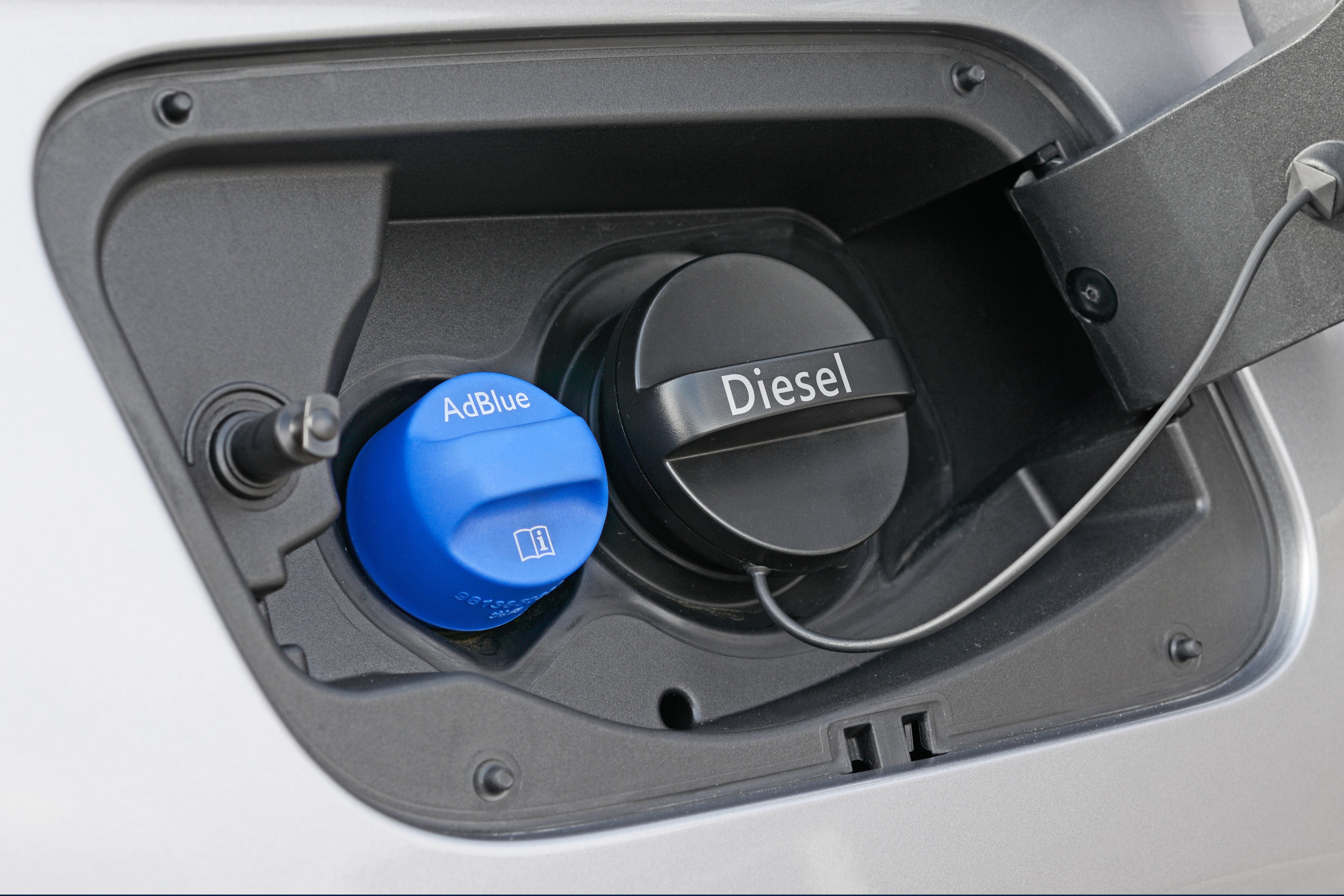
AdBlue is a fluid which is used in diesel cars' engines to help reduce the volume of harmful nitrogen oxide (NOx) gases emitted. It's one element of a process known as Selective Catalytic Reduction (SCR), during which the NOx undergoes a chemical change, exiting the exhaust pipe as nitrogen and water.
Strictly speaking, rather than a generic term, AdBlue is actually a brand name which has fallen into far more common use than Diesel Exhaust Fluid, or DEF for short. It's odourless and non-toxic liquid, consisting of two-thirds distilled water and one-third high-purity urea. And yes, urea is a synthetically produced organic compound which replicates the primary waste product in urine.
Stored in a separate tank from diesel, AdBlue is replenished via a specific filler neck that's typically located next to the one for fuel. You can't get the two confused as the AdBlue one has a bright blue cap and its opening is too small for the diesel nozzle to fit in it anyway. As the engine is running, precise doses of AdBlue are injected into the hot exhaust gases as they leave the engine. The amount of AdBlue used is tiny in relation to how much diesel fuel is burned during the engine's combustion cycle.
AdBlue's use became more widespread when tough Euro 6 emission standards came into force in September 2015, although several larger-capacity diesel engines already featured SCR technology before then. Euro 6 standards for diesels – and Euro 4 for petrol engines – are typically the minimum requirement for driving in UK cities operating Clean Air Zones (CAZ) and Low Emissions Zones (LEZ) without receiving a fine.
In this article you'll discover how effective AdBlue is, why we need it, which cars can use it and how to refill its tank.
What is AdBlue and why do we need it?
AdBlue is a fuel additive injected into the exhaust systems of modern diesel-engined cars. The introduction of Euro 6 emissions standards made Selective Catalytic Reduction (SCR) systems, which use AdBlue, a necessity for most diesels produced from September 2015, although many larger capacity engines were using it for years beforehand.
Euro 6 strictly limited NOx emissions levels due to those gases' link to worsening respiratory conditions. AdBlue is an effective method of neutralising NOx.
What is Selective Catalytic Reduction?
SCR is the name of the whole system involved in reducing NOx emissions, with AdBlue being one component in that process. When your diesel engine is running, tiny amounts of AdBlue are squirted into the exhaust gases while they're still very hot. That heat turns the urea in the AdBlue into ammonia.
As the exhaust gases pass through the car's catalytic converter, the metals within it – typically copper-zeolite, titanium or vanadium – cause the amonia to react with the NOx, changing up to 95% into nitrogen and water.
What is AdBlue made of?
AdBlue is made from just over two-thirds purified water and slightly less than one-third high-purity urea. It's purely synthetic, with a chemical compound that replicates the wate product of protein breakdown which also appears in urine.
Despite this, it's a myth that urine can be substituted for AdBlue if you happened to be caught short, so to speak. Aside from how unpleasant it would be, you'll likely also cause your car significant damage if you try to fill its AdBlue tank with your bladder's contents.
How much AdBlue will my car use?
AdBlue consumption varies from vehicle-to-vehicle and how it's driven, but a consumption rate of between 1 litre per 350 to 600 miles would be considered normal. The faster you drive, the more AdBlue you'll use.
AdBlue tanks also vary in size, but 10 litres is a typical capacity across a broad spectrum of diesel-engined cars. Some drivers may find that the AdBlue tank only needs topping up as part of their car's service schedule, but most will need to refill it more frequently than that.
Can I refill the AdBlue tank myself?
It depends entirely on your particular model of car as to whether you can refill the AdBlue tank yourself. Most cars have a second filler neck next to the diesel one behind the fuel flap, which is the most convenient location for it.
Other diesel cars have their AdBlue filling points located in more awkward positions, including under the bonnet, down near the bottom of the front passenger door or even below the carpet in the boot. You can still refill those tanks yourself, but their locations feel designed to discourage you from doing so.
Although AdBlue isn't toxic or flammable and doesn't have much of a smell either, it's still important to treat it with care. Avoid direct contact with the fluid on your skin, eyes and mouth, as well as washing your hands thoroughly after refilling the tank.
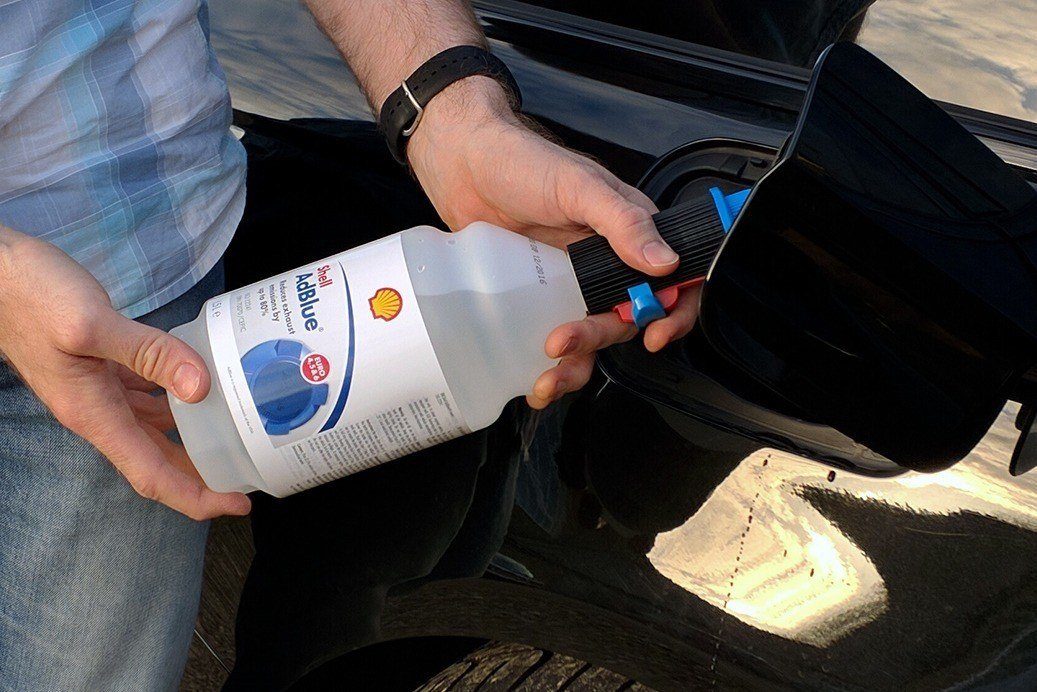
Take precautions to avoid spillages, such as using a funnel with a flexible spout if you're refilling the AdBlue tank from a large container. While it's not a corrosive liquid, it can stain surfaces it comes into contact with as water does, but as it dries it leaves a white, crystalised residue behind.
Where can I buy AdBlue?
You can buy AdBlue anywhere you’d buy other products for your car, such as windscreen washer fluid, including filling stations, motor factors including Halfords and larger supermarkets. You can expect to pay around £25-£30 for 10 litres.
Some filling stations also have dedicated AdBlue pumps, although they aren't a common sight. In fact, most of the time where they're present you will find them in the areas set aside for refuelling trucks. It would be prudent to check with the staff in the filling station shop first whether you're permitted to use the truck's AdBlue pump with a car.
Pumped AdBlue is usually cheaper than its bottled equivalent at £1.00-£1.50 per litre.
I have an AdBlue warning light, what should I do?
An AdBlue warning light can mean different things. Diesel cars with SCR systems will notify you each time you start the engine when the AdBlue tank is starting to run low. The longer you leave it before refilling, the more prominent the notifications will be, with amber visual warnings joined by audible ones.
Continue ignoring the warnings, which will also start appearing more frequently with a remaining mileage countdown, the symbol on your driver's display will eventually turn red. At that point your car will not allow its engine to be started until there's a sufficient amount of AdBlue in the tank.
Why won't a diesel start when there's no AdBlue?
In order to comply with Euro 6 emissions regulations, most diesel-engined cars require an SCR system which uses AdBlue to massively reduce harmful NOx output from the exhaust. Car manufacturers are therefore required to ensure that such cars comply with the regulations at all times. Running out of AdBlue means that they won't be operating at the legal emissions limit, which is why the cars are programmed to not start until the tank has been replenished.
If the AdBlue in the tank runs out while the car is already in use, the diesel engine will go into limp mode rather than cutting itself out immediately. Limp mode is where the engine's electronic control unit (ECU) reduces power and locks out higher gears in automatic transmissions, forcing you to drive along at low speeds until you can find somewhere safe to park.
When the car's AdBlue tank is empty and the engine's been turned off, it won't fire up at all until it's replenished.
It's also worth noting that, unlike the car's diesel tank, you can't just stick a couple of litres' worth of AdBlue in and get going again. Most systems will require a significant top-up of at least 50% before the engine will operate normally once more, so it's worth buying enough to fill the tank completely.
Can I store bottles of AdBlue in my garage or shed?
You can store larger bottles of AdBlue at home, but whether or not it's worthwhile stockpiling depends on how much of it you get through.
AdBlue degreads over time, usualy within 12 months, so if you are storing any ensure that you will actually use it before the expiry date shown on the bottle.
It also needs to be stored at temperatures of higher than -10C and lower than +30C. While AdBlue won't explode beyond those extremes, it does expand and potentially cause the bottle to rupture, leaving a mess over wherever it flows.
Which cars have SCR systems?
SCR systems were introduced so that diesel cars built from September 2015 could meet Euro 6 emissions standards. The vast majority manufacturered after that time have SCR systems, but several slightly older models also do.
While it's not a failsafe method of identifying such cars, many manufacturers initially advertised how low-emission their diesels were by adding the word 'blue' to their names. Some of the more commonly found models include Citroen's and Peugeot's BlueHDi, Hyundai's Blue Drive, Mercedes-Benz's BlueTEC and Volkswagen's BlueMotion. Few of those names are still in use today, even though the technology is.
A convenient way to check is to see if your diesel car is permitted to drive in English Clean Air Zones (CAZ) or Scottish Low Emission Zones (LEZ). If they are, then there's a greater likelihood that your car complies with Euro 6 regulations and uses an SCR system.
No, the brand or manufacturer doesn't matter as AdBlue has to be produced to various internationally recognised standards.
Make sure you buy the correct AdBlue standard for checking the label ensures it complies with ISO 22241 – including ISO-22241-1, ISO-22241-2 and ISO-22241-3.
These standards ensure that the AdBlue won't damage the catalytic converter in your car’s exhaust – an expensive component to replace.
AdBlue is very effective at reducing NOx, typically by up to 95% compared with diesel engines without SCR systems.
A study conducted by Leeds University in 2017 found that a Volkswagen Polo with a 1.4-litre diesel engine and no SCR system produced more NOx than a 13-litre diesel lorry with one fitted.
AdBlue doesn’t increase performance, in fact, running out of AdBlue could have the opposite effect, limiting the amount of performance available before stopping the car from working altogether.