Citroen e-C4 Review

Written By Matt Robinson
- 2021
- Family hatch
- Electric
What we love
Exceptionally comfortable ride
Distinctive hatchback and SUV styling
Competitive pricing and useful equipment
Things to consider
Not the most polished of interiors
It's not fast nor particularly fun to drive
Newer rivals travel further
The DRIVE take on the Citroen C4, is it the right car for you?
The Citroen e-C4 is a quiet, comfortable and competitively priced electric family car. Its soft suspension and supportive seats make it particularly relaxing around town and on longer journeys.
The 50kWh Standard Range version is the more affordable choice, but its 219-mile range is modest. The 54kWh Extended Range model is easier to recommend as a main family car, with up to 258 miles and slightly stronger performance. It is not as spacious or as technologically advanced as the best newer EVs, but buyers who prioritise comfort, distinctive styling and value should find plenty to like.
The Citroen C4 in more detail
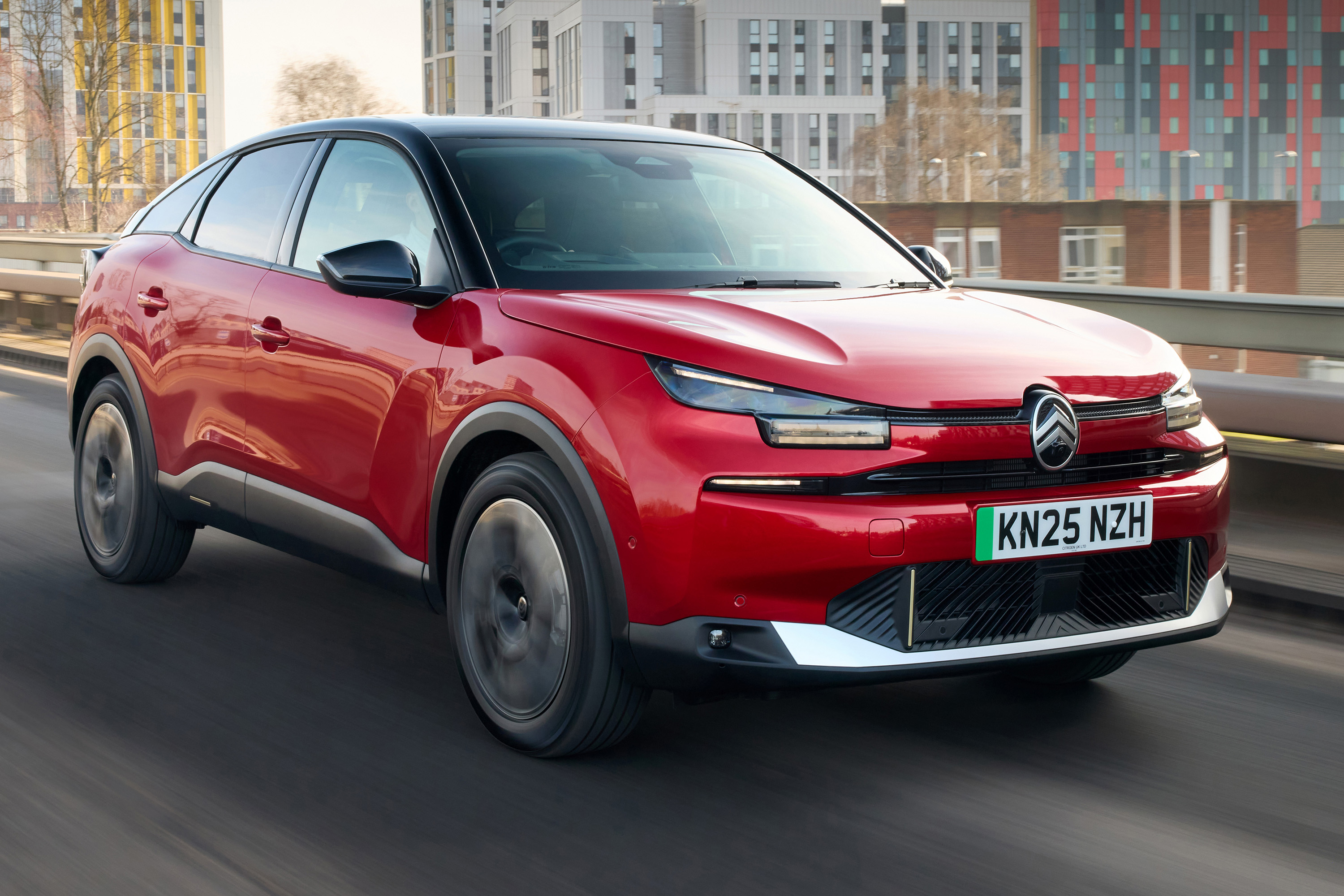
The Citroen e-C4 occupies an unusual position in the electric-car market. It combines the basic proportions of a family hatchback with a raised ride height, black lower-body protection and a sloping coupe-style roof.
Citroen describes it as a hatchback, although its styling borrows heavily from SUVs and crossovers. That makes direct comparisons difficult, but also helps the e-C4 stand out from more conventional alternatives such as the Volkswagen ID.3, MG4 and Vauxhall Astra Electric.
Citroen has a long history of producing cars that do not fit neatly into established categories, so the e-C4’s unconventional shape feels appropriate. It looks lower and sleeker than a family SUV, but taller and more substantial than a traditional hatchback.
A substantial update introduced revised front-end styling, Citroen’s latest badge and a new lighting signature. The changes are particularly noticeable from the front, while the side profile and unusual split rear spoiler remain familiar.
The facelift also brought an updated version of Citroen’s Advanced Comfort seats, with an additional 15mm of foam padding. Combined with the brand’s Progressive Hydraulic Cushion suspension, this reinforces the e-C4’s focus on ride comfort rather than sporting handling.
That approach gives the Citroen a clear personality. Many electric cars use firm suspension to control the weight of their batteries or create an impression of sportiness. The e-C4 takes the opposite route, prioritising isolation from bumps and broken road surfaces.
Two battery and motor combinations are available. The Standard Range model uses a 50kWh battery and a 136PS motor, while the Extended Range version combines a 54kWh battery with a more efficient 156PS motor.
Citroen quotes an official range of up to 219 miles for the Standard Range version and 258 miles for the Extended Range car.
Those figures are better than the earliest e-C4 models achieved, but remain modest beside newer electric family cars. A Volkswagen ID.3, Kia EV3 or long-range MG4 can travel significantly further in the right specification.
The Citroen responds with competitive pricing. Before the current Electric Car Grant, the e-C4 starts at £28,715. That brings it closer to several smaller electric cars and makes it one of the more affordable EVs with enough cabin and boot space for family use.
The e-C4 shares its body and interior with petrol and hybrid versions of the Citroen C4. Unlike the Volkswagen ID.3 or MG4, it was not designed exclusively as an electric car.
That creates some packaging compromises. Rear passenger space is reasonable rather than outstanding, and there is no storage compartment beneath the bonnet. The electric components do not reduce boot capacity, however, so the e-C4 retains the same 380-litre load area as the other C4 models.
There is also an e-C4 X. It uses the same basic platform, batteries and motors, but has a longer saloon-style body and a separate boot lid. This review focuses on the five-door e-C4 hatchback.
What's the best Citroen C4 trim and battery option?
The 54kWh Extended Range model is the strongest all-round choice.
Its 156PS motor is more powerful than the 136PS unit fitted to the Standard Range version, reducing the 0-62mph time from 10.0 to 9.2 seconds. Neither version is fast by electric-car standards, but the additional response makes the larger-battery car more relaxed when joining a motorway or overtaking.
The more important advantage is range. The 54kWh version can officially cover up to 258 miles, compared with 219 miles for the 50kWh model.
That additional 39 miles gives the Extended Range e-C4 more flexibility on longer trips and reduces the likelihood of needing to charge during an ordinary week. It may also make the car easier to sell later.
Both versions accept up to 100kW from a suitable DC rapid charger, so the larger battery does not bring a charging-speed advantage. Citroen quotes less than 30 minutes for a 20 to 80 per cent rapid charge.
The Standard Range model still makes sense for buyers who mainly cover short journeys and can charge at home. Its lower price is appealing, and a 219-mile official range should comfortably cover several days of typical commuting.
Citroen’s current UK range pairs Plus trim with the Standard Range powertrain and Collection with the Extended Range version.
Plus includes most of the equipment buyers are likely to need, including 18-inch alloy wheels, dual-zone climate control, rear parking sensors, a reversing camera, smartphone connectivity and Citroen’s Advanced Comfort suspension and seats.
Collection adds distinctive exterior and interior details alongside the larger battery and motor. The mechanical upgrade is more significant than the cosmetic changes and is the main reason to choose it.
What’s the price of the Citroen C4?
The Citroen e-C4 Plus Standard Range has an official price of £28,715 before the Electric Car Grant.
The current £1,500 grant reduces the advertised customer price to £27,215.
The Collection Extended Range costs £32,495 before the grant, falling to £30,995 once the deduction is applied.
Those prices are substantially lower than the e-C4 cost earlier in its life. Citroen reduced the model’s price as competition increased and more affordable electric cars entered the UK market.
Alternatives to the Citroen C4
The MG4 is one of the e-C4’s strongest rivals. It is competitively priced, more enjoyable to drive and available with batteries offering a much longer range. The Citroen counters with a softer ride, more supportive seats and a calmer character.
The Volkswagen ID.3 has a roomier cabin despite being shorter on the outside. Its dedicated electric platform provides better rear passenger space, while its larger-battery versions travel further. The e-C4 is generally less expensive and rides more comfortably.
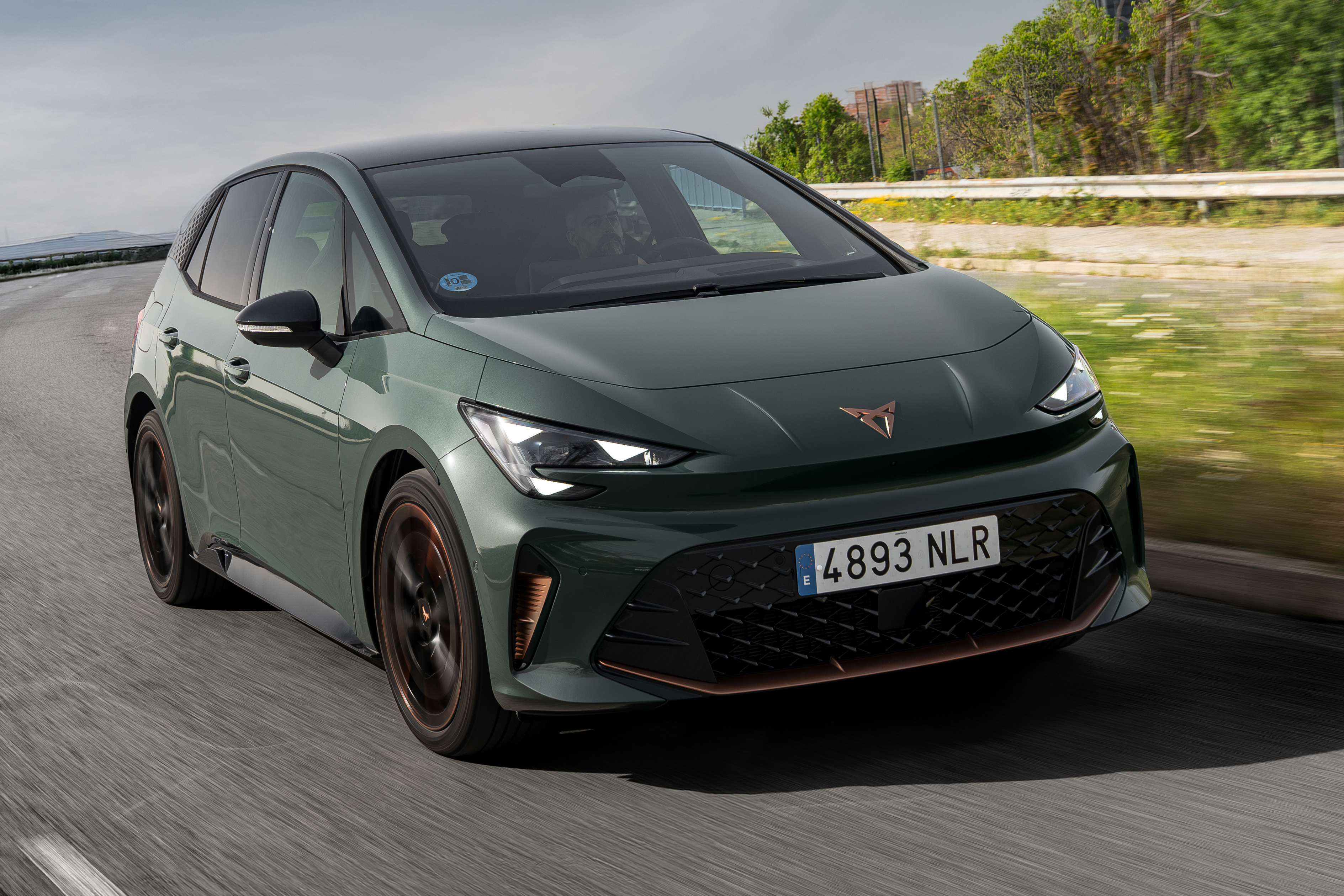
The Cupra Born shares much of the ID.3’s engineering but has sharper styling and firmer, more engaging handling. It will appeal to drivers who find the Citroen too relaxed, although it is usually more expensive.
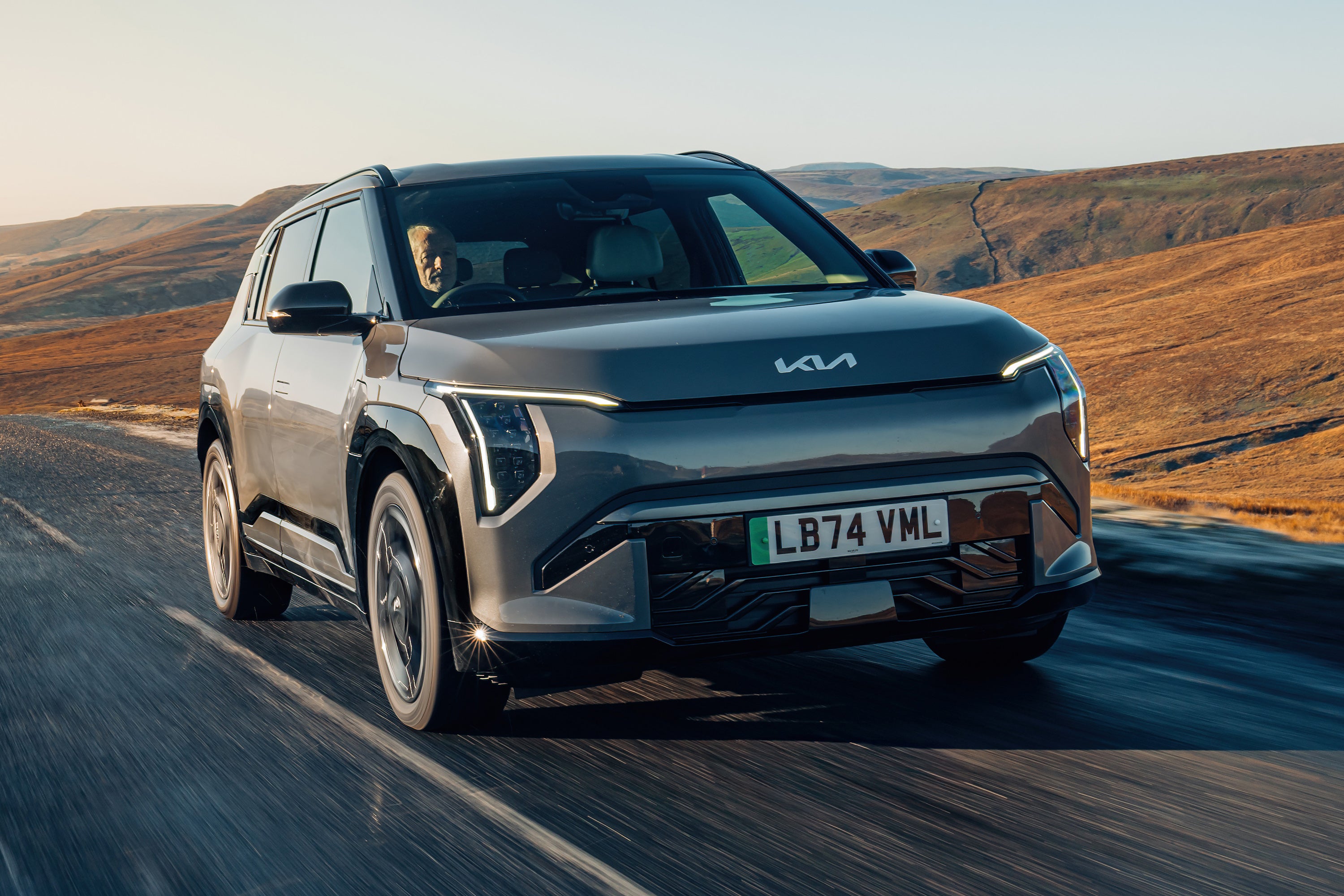
The Kia EV3 is a newer and more sophisticated alternative. It offers a much longer maximum range, a more modern interior and an efficient use of space, although its design is more overtly SUV-like.
The Vauxhall Astra Electric and Peugeot E-308 share much of the Citroen’s electrical hardware. Both feel more conventional, while the Peugeot has a richer cabin and sharper handling. Neither rides as softly as the e-C4.
What's the interior like in the Citroen C4?
The Citroen e-C4 has a comfortable and sensibly arranged cabin. It feels solidly assembled and provides enough room for family use, although newer Citroen models have more imaginative interiors.
Citroen C4 boot space and practicality
There’s as much space in the Citroen e-C4 as you’ll find in the vast majority of other family hatchbacks. In practice that means a generous amount of room in the front seats, allowing anyone to get comfortable — whatever size they are.
In the back there’s enough space for a couple of adults to sit reasonably comfortably, though the car’s steeply sloping roofline does impinge on headroom. It’s unlikely that even rapidly growing kids will feel cramped in the back, and they can enjoy a decent view out.
The boot has a capacity of 380 litres, which is exactly the same as the current Volkswagen Golf — as well as combustion-engined Citroen C4 models, for that matter. The boot floor is height-adjustable and you’ll lively leave it at the higher level so you can store the charging cables underneath.
Fold the back seats down and there is 1250 litres of space. Just bear in mind that the sloping roofline does limit the height of objects you can load inside.
There are clever storage spaces dotted around the interior including a large cubby hole under the front centre armrest and a drawer that pulls out from the passenger-side dashboard. There’s also a mounting bracket for a tablet computer on the dashboard.
Citroen C4 dimensions
The Citroen e-C4 measures 4,355mm long, 1,800mm wide and 1,520mm high.
Its wheelbase is 2,670mm, while overall width increases to 2,032mm when the door mirrors are included.
That makes it longer than a Volkswagen ID.3 or MG4 but lower than most compact electric SUVs. Its shape sits somewhere between the two categories.
The e-C4 is manageable in town, with light steering and a relatively tight 10.9-metre turning circle. Its raised driving position also gives the driver a useful view forwards.
Rear visibility is less impressive because of the sloping roof and small rear glass. Parking sensors and the reversing camera reduce the problem.
Tech and infotainment in the Citroen C4
Every Citroen e-C4 has an infotainment system with a 10.0-inch touchscreen display that stands proud of the dashboard. Features of the system include DAB radio, Bluetooth and — on all by You-grade models — integral navigation. It’s not the slickest setup with a screen that’s a bit laggy in its responses and blocky graphics.
You can improve matters to some extent by connecting your phone to use Apple CarPlay or Android Auto. Since the 2025 facelift there's also ChatGPT functionality so you can ask the car various questions. We ended up triggering it accidentally causing an annoying graphic to appear that blocked nav instructions before eventually disappearing.
There's a 7.0-inch digital driver’s display that's complemeted by a useful head-up display projected onto the windscreen at eye-level on Plus and Max trims. It's not especially sharp in terms of graphics but its useful to have all the same. You version do without the HUD and the display screen is only 5.0 inches.
Materials available on the Citroen C4
The quality of Citroen’s interiors used to leave a lot to be desired but the company has upped its game massively in recent years, and this shows in the e-C4. Its interior design isn’t as bright and bold as in some others in the range but it’s easy to use and feels solidly put together.
Everything you touch most often is made from pleasant-feeling materials, although there are some harder, colder plastics used lower down. There's also a large amount of glossy finishes which have more fingerprints than a Scene of Crime Officer's hard drive.
The seats look and feel good and are hugely comfortable. Top-of-the-range models have seats upholstered in Alcantara and leatherette which feel suitably plush.
What's the Citroen C4 like to drive?
The e-C4 is one of the most comfortable electric cars at its price. It is quiet, easy to drive and reassuringly predictable, although it offers little excitement and leans noticeably in faster bends.
Citroen C4 range and performance
All Citroen e-C4s have front-mounted electric motor, a single-speed automatic transmission and an electronically capped top speed of 93mph.
The Citroen e-C4 was initially introduced only with a single 136PS electric motor. Performance is leisurely, if we're being kind, evidenced by a 0-62mph time of 10.0 seconds. While sedate for an electric car it helps ensure that not too much battery energy is wasted with neck-wrecking bursts of acceleration.
Versions with the bigger 54kWh battery pack also gain a more powerful 156PS motor, although the 260Nm of torque it produces is identical to the lower-powered version. The boost in power doesn't translate into terrifically feistier acceleration, only shaving the 0-62mph sprint down to 9.2 seconds.
Performance data
| Model | Engine/battery size | Power | 0-62mph | Range/MPG |
|---|---|---|---|---|
e-C4 Standard Range | 50kWh battery, automatic, front-wheel drive | 136PS | 10.0 seconds | Up to 219 miles |
e-C4 Extended Range | 54kWh battery, automatic, front-wheel drive | 156PS | 9.2 seconds | Up to 258 miles |
Citroen C4 driving and refinement
The Citroen e-C4 driving experience is geared towards comfort above everything else. It has what Citroen calls Advanced Comfort Suspension which soaks up even the very worst potholes, lumps and speed humps. Very little wind and road noise gets through to the interior, either. The result is a car that’s serenely relaxing to travel in.
From behind the wheel, the Citroen e-C4 feels nice and light, if not quite as nimble as the Cupra Born. It leans over noticeably when going around corners at higher speeds. Overall, the e-C4 feels perfectly safe and secure, it just encourages you to drive at a more relaxed pace and enjoy the super-soft ride.
One demerit to note is the sub-par rearward visibility, a result of the steeply sloping roofline and relatively small back window. This can make manoeuvring tricky but there are parking sensors to help you out.
Refinement is strong. The electric motor is almost silent and very little vibration reaches the cabin.
Wind and tyre noise are well controlled at moderate speeds. Some road noise becomes noticeable on coarse motorway surfaces, but the e-C4 remains a calm car in which to cover distance.
Regenerative braking is available through the transmission’s Brake mode. It increases deceleration when the accelerator is released, although it does not provide the strong one-pedal driving available in some rivals.
The brake pedal feels reasonably natural during ordinary use, with a smooth transition between energy recovery and the conventional brakes.
How safe is the Citroen C4?
Euro NCAP awarded the Citroen C4 and e-C4 four stars in 2021.
The e-C4 scored 80 per cent for adult-occupant protection, 83 per cent for child-occupant protection, 57 per cent for vulnerable-road-user protection and 63 per cent for safety assistance.
Protection of occupants was generally good or adequate in the main frontal tests. The e-C4 also scored maximum points in the side-barrier and side-pole assessments.
The four-star result reflected weaker performance in the safety-assistance and vulnerable-road-user categories rather than a fundamental problem with the passenger compartment.
Euro NCAP testing standards have become tougher since 2021, so the result cannot be compared directly with the rating of a car assessed under the latest protocols.
Standard equipment includes autonomous emergency braking, lane-departure warning, lane-keeping assistance, speed-limit recognition and driver-attention monitoring.
Parking sensors are also included, while higher trims add a reversing camera and further parking assistance.
The e-C4 does not have the newest or most comprehensive assistance package in the class. Drivers prioritising the latest collision-avoidance technology may prefer a more recently tested rival.
Running costs: What it's like to live with a Citroen C4
The e-C4 should be inexpensive to service and affordable to charge at home. Its modest range and charging speed make it less suitable for drivers who regularly cover very long distances.
Citroen C4 charging times and costs
Both versions can accept up to 100kW from a compatible DC rapid charger.
Citroen quotes less than 30 minutes to charge from 20 to 80 per cent under suitable conditions. The precise time will depend on battery temperature, charger output and how many vehicles are sharing the site.
A 100kW maximum is modest beside newer electric cars. Some rivals can accept 150kW or more, although a larger peak figure does not always result in a dramatically shorter stop.
The e-C4’s relatively small batteries help keep charging times manageable despite the lower maximum rate.
A 7.4kW home wallbox takes approximately seven hours and 30 minutes to charge the battery. The larger pack contains only 4kWh more energy, so the difference between the two versions is limited.
An optional 11kW three-phase onboard charger may reduce AC charging time when connected to a suitable workplace or public unit. Most UK homes cannot provide 11kW without a three-phase supply.
Using a domestic three-pin socket takes more than 24 hours and is best treated as an occasional backup rather than the main charging method.
Official efficiency is approximately 3.7 to 4.4 miles per kWh, depending on battery, trim and conditions.
Charging at home on an overnight tariff should make the e-C4 inexpensive to run. Public rapid chargers can cost substantially more per unit of energy and may narrow the cost advantage over an efficient petrol or hybrid car.
Citroen C4 warranty and servicing
The e-C4 has Citroen’s standard three-year vehicle warranty.
Mileage is unlimited during the first two years, with a 60,000-mile limit applying in the third year under the standard UK terms.
The high-voltage battery has separate cover for eight years or 100,000 miles. Citroen guarantees at least 70 per cent of its original usable capacity during that period, subject to the warranty conditions.
Cars ordered new in the UK from 1 June 2025 are also eligible for Citroen We Care. This combines the three-year standard warranty with up to five further years of service-activated cover. Protection is renewed when the car is serviced within the participating Citroen network according to the required schedule.
Cover can continue until the car reaches eight years old or 100,000 miles, whichever comes first.
This is not an unconditional eight-year warranty, because owners must continue meeting the servicing requirements within the participating authorised network.
The e-C4’s routine maintenance interval is every two years or 16,000 miles. Electric cars have fewer service items than combustion-engined models, but still require checks of the brakes, suspension, tyres and battery cooling systems.
Citroen C4 insurance groups
The Citroen e-C4 falls into insurance groups 22 to 23. That is reasonable for an electric family car, although it may still cost more to insure than a similarly priced petrol hatchback.
How much does it cost to tax a Citroen C4?
From the second year, the standard annual rate is £200.
Electric cars costing over the £50,000 threshold for the Expensive Car Supplement are in line for an additional £440 bill from year two to six. Every current e-C4 is well below that figure, so no version attracts the additional charge.
The Electric Car Grant and any retailer discount do not affect the tax calculation. The vehicle’s official list price before discounts is used.
What trims are available with the Citroen C4?
The current factory-order range centres on Plus and Collection specifications.
Plus is paired with the 50kWh Standard Range powertrain. It includes 18-inch alloy wheels, Citroen Advanced Comfort Suspension, Advanced Comfort seats, automatic LED headlights, rain-sensing wipers, rear parking sensors and a reversing camera. Inside, it has dual-zone climate control, the 10-inch infotainment touchscreen, digital instruments, Apple CarPlay and Android Auto, DAB radio and a head-up display.
Collection is paired with the 54kWh Extended Range powertrain. It adds distinctive exterior and interior detailing while retaining the e-C4’s main comfort and technology features. The larger battery and 156PS motor are the most significant differences.
Ask the Drive experts: common questions
How big is the Citroen e-C4 boot?
Can the Citroen e-C4 tow?
Is the Citroen e-C4 an SUV?
Get our latest advice, news and offers
Keep me updated by email with the latest advice, news and offers from Drive.
.jpg)
.jpg)