Volkswagen ID.7 Review

Written By Richard Aucock
- 2023
- Hatchback
- Electric
What we love
Exceptionally refined and grown-up to drive
Spacious interior and very useful hatchback boot
Much improved infotainment system
Things to consider
Its size is worth considering for urban use
Larger wheels can affect ride comfort
Narrow choice of trim and powertrain options
The DRIVE take on the Volkswagen Id7, is it the right car for you?
The ID.7 is one of Volkswagen’s most convincing electric cars. It is roomy, refined and very easy to live with, and it has the sort of maturity that should appeal to would-be EV drivers stepping out of a Passat or Arteon. The price is on the high side, and the cabin is too reliant on touchscreen controls, but if your priorities are comfort, ease and decent electric range, then the Volkswagen ID.7 is a very impressive all-rounder.
The Volkswagen Id7 in more detail
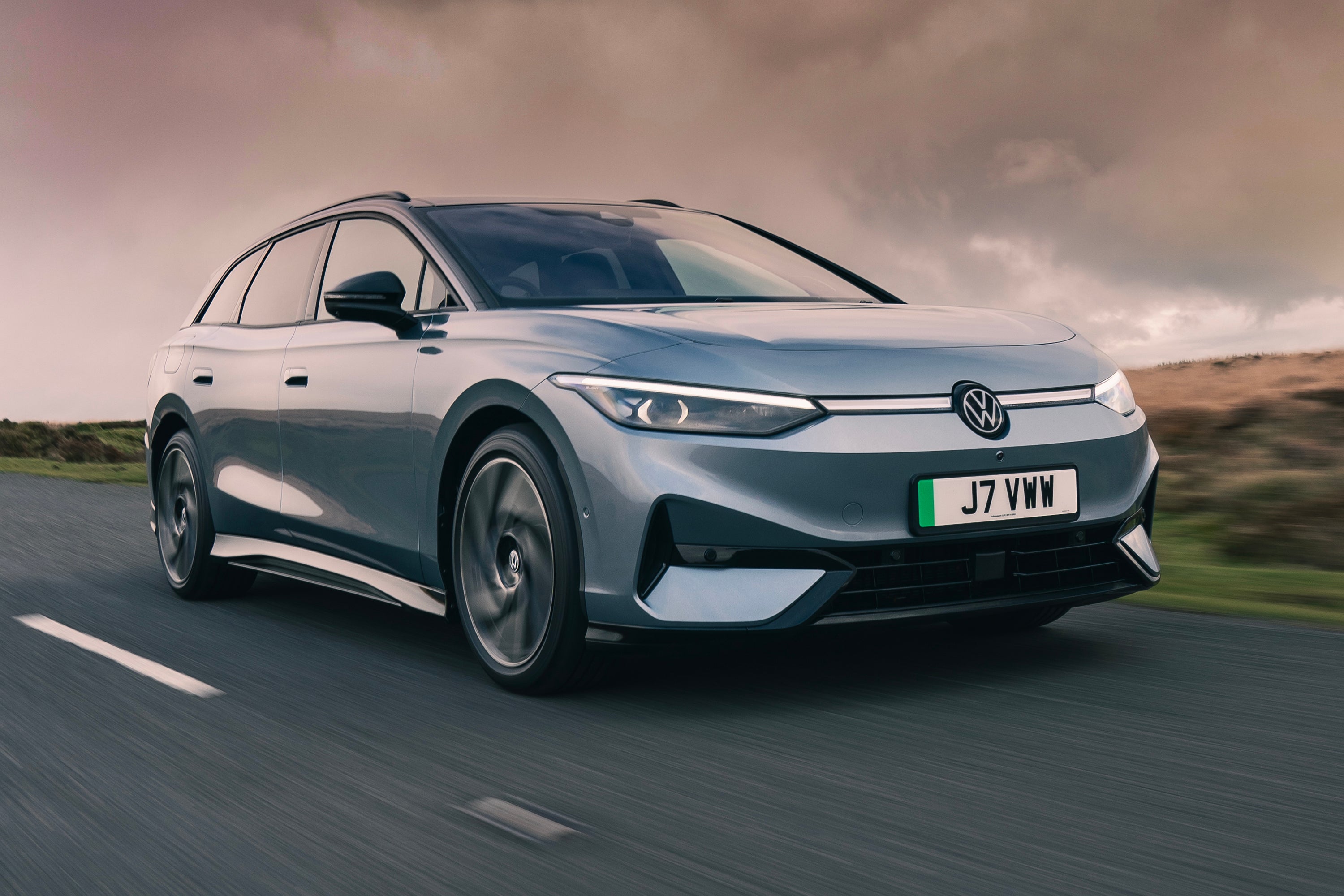
The Volkswagen ID.7 is the biggest hatchback in Volkswagen’s electric line-up, and for many buyers, it will be the closest thing yet to an electric Passat. That means it needs to be more than merely efficient and competent. It has to feel spacious, high-tech and sophisticated.
Happily, it does. In fact, the Volkswagen ID.7 feels like one of Volkswagen’s most convincing electric cars. Some earlier ID models had something slightly unfinished about them, whether that was the infotainment, the cabin quality, or the overall sense of polish. The ID.7 feels much more complete. It is quiet, comfortable, and easy to get along with, and there is a maturity to the way it drives that lifts it beyond many mainstream electric rivals.
There is a lot of substance beneath that sleek fastback shape. At nearly five metres long, the ID.7 is a big car, and it uses that size well. Interior space is excellent, particularly where rear legroom is concerned and the hatchback tailgate makes it more practical than some of its saloon-like rivals.
The current UK line-up centres on Pro Match Plus and Pro S Match Plus versions. There’s also a more powerful four-wheel-drive version in the form of the Volkswagen ID.7 GTX, but we’ve covered that version in a separate review.
For the main range, the key choice is between the standard 77kWh battery and the larger 86kWh pack in the Pro S. Official WLTP range runs from 368- to 433 miles, which is enough to put the ID.7 among the more convincing long-distance EVs in its class.
That long-range ability is central to the car’s appeal. This is not an electric car that feels suited only to short commutes or predictable urban use. The ID.7 feels built for motorway mileage and regular longer trips, and it backs that up with the kind of refinement and ride comfort that make long distances feel easy.
The cabin also marks a step forward. Volkswagen has improved the infotainment system significantly over those of earlier ID models, and although it still relies too heavily on the central touchscreen and touch-sensitive controls rather than proper buttons and switches, it is more logical and less frustrating than some of VW’s other systems. Cabin quality is stronger than in earlier ID models as well, with better materials and a more carefully finished feel.
The biggest challenge for would-be Volkswagen ID.7 drivers is value. It’s really not cheap, and key rivals such as the Tesla Model 3, Hyundai Ioniq 6 and BYD Seal all undercut it. The BMW i4 is closer on price and badge appeal, but it gives away some rear space and practicality. So, the ID.7’s appeal is less about value and more about the sense of polish it delivers.
What's the best Volkswagen Id7 trim and battery option?
For most buyers, the Volkswagen ID.7 Pro Match Plus will be the best option. It has the smaller 77kWh battery, 286PS and the full measure of the ID.7’s strengths, which means practicality, class, easy performance and a generous amount of standard equipment. It delivers up to 379 miles of official range, which should be more than enough for most drivers without pushing the price even deeper into premium territory.
The Pro S Match Plus will be worth the extra cash (about £3,500 or so) if maximum range is your main priority. Its 86kWh battery raises the official figure to 433 miles, which is a genuinely impressive number and one that will matter if you regularly cover big distances. The trade-off is that higher purchase price for a car that otherwise feels very similar.
If you are interested in the quicker four-wheel-drive version, head to our Volkswagen ID.7 GTX review. In the main range, though, the Pro Match Plus is the version that best balances price, range and overall capability.
What’s the price of the Volkswagen Id7?
The mainstream Volkswagen ID.7 range currently starts at £51,445 for the Pro Match Plus and rises to £54,930 for the Pro S Match Plus. The GTX Plus is even pricier at £59,640, but we’ve covered that in a separate review.
Those prices put the ID.7 firmly into territory where buyers will be expecting a lot for their money. And in fairness, the Volkswagen ID.7 does feel expensive. It is roomy, classy inside, very refined and well equipped, and it has the sort of long-range ability that should make it easy to justify to drivers covering big mileages.
The challenge is that several key rivals are cheaper. A Tesla Model 3, BYD Seal or Hyundai Ioniq 6 will all undercut it, while the BMW i4 is close enough that your decision will probably be a case of brand appeal versus practicality.
Alternatives to the Volkswagen Id7
The Tesla Model 3 is the most obvious alternative. It is cheaper, fast, efficient and still leads on charging convenience thanks to the Supercharger network. The downside is that it is not as relaxing or as polished in the way it goes about its business, and the Volkswagen ID.7 feels more grown up on a long journey.
The BMW i4 is another key rival. It offers more badge appeal and a more engaging rear-wheel-drive feel, while still appealing strongly to company-car users. The drawback is that it is not quite as roomy or as practical - especially in the back - as the ID.7.
The BYD Seal and Hyundai Ioniq 6 are worth serious attention, too. Both are well equipped, both look like good value next to the Volkswagen, and both have very decent official range figures. The BYD in particular feels like a genuine rival on price and equipment, while the Hyundai brings a more distinctive design.
If you want something more conventional within Volkswagen showrooms, the Passat plug-in hybrid remains an obvious stepping stone. If you want more load space from a closely related EV, there is also the ID.7 Tourer, which we’ve covered in a separate review.
What's the interior like in the Volkswagen Id7?
The Volkswagen ID.7 has a smart, airy cabin that feels like a clear step on from earlier ID models. It is roomy, tactile enough and much more polished than the first wave of Volkswagen EV interiors, even if the over-reliance on touch controls is still not ideal.
Volkswagen Id7 boot space and practicality
The Volkswagen ID.7 is a large car, and you feel that in a good way from the moment you get inside. The front seats are mounted fairly high, there’s loads of adjustment in the driving position so it's easy to get comfortable, and the cabin feels broad and open. The only limiting factor up front is the steeply angled windscreen pillars, which create some blind spots at junctions.
Rear-seat space is one of the biggest highlights. Legroom is excellent, and headroom is generous, too, despite the sleek roofline. Even the tallest adults will have no problem at all getting comfortable in the back, and most passengers will even have room to stretch out. Three adults will also fit across the rear bench relatively comfortably thanks to the generous width of the cabin, and the rear bench is supportive and comfortable in all three pews.
The hatchback boot is another big strength. At 532 litres, it’s large enough to make family life easy, and just as importantly, the space is easy to access thanks to the massive hatchback opening. That gives the ID.7 an advantage over some saloon-style EV rivals.
Against key alternatives, the Volkswagen ID.7 compares well for boot space. Tesla quotes a larger figure for the Model 3 at 594 litres, but there are questions over the way the company measures these things, and besides, the space sits beneath a saloon bootlid, making it more difficult to access. The BMW i4 offers just 470 litres, while the Hyundai Ioniq 6 lags a long way behind for boot space. If luggage flexibility matters, the ID.7 is one of the more useful cars in this class.
Volkswagen Id7 dimensions
The Volkswagen ID.7 measures 4,961mm long, 1,862mm wide and 1,536mm high. That makes it a very large fastback by modern standards, and larger than many buyers may expect when they first see it.
The upside is huge interior space and lots of room for luggage. The downside is that you need to take a bit more care in tighter urban settings and smaller parking spaces. Still, visibility is fairly reasonable for something this size and the light, accurate controls stop it feeling cumbersome.
Tech and infotainment in the Volkswagen Id7
The Volkswagen ID.7 gets a 15.0-inch central touchscreen and a slim driver display, and the whole system is a clear improvement on the set-up used in earlier Volkswagen ID models. The layout is more logical, the screen is quicker to respond and the shortcut structure makes more sense than before.
It is still not perfect. You still need to use the touchscreen for too many functions, and the touch-sensitive slider-style controls for the cabin temperature and stereo volume remain less intuitive than proper buttons and switches would be. But the important thing is that the ID.7 no longer feels like it is fighting you off in the way older Volkswagens sometimes did.
Wireless smartphone charging, Apple CarPlay and Android Auto are all present, and the augmented-reality head-up display (which is standard) is one of the more convincing examples of the technology. On the whole, this is a much stronger infotainment package than Volkswagen has managed before.
Materials available on the Volkswagen Id7
Material quality is much improved over earlier Volkswagen EVs. There are more soft-touch surfaces, smarter finishes and a generally more expensive feel to the cabin, particularly on the upper parts of the dashboard and doors.
That does not mean the ID.7 suddenly feels like a full-on luxury car, because there are still a few harder plastics to be found lower down, but it does feel properly mature and well assembled. Importantly, it feels classy enough to help justify the ID.7’s high price tag.
What's the Volkswagen Id7 like to drive?
The Volkswagen ID.7 is one of those cars that feels instantly settled and sophisticated from behind the wheel. It’s a car that puts comfort and refinement very much at the forefront, and it succeeds in making every journey feel easy and relaxed.
Volkswagen Id7 range and performance
Both mainstream versions of the Volkswagen ID.7 have the same electric motor, delivering 286PS to the rear wheels. The biggest difference between the two versions is that the Pro Match Plus uses a 77kWh battery, while the Pro S Match Plus gets a bigger 86kWh battery.
Performance is effortlessly brisk rather than dramatic, but that’s just fine because it suits the car’s laid-back character really well. The Pro Match Plus gets from 0-62mph in 6.5 seconds, while the slightly heavier Pro S Match Plus takes 6.6 seconds. So, most drivers are never going to be left wanting for pace, even if some rival EVs deliver more blistering performance.
The benefit of the bigger battery is range. The Pro Match Plus officially manages up to 368 miles, while the Pro S Match Plus stretches that to 433 miles. Those are good figures, particularly for a car this large, and they’re central to the ID.7’s appeal as a cracking long-distance EV.
At the top of the range, the more powerful GTX derivative has a second motor on the front axle that gives four-wheel drive and 340PS, making it capable of 0-62mph in 5.4 seconds and a range of up to 371 miles. Read more about what it’s like in our separate Volkswagen ID.7 GTX review.
Performance data
| Model | Engine/battery size | Power | 0-62mph | Range/MPG |
|---|---|---|---|---|
Pro Match Plus | 77kWh | 286PS | 6.5 seconds | Up to 368 miles |
Pro S Match Plus | 86kWh | 286PS | 6.6 seconds | Up to 433 miles |
Volkswagen Id7 driving and refinement
The Volkswagen ID.7 is offered with a choice of two suspension options: there’s a regular steel-sprung passive setup, or DCC adaptive suspension that comes as standard on the GTX, or is optional on the mainstream variants we’re talking about here.
Even with the more basic setup, the ID.7 is a really impressive car to drive. The steering is accurate and naturally weighted, the body feels solidly tied down and there is a genuine sense of composure to the way it goes, turns and stops. The handling isn’t what you’d call entertaining, exactly, but you wouldn’t expect that of a car like the ID.7, and there’s still a sense of connection with the car that you might well be surprised by.
Its real talent, though, is comfort. On all types of road and at all speeds, bumps and ruts in the road are mopped up really effectively, keeping life comfortable at all times. The ID.7 feels especially at home on the motorway, where it feels settled, stable and utterly unflustered. That’s aided by the car’s sensational refinement: you hear very little from the electric motor, as you’d expect, and wind- and road noise are also really well isolated, even at high speeds.
The adaptive suspension is brilliant, too. It has 15 levels of adjustment from softest to hardest, and there’s an easily appreciable difference between the extremes. That said, the ride is still really comfy even in the hardest mode, and it’s properly cosseting in the softest, while in the middle of the spectrum, you get a really nice balance of comfort and control. As good as the DCC is, though, we reckon that the standard setup is so good that you really don’t need to spend the extra, because the DCC option isn’t cheap, partly due to the fact that it’s part of an option pack that includes other pricey items.
How safe is the Volkswagen Id7?
The Volkswagen ID.7 has a five-star Euro NCAP rating, and it backs that up with a strong spread of standard safety equipment and driver-assistance systems. Adaptive cruise control, driver attention monitor, road sign recognition, front- and rear cross traffic alert, various levels of lane support, and automatic emergency braking are all included. So are a bunch of airbags and three Isofix child seat mounting points, two on the outer rear seats and one on the front passenger seat.
Running costs: What it's like to live with a Volkswagen Id7
The Volkswagen ID.7 should be really easy to live with. It has good range figures, decent rapid-charging capability, strong refinement and excellent comfort, and it should be affordable to run if you charge at home. The challenge is that the initial purchase price is high, so the savings will be biggest for company-car drivers.
Volkswagen Id7 charging times and costs
The Volkswagen ID.7’s aerodynamic shape helps efficiency, and that in turn helps the ID.7 give you as much mileage as possible for every kWh of power you put in. A standard heat pump helps on that score, too.
If you’re charging at home on a 7.2kWh wallbox charger, as most buyers will be, then a full charge of the smaller 77kWh battery will take around 11 hours, while the larger 86kWh item will take more like 12 hours. Assuming that you pay for your domestic electricity at the UK’s national average rate, the first charge will cost around £22, while the second one will cost more like £24. That’s already much cheaper than fueling a petrol or diesel car. However, get yourself on a variable home power tariff that gives you massively discounted prices on off-peak power, and charge your car overnight (which you probably will anyway), and you’ll easily cut those costs in half.
Using public DC rapid chargers will be a much more expensive means of putting charge into your ID.7 (usually around three times more than a home charge at the non-discounted average rate), so only use these when you really can’t avoid it, and certainly don’t rely on them on a regular basis. The 77kWh battery has a maximum DC charging speed of 185kW, while the larger 86kWh battery can accept DC charge at up to 199kW. Either way, you’ll be able to get a 10% to 80% top-up in a little less than half an hour: if conditions are perfect, which they seldom are.
Volkswagen Id7 warranty and servicing
The Volkswagen ID.7 comes with a three-year, 60,000-mile vehicle warranty. Battery cover stands at eight years or 100,000 miles, and if the capacity drops below 70% of its original capacity throughout that period, the battery will be repaired or replaced for free.
Servicing should also be simpler than on an equivalent combustion-engined car, simply because there are fewer moving parts to maintain. Don’t expect it to be any cheaper per service, but you will likely go longer between services than with a combustion-engined car, as routine work is only needed every two years (there’s no mileage limit).
Volkswagen Id7 insurance groups
There’s very little difference between the two mainstream versions of the ID.7 other than their range and price, so it’s no surprise that both are close on insurance groupings, with classifications of 38 or 39. That means cover won’t be cheap, but it is about what you would expect for a large, expensive EV with strong performance.
How much does it cost to tax a Volkswagen Id7?
Electric cars are no longer exempt from Vehicle Excise Duty, and not only that, those with a list price of more than £50,000 when brand new are also liable for higher-rate tax. This takes the lower-rate sum of £200 per year, and adds on another £440 per year for a five-year period between years two and six of the car’s life.
Unfortunately, all versions of the ID.7 have a list price north of that £50,000 threshold, so higher-rate tax is an inevitability.
What trims are available with the Volkswagen Id7?
The mainstream Volkswagen ID.7 range contains two versions, Pro Match Plus and Pro S Match Plus. The only real difference between them is the battery and range you get, so equipment provision is all-but identical.
Happily, it’s also very generous, as it jolly well should be given what the ID.7 costs. Standard kit includes 19-inch alloy wheels, LED matrix headlights, rear privacy glass, front- and rear parking sensors, a reversing camera, powered tailgate, rain-sensing wipers, a heated windscreen, keyless entry and start, three-zone air-conditioning, powered and heated front seats with massaging function, 30-colour ambient lighting, adaptive cruise control, a heat pump, a self-parking feature, and an augmented-reality head-up display. That little lot is on top of all the safety and infotainment gubbins we mentioned earlier. By pretty much anyone’s standards, that should be enough.
The range-topping GTX Plus gets a few more bits and pieces to hammer home its extra sportiness, but we’ll save the details for our separate GTX review.
Ask the Drive experts: common questions
Is the Volkswagen ID.7 a good replacement for a Passat?
Which Volkswagen ID.7 version is best?
How much range does the Volkswagen ID.7 have?
Is the Volkswagen ID.7 better than a Tesla Model 3?
Get our latest advice, news and offers
Keep me updated by email with the latest advice, news and offers from Drive.
.jpg)
.jpg)