- Home
- …
- Electric Cars
- Hyundai electric cars: Every EV explained
07/09/2026
Hyundai electric cars: Every model explained

Written By Keith WR Jones

Hyundai’s wide assortment of electric cars covers almost all bases when it comes to satisfying demand for EVs of different shapes and sizes, but many are also infused with an ingredient many cars lack: desirability.
Although Hyundai arrived on the EV scene a couple of years after its Kia subsidiary with the Ioniq Electric in 2016, it’s rapidly made up for lost ground. Not only is it now producing its second-generation Kona Electric, there’s a quartet of radically styled Ioniq models to choose between.
Among those are the high performance Hyundai Ioniq 5 N and Ioniq 6 N, proving that the EV age doesn’t have to mean the end of cars aimed squarely at driving enthusiasts.
Yet, the 2026 Hyundai electric car line-up’s entry point is the cleverly packaged Inster — a tiny urban-focused EV that’s more than capable of holding its own outside city limits, which somehow has genuine space for four adults inside.
If you’re considering buying an EV, then an electric Hyundai really should be on your shortlist.
Hyundai Inster
Launched in: 2024
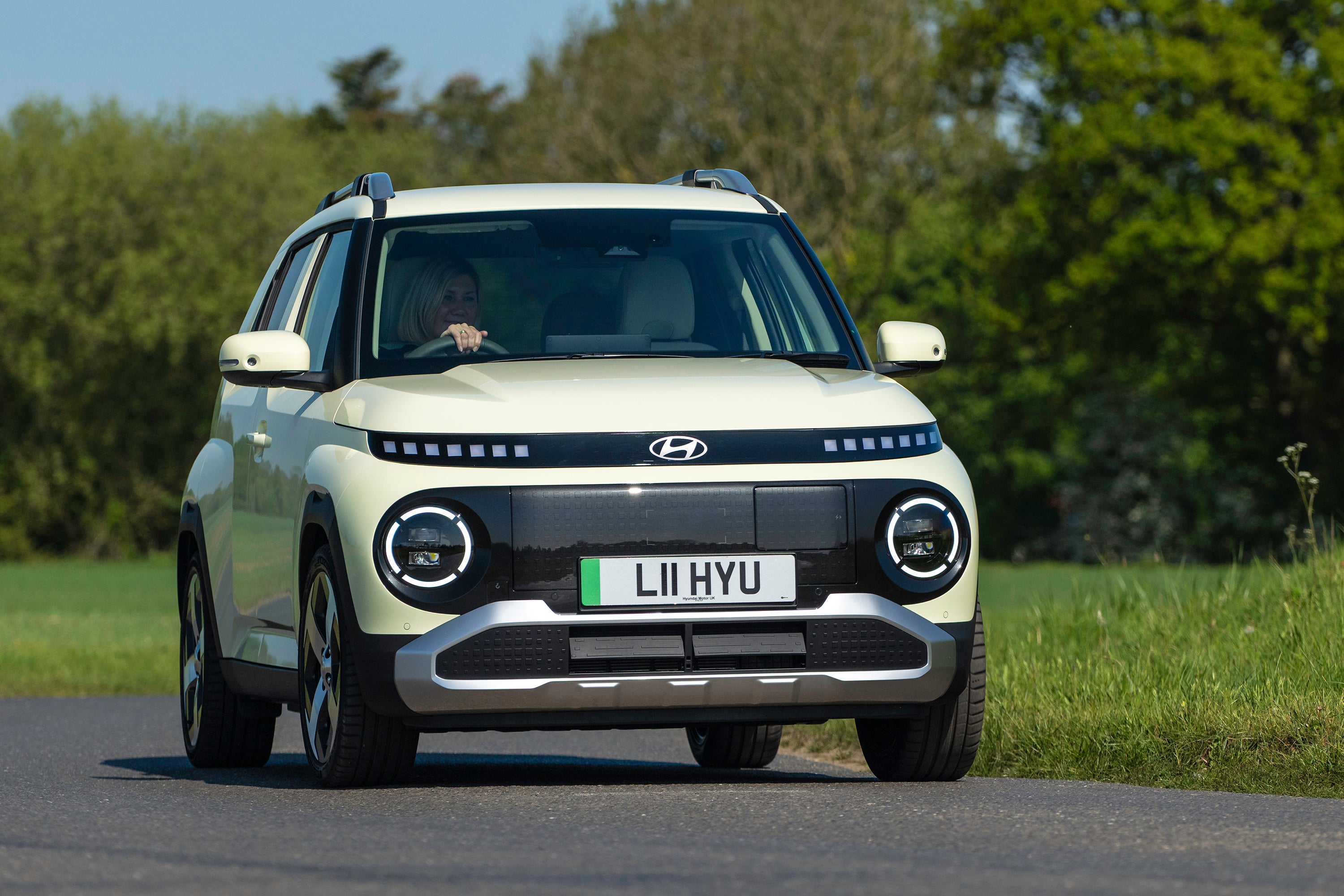
Even a cursory glance at the dainty Hyundai Inster confirms it has character, without remotely looking like a retro pastiche of an older car. It’s a curious combination of shrunken down SUV toughness, peppered with cutesy details, including the circular and pixel-esque lighting motifs.
At 3825mm long — or 3845mm if you opt for the range-topping Inster Cross — the Hyundai is one of the shortest cars currently on sale, yet there’s genuine space inside for four tall adults.
Choose the middle-ranking Inster 02 specification — which we would recommend doing — and its flexibility is bolstered by a 50/50-split rear seat that both slides and reclines to maximise legroom or boot space depending on your priorities. Slid right back, the boot will hold 238 litres of stuff, but pushed forwards and that expands to 351 litres.
Two electric motor and battery combinations are available for the Inster. Powering the 42kWh Standard Range is a 97PS motor, while the 49kWh Long Range has a 115PS alternative. Neither is scintillatingly quick, but that’s not what this car is about.
Hyundai’s official claims are up to 203 miles of driving for the Standard Range and 229 miles for the Long Range, meaning infrequent plug-ins if you do stick primarily to urban driving. DC recharging takes 30 minutes to take either battery from 10-80%, with the Standard Range managing a maximum energy flow of 73kW, the Long Range a bit higher at 85kW.
Standard kit on the Hyundai Inster 02 includes a heated steering wheel and front seats, LED headlights and a wireless smartphone charging pad — although slightly frustratingly, it still requires a cable to activate Android Auto and Apple CarPlay.
Recently realigned prices mean the Inster 02 is now available from under £25k — not an insubstantial sum for such a small car, but one which still feels like good value, especially when you remember it’s backed up by Hyundai’s five-year, unlimited mileage warranty.
Hyundai Ioniq 3
Launched in: 2026
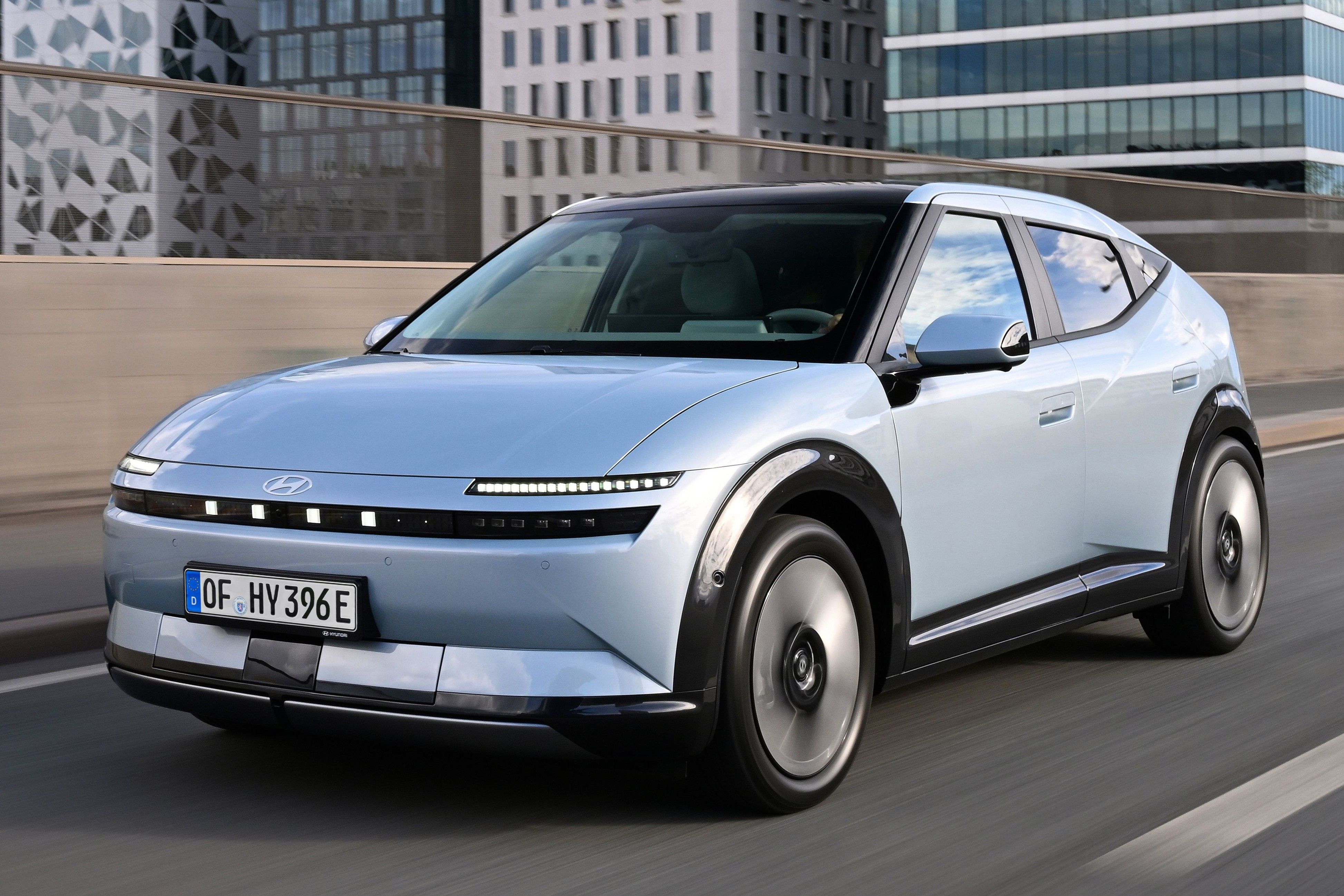
Latest to join the EV line-up is the striking Hyundai Ioniq 3 — it’s a rakish compact hatchback aimed squarely at the likes of the Cupra Raval, Renault 5 E-Tech and Volkswagen ID. Polo. There’s a hint of SUV-chunkiness about it, but its 60mm lower than the larger Kona Electric.
Hyundai’s pixel light theme is again used front and rear, with the Ioniq 3’s tail crescendoing with a blade-like rear spoiler to boost its aerodynamic efficiency. It evidently works, too — when fitted with the 42kWh battery its 213-mile range outdoes the Inster Standard Range by 10 miles, despite having a 50PS more power.
Somewhat unusually, the longer range alternative with a 61kWh battery pack is less powerful at 135PS, but it will still feel nippy from the get-go. Depending on which version you go for, its theoretical driving range is stretched to 308 miles, 11 short of the Kona Electric with a 64kWh alternative.
DC recharging from 10-80% requires 29 minutes for the smaller battery and 30 minutes for the larger one. The former can handle an energy flow of 119kW, the latter a shade behind at 110kW.
We’ve yet to experience the Ioniq 3 in person to judge its spaciousness, but its 441-litre boot capacity is only just behind the VW’s and a useful 115 litres up on the Renault.
Slightly disappointingly, if you want energy-saving features such as a heated steering wheel and front seats, you need to go for the pricier Ultimate trim level, but even the entry-level Advance specification comes with a 12.9-inch multimedia touchscreen, dual-zone climate control, keyless entry and adaptive cruise control.
Prices start at £22,245 for the Ioniq 3 Advance 42kWh, with the 61kWh in the same trim priced at £3500 more.
Hyundai Kona Electric
Launched in: 2023
.jpg)
Not only is this the second generation of Hyundai Kona Electric, it’s already been on sale for three years, demonstrating how deeply ingrained EVs are in the Korean firm’s model mix. Its unusual styling won’t be everyone’s cup of tea, but it certainly stands out among a plethora of vanilla alternatives.
It’s a compact SUV that’s very spacious for four adults, although a fifth is a squeeze due to the comparative narrowness of the rear central bench seat. Boot space is generous at 466 litres with the rear seats in place, expanding to 1300 litres when folded, with an additional 27 litres of storage below the bonnet.
Hyundai recently streamlined the Kona Electric’s motor and battery choices meaning you can now only go for the 218PS version with a 65kWh battery — not exactly a hardship, then. While it’s not an out-and-out performance model, it’s capable of sprinting from a standstill to 62mph in 7.8 seconds, so easily nips into gaps in traffic while rapidly getting up to speed.
Driving range, as ever, depends on which trim level you choose, with the entry-level Kona Electric Advance boasting the greatest potential at 319 miles. All of the others are quoted at 282 miles. Hooked up to a DC public charger capable of serving up 101kW of power, a 10-80% recharge will take 41 minutes, so a little off the pace.
You may decide that range drop-off is a price worth paying if you fancy niceties such as a heated steering wheel and front seats, dark-tinted rear windows and an electric tailgate as they’re all part of the N Line specification, one rung above the Advance. It’s also an extra £2000 at £37k, so it’s not exactly inexpensive.
Ultra-dependable, comfortable and cost a pittance to run if you can charge it home, the Kona Electric has real-world appeal, even if it’s not as exciting to drive as its looks suggest it could be.
Hyundai Ioniq 5
Launched in: 2021
.jpg)
Blurring the boundaries between hatchbacks and SUVs, the Hyundai Ioniq 5 still looks eye-catchingly sharp five years after it first went on sale here. It’s an incredibly spacious five-seater, with a generous 520-litre boot behind the rear bench that can be considered an alternative to the rakish Volkswagen ID.5 as a coupe-like SUV.
A trio of electric drive systems make up the choices for the core Ioniq 5 line-up, starting with the 170PS rear-wheel drive fitted with a 63kWh battery for a 273-mile range. If your budget stretches to it, we’d recommend the 228PS alternative with an 84kWh pack, increasing its driving potential to 354 miles.
A second motor dials the power up to 325PS for the all-wheel drive version with the 84kWh battery, but that extra oomph dials the range down to 307 miles.
Yet even more is available with the Hyundai Ioniq 5 N. The same 84kWh battery now feeds electric motors generating a colossal 650PS of power, scorching it from a standstill to 62mph in just 3.4 seconds. Range? Aah, yes — that falls to a high of 278 miles in the process.
Regardless of battery size, DC recharging can be completed at an energy flow rate of up to 260kW, meaning that a 10-80% top-up could take as little as 18 minutes.
All versions of the Hyundai Ioniq 5 are generously equipped, so you may well feel justified in not looking any higher than the entry-level Advance specification. It costs £40,695 with the 63kWh battery and £3500 more for the 84kWh alternative.
Hyundai Ioniq 6
Launched in: 2022
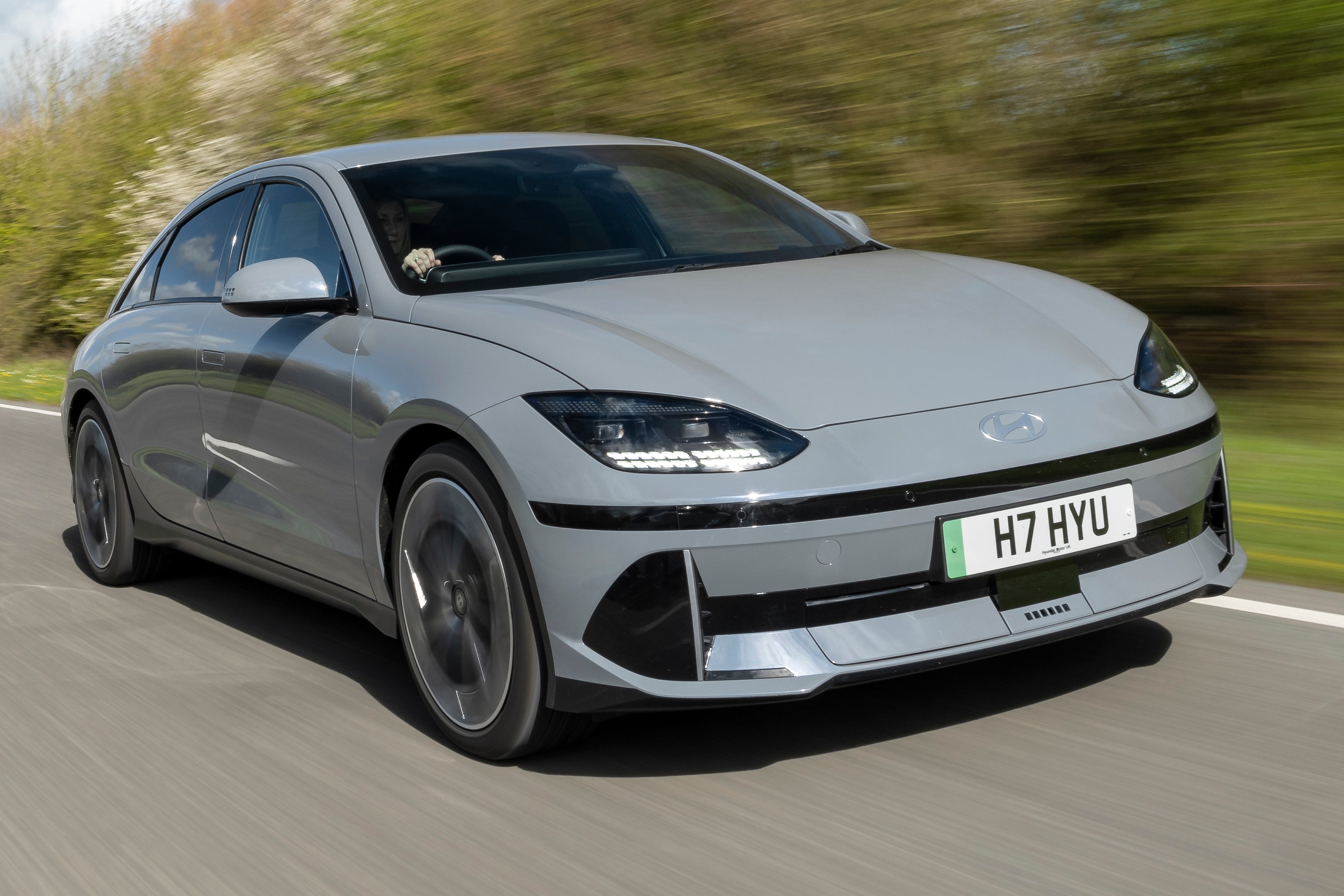
The swooping, streamliner shape of the Hyundai Ioniq 6 makes it very distinctive and the epitome of a Marmite design — you’ll either love it or hate it, with no fence-sitting permitted between those opinions.
Essentially, it’s a coupe-like saloon version of the Ioniq 5, albeit not yet having gone through its mid-production cycle updates, hence why the sole battery choice for the core models is a 77.4kWh pack with a choice of 228PS rear-wheel drive or 325PS all-wheel drive propulsion options.
Theoretically, 338 miles of range can be extracted from the former, with 322 miles the best if you go for the AWD version. Again, a 10-80% recharge takes 18 minutes when hooked-up to an appropriately powerful DC charger.
Topping the line-up — and the only facelifted version so far available — is the Hyundai Ioniq 6 N. Mechanically identical to the Ioniq 5 N, the 6 N’s superior aerodynamics make its 0-62mph even quicker at 3.2 seconds as well as improving its potential driving range — here it’s 302 miles, although good luck driving it gently enough to get anywhere near that.
Unsurprisingly, interior space isn’t as generous as it is in the Ioniq 5, but it’s not exactly cramped. Boot space is quoted at 401 litres for all barring the Ioniq 6 N, although practicality is hampered by access being via a boot lid rather than a tailgate incorporating the rear windscreen.
The best all-round choice in the range is the entry-level Premium version with rear-wheel drive, which will set you back a smidgen over £47k.
Hyundai Ioniq 9
Launched in: 2025
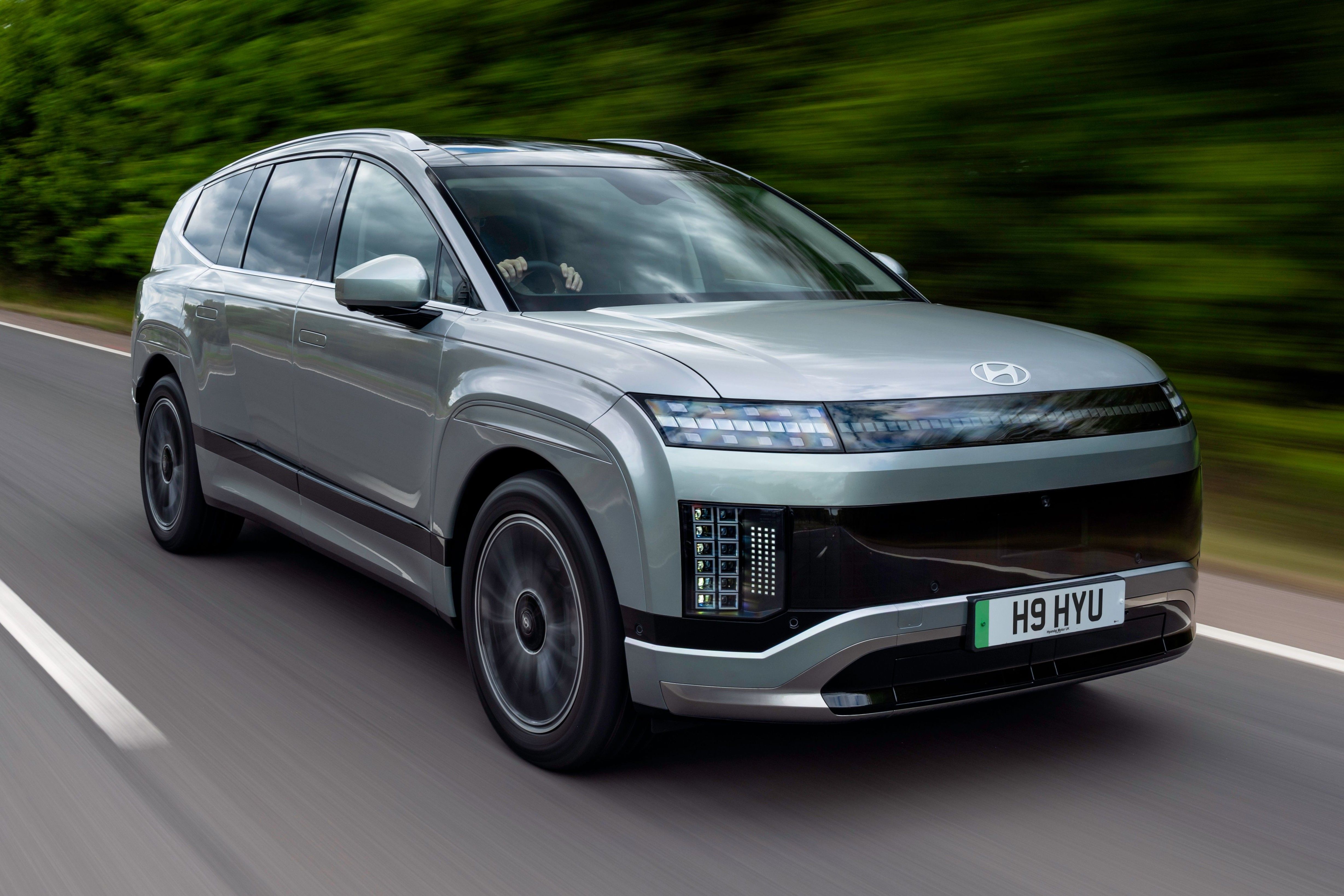
Although developed in conjunction with the similarly sized Kia EV9, the Hyundai Ioniq 9 is slightly larger at 5060mm long and has a different assortment of power outputs, all fed by an increased capacity 110.3kWh battery.
That’s sufficient to give the entry-level 218PS rear-wheel drive version a 385-mile theoretical range while the dual-motor all-wheel drive 307PS model sees a drop to 376 miles. Not too far behind is the AWD Peformance range-topper, still with a claimed 372-mile range.
For comparison, the slightly smaller — and lighter —Skoda Peaq with a 91kWh battery boasts equivalent figures of 395 miles for rear-wheel drive versions and 373 miles if all-wheel drive is fitted.
Although it’s less expensive than the Volvo EX90, the Ioniq 9 feels a little cheap in places — particularly in terms of the interior plastics. Using higher grade materials and charging more for the car would still keep the Hyundai at sub-Volvo prices while feeling substantially better.
DC recharging can be performed at a rate of up to 233kw, meaning a 10-80% top-up can be achieved in 24 minutes.
Interior space is generous, with adult-sized space in the third-row of seating, although it’s less comfortable there than in either of the two rows in front. The middle-row bench can be swapped for two revolving captain’s chairs on the priciest Ioniq 9s, but we suspect most will find the three-seater standard fitment more convenient.
While the Hyundai’s ride quality is reassuringly cosseting, the handling can feel roly-poly through sweeping corners. It’s a large SUV that’s best driven smoothly, regardless of how much pace it has available.
Prices start just below £65,000 for the generously equipped Ioniq 9 Premium, which only comes in RWD guise. Think carefully before upgrading to the mid-range Ultimate and its 307PS AWD setup — yes, it also has more equipment, but it’s a chunky £8500 more expensive.
Yes, the Skoda Peaq has a less roomy interior, but the most dearest version of it only just breaches the £60k mark.
On sale from summer 2016, the Hyundai Ioniq Electric was the marque’s first EV launched in the UK. The Ioniq was a sleek, family sized hatchback which was also available in self-charging and plug-in hybrid formats.
The Ioniq’s slinkiness was to its advantage because despite having a battery capacity of just 28kWh, it had a claimed driving range of 174 miles, although that was measured using older and less accurate testing procedures.
Its front-mounted electric motor produced 120PS with a richer torque figure of 295Nm — enough to ensure a 9.9-second 0-62mph acceleration time.
What about the cost? If you stuck with the entry-level Premium trim it would have set you back £28,995 in 2016, with the more generously appointed Premium SE adding a further £1800 to the sticker price.
It’s certainly possible, but nothing has been confirmed for production. The most likely candidates would be a Hyundai Ioniq 3 N to take on the likes of the Vauxhall Corsa GSE and Volkswagen ID. Polo GTI, plus an Ioniq 9 N to challenge the punchiest-performing Volvo EX90.
Although Hyundai sold a Kona N in that model’s first generation, it was a petrol-powered derivative.
Hyundai has no plans to phase out the availability of cars with combustion engines until either legislation forces it do or falling customer demand makes it a profitable decision.
Based on current laws, combustion-engined new cars, with a sufficient degree of hybrid assistance, will remain on sale until 2035.
This depends on a number of factors, including the battery capacity and the level of power the charger is able to deliver.
Hyundai generally quotes 10-80% recharge times for its electric models when using DC public chargers, meaning a plug-in time of 18-40 minutes depending on the car in question.
At home, using a common 7kW domestic wallbox charger, a flat-to-full recharge will likely take between eight and 17 hours.
Find an electric Hyundai for sale
Hyundai IONIQ 5239kW Premium 77 kWh 5dr AWD Auto [Part Leather]
202332,415 milesElectric£21,295
CF313NBHyundai Kona160kW N Line 65kWh 5dr Auto
10 milesElectric£37,785
EX28QQHyundai Inster85kW 02 49kWh 5dr Auto
20261 milesElectric£19,620
WF29FQHyundai Inster85kW Cross 49kWh 5dr Auto
202610 milesElectric£21,950
S711AJHyundai Inster85kW 02 49kWh 5dr Auto
13 milesElectric£26,310
LU63HSHyundai Ioniq 5 N478kW 84 kWh 5dr Auto [Vision Roof]
Electric£67,180
SR53NXHyundai Inster85kW 02 49kWh 5dr Auto
Electric£27,765
EX28QQHyundai Kona160kW Ultimate 65kWh 5dr Auto
20261 milesElectric£30,490
S711AJ