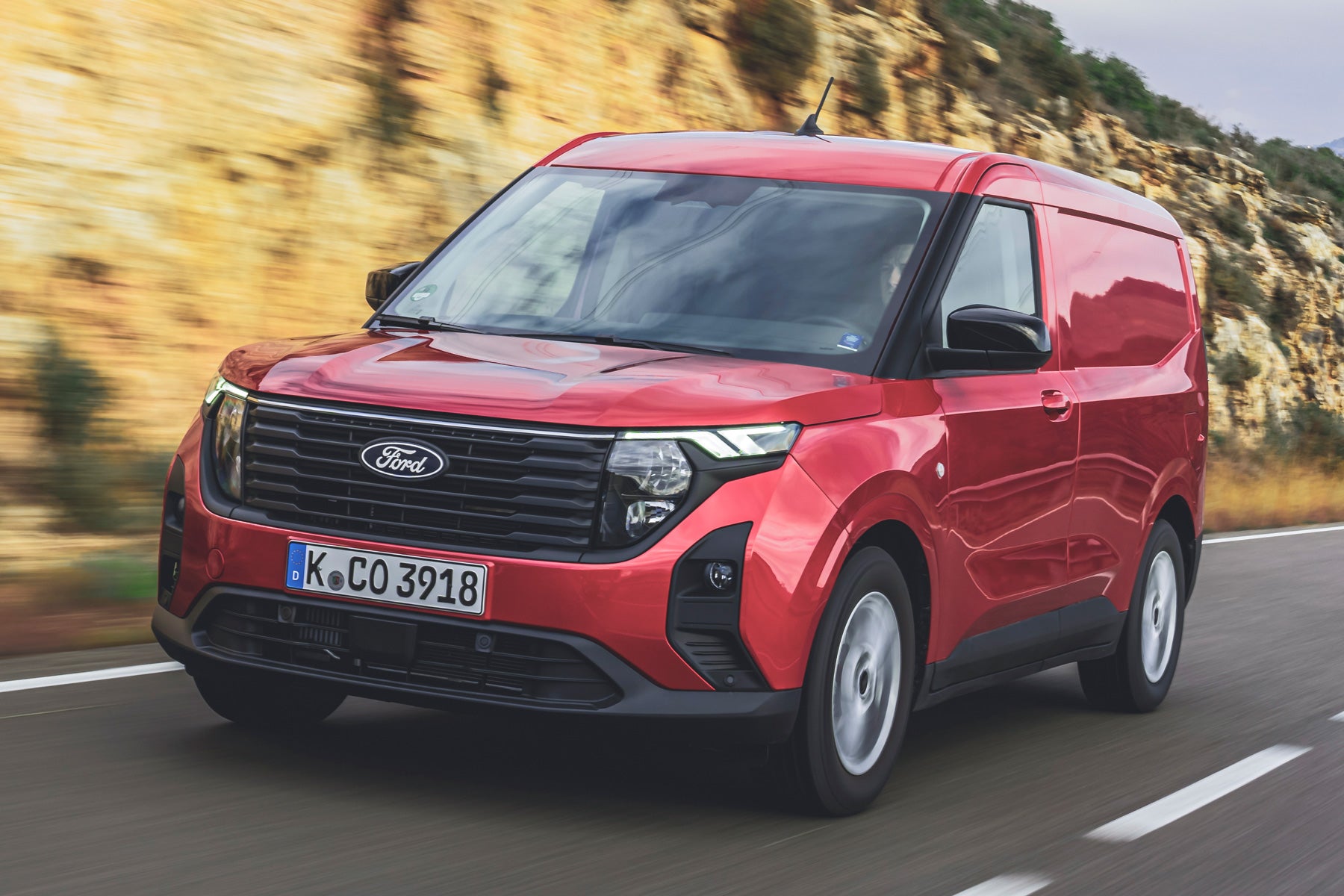
Ford Transit Courier Review

Written By Matt Robinson
- 2024
- Van
- Petrol, Diesel, Electric
What we love
Easy to drive
Cheap to buy and run
More versatile than predecessor
Things to consider
Cheapest models are very basic
We'd like a less minimalist cabin
Strays into Ford Transit Connect territory
The DRIVE take on the Ford Transit Courier, is it the right car for you?
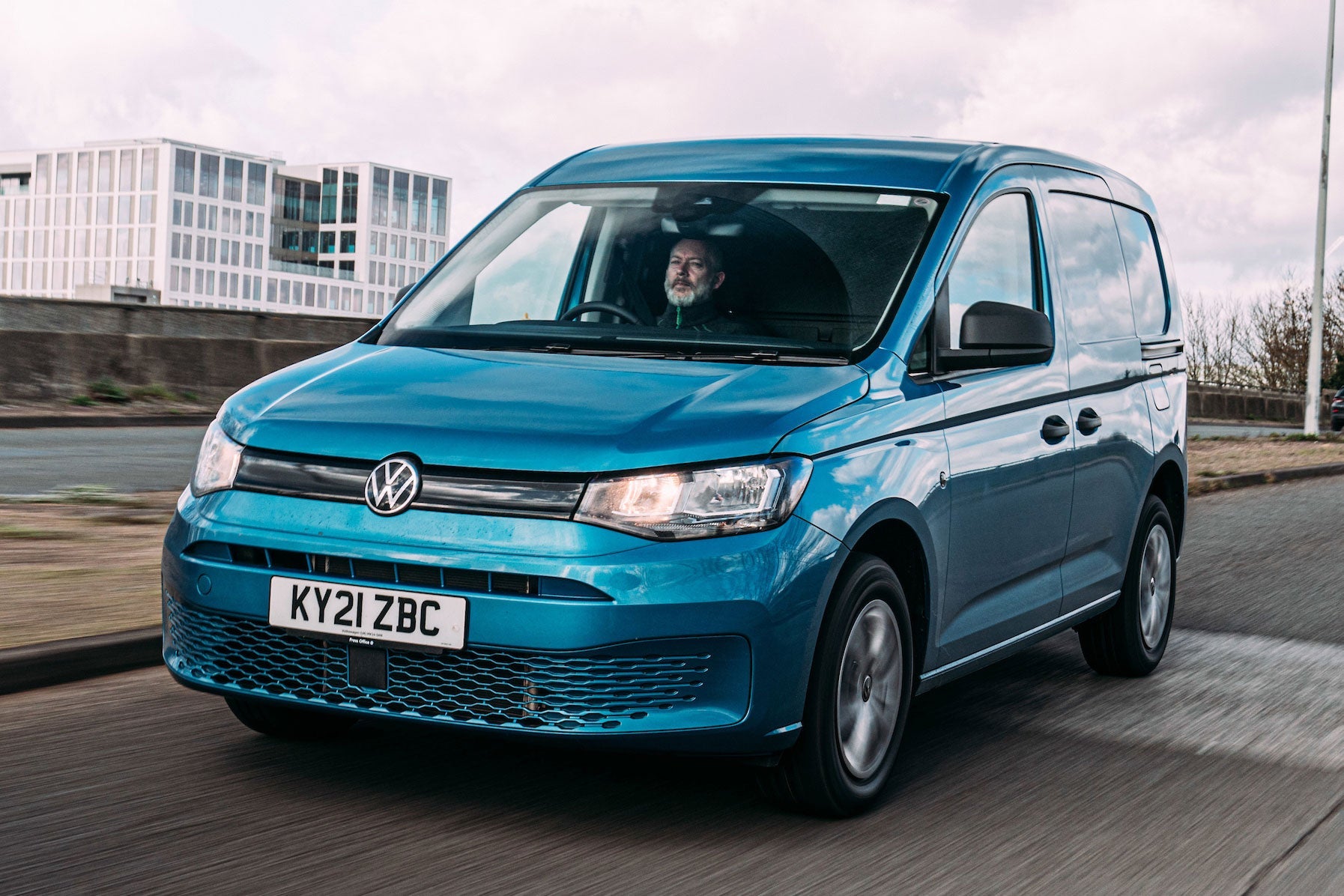
If you're looking for a versatile little van that represents impressive value for money, the Ford Transit Courier is a good choice. We like how car-like it is to drive, while it's also got an impressive amount of technology available. If overall versatility is what you're after - or you want to be able to carry more than one passenger - you might want to look at slightly bigger vans like the Volkswagen Caddy, Ford Transit Connect or Citroen Berlingo.
The Ford Transit Courier in more detail
If you're new to the world of vans, you can make your life a lot simpler by looking for one with a 'Ford Transit' badge. The Transit is an iconic vehicle for good reason: it combines decent value for money with a strong reliability record and impressive versatility, all important considerations for van buyers, whether you're a one-man band or running a large fleet.
The Transit model line-up is actually quite expansive and it starts with this, the Ford Transit Courier. Traditionally quite diminutive in size, the Courier is intended to appeal to small shop owners, artisans and anyone who needs a bit more practicality than a car but doesn't need the space a full-sized van can offer.
Now based on the Ford Puma SUV, the Ford Transit Courier has grown in size compared to its predecessor. That means it's now in danger of overlapping with the bigger Ford Transit Connect, although it's still cheaper than the Connect to buy, and we reckon it has the edge in terms of style.
Another selling point of the Transit Courier is that it's offered as a pure-electric model (badged the Ford E-Transit Courier). We've sampled the petrol and diesel versions plus the E-Transit Courier and would recommend the 1.0-litre petrol, especially with the excellent six-speed manual gearbox. The E-Transit Courier could be worth a look if your use case is such that the limited range isn't a problem, and the savings in terms of running costs offset the higher purchase price. As a bonus, it's more relaxing to drive.
While it might be bigger than before, the new Ford Transit Courier feels more car-like than ever to drive. It's reassuringly easy to manoeuvre, while there's a huge amount of driver-assistance tech on hand, making it one of the safest vans you can buy.
Of course, if you're looking to buy a small van, you're probably more interested in how versatile it is. Well, the Ford Transit Courier can carry up to 845kg, while its loadspace is now big enough for two standard Euro pallets. It's also available with a trick load-through bulkhead, allowing you to carry long items (such as ladders) measuring up to 2.6 metres long.
What's the best Ford Transit Courier trim and battery option?
Unless you're planning to cover a lot of miles, we'd recommend the 1.0-litre petrol engine. It works better with the manual gearbox than the clumsy dual-clutch auto: if you don't want the faff of changing gears yourself, you might want the electric Ford E-Transit Courier, instead.
In terms of trim level, avoid the most basic Ford Transit Courier Leader: no one wants a van without air conditioning. Other than that, all Ford Transit Couriers are well-kitted out for the money. The Trend model more than covers all the basics, while both the Limited and Active models have some nice-to-have features (such as a rear-view camera and wireless phone charging).
As already noted, the all-electric E-Transit Courier is more expensive, but the additional outlay might be more than offset in running-cost savings, depending on how the van is used.
What’s the price of the Ford Transit Courier?
Prices for the Ford Transit Courier start at around the £23,500 mark (if you're factoring VAT into the equation), and rise up to more like £36,000 for the top-of-the-range electric version.
The entry-level Ford Transit Courier Leader is aimed at the most miserly of fleet managers: it doesn't even have air conditioning or a sliding side door. We'd recommend splashing out on the Trend specification at least. It has the two essential features already mentioned, plus extra parking assistance, a reversing camera and keyless start. Specified with the 125PS petrol engine and manual gearbox, this will set you back around £27,000.
If you want the five-seater Double-Cab-In-Van model, which is available exclusively in Trend trim, it'll cost you between £27,000 and £29,000, approximately, depending on your choice of powertrain.
The E-Transit Courier is around £34,500 in Trend trim, while the Limited is around £36,000. That might sound quite a lot, especially because the larger (and combustion-only) E-Transit Connect can be bought for a fair bit less, but the pricing is similar to the likes of the Citroen E-Berlingo.
Alternatives to the Ford Transit Courier
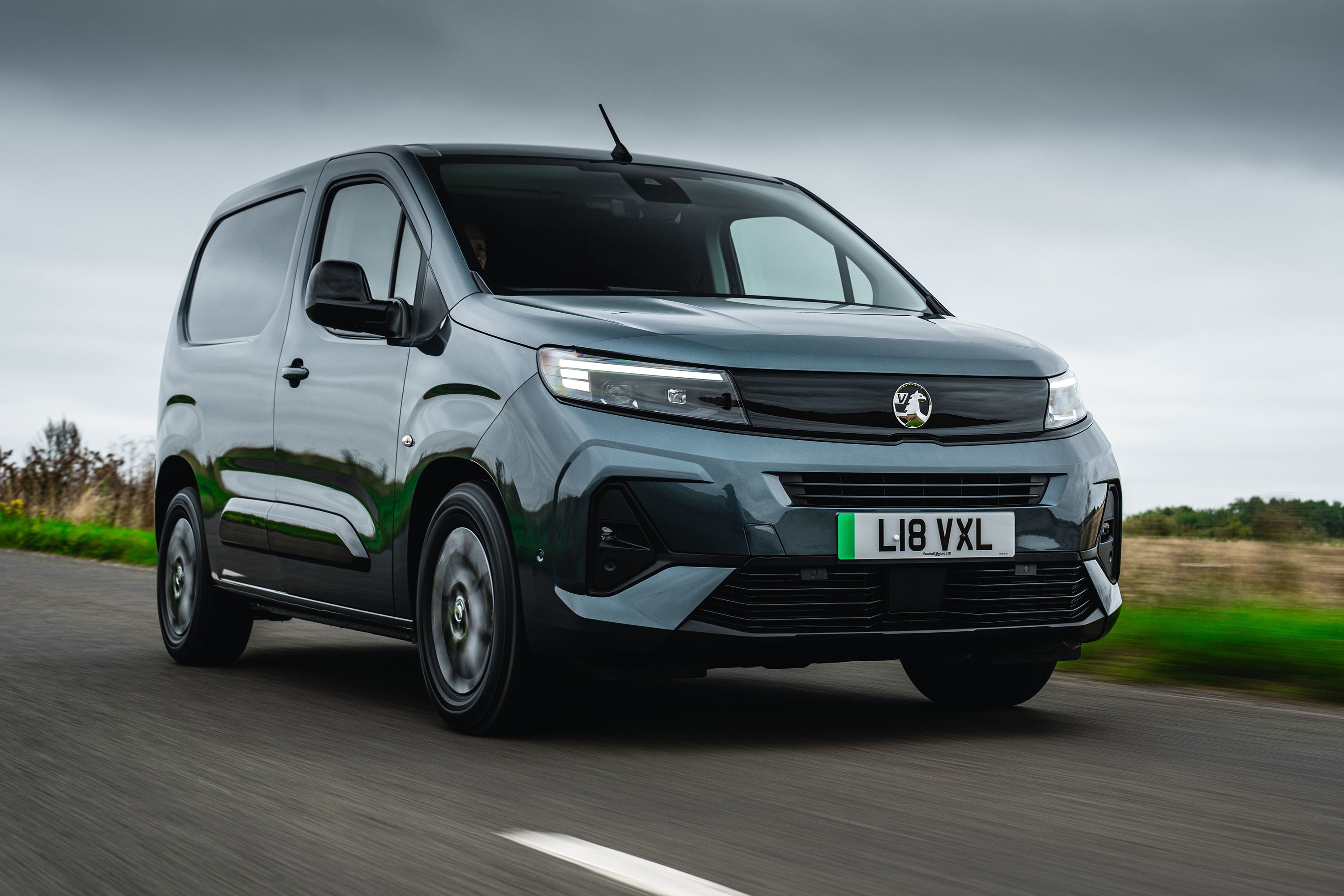
The Ford Transit Courier is one of the smallest vans you can buy. In reality, though, you're likely to be considering it alongside slightly bigger alternatives such as the Volkswagen Caddy, Nissan Townstar, Citroen Berlingo, and even the Ford Transit Connect.
What's the interior like in the Ford Transit Courier?
The Ford Transit Courier's interior feels smart yet utilitarian. The larger, VW-Caddy-based Ford Transit Connect is a better option if you want a classier cabin, but there's little to dislike about the Courier's functional interior. Practicality is decent for such a small van, too.
Ford Transit Courier boot space and practicality
Apparently, customer feedback said that buyers of Ford's smallest van actually wanted it to be a bit bigger... which is why it's grown in size compared to its predecessor, both inside and out. The Ford Transit Courier now has external dimensions of 4,337mm long, 2,076mm wide (1,800mm without mirrors) and 1,827mm tall - which means it's not a great deal smaller than the Volkswagen Caddy Cargo - or the Caddy-based Ford Transit Connect - Citroen Berlingo or Mercedes Citan.
The Transit Courier's cargo length has been increased by 181mm to 1,802mm, while new rear suspension with angled shock absorbers has increased the load width between the wheel arches to 1,220mm. This means the Courier can now carry two Euro pallets (the old model could only manage one). Total cargo volume is 2.9 cubic metres, 25 per cent more than the outgoing model, while an optional load-through bulkhead boosts that to 3.0 cubic metres and allows customers to carry items such as planks or pipes up to 2,661mm long.
As standard, the Ford Transit Courier has a payload of between 614kg and 696kg depending on the version, with the majority of the various versions sitting somewhere near the 650kg mark. Alternatively, you can buy a 'high payload' version of most variants, which are fitted with beefier springs that allow you to carry anywhere between 781kg and 850kg, with most versions sitting around the 800kg mark. Unusually, the electric versions of the Ford Transit Courier have some of the best standard payload figures on offer (electric vans often trail their diesel counterparts in this area), but note that the electric versions are the only ones on which no 'high payload' option is offered.
The maximum braked towing weight for petrol variants is 1,000kg, while the diesel boosts this to 1,100kg, but the all-electric E-Transit Courier can only pull 750kg.
The side-hinged rear cargo doors open up to 180 degrees to enable easy access, while there are six floor tie-down points fitted as standard. Bear in mind, too, that the entry-level Leader trim doesn't have a sliding side door. All others get one on the left side of the vehicle, while the Double-Cab-In-Van variant gets one on both sides.
Speaking of the Double-Cab-In-Van variant, the extra pews in this five-seater variant obviously come at the expense of some loadspace. The length of your loadbay is 935mm, or 1,429mm on occasions where you don't need the second row of seats and you fold them away. Doing that also boosts your loadbay capacity from 1.3 cubic metres to 2.4 cubic metres. However, we've never encountered a Double-Cab-In-Van variant, so we can't say how those rear seats fare for passenger space.
Get yourself up front, and you'll notice that there are some neat touches in the front of the Ford Transit Courier. The thick-rimmed steering wheel is just like that you'd find in any Ford car, while the 'blocky' dashboard adds to the slightly rugged vibe. There are a few shortcut buttons for the infotainment system, although we think the Courier is a little too reliant on touchscreen operation for things like climate control. What's wrong with twiddling a knob when you want to turn up the heat?
You'll notice a slightly odd plastic recess next to the infotainment system. That's because, however much Ford offers clever connectivity, many drivers still want their phone within sight. Attach an aftermarket phone mount to the plastic flap here and you won't be as reliant on Apple CarPlay or Android Auto on the main screen (which is useful when your passenger wants to bring up the climate control display).
The interior of the Ford Transit Courier is a little spec-dependent. All models get the central 8.0-inch touchscreen display (or 12.0-inch one on the electric versions), but we suspect the entry-level Leader derivative will feel a bit basic inside. It hasn't even got air conditioning or mirrors in the sun visors.
Ford offers the Transit Courier with a variety of optional extras, including LED loadspace lighting, rubber or wooden floor covers and half-height cargo stowage rails, depending on your requirements.
Ford Transit Courier dimensions
The Ford Transit Courier measures 4,337mm long, 2,076mm wide (1,800mm without mirrors) and 1,827mm tall. As such, it's a little smaller than rivals such as the Volkswagen Caddy Cargo - and the Ford Transit Connect that's based on the Caddy - the Citroen Berlingo and the Mercedes Citan, but there's not a huge amount in it.
Tech and infotainment in the Ford Transit Courier
Ford's 8.0-inch SYNC4 infotainment screen is standard on the Transit Courier, while battery-electric versions have a larger 12.0-inch screen. Either way, you get a user-friendly display with connected navigation as well as wireless Apple CarPlay and Android Auto. It's a pretty good system with bright graphics and fast responses, but some of the menu layouts could be a bit more logical, in our opinion. Note that, while you can connect your phone wirelessly to the infotainment system, you'll need a Limited or Active model if you want a wireless phone charger.
As well as the central display, the Ford Transit Courier comes with an additional digital instrument cluster, which verges on information overload but at least looks more modern than a pair of traditional analogue dials behind the steering wheel.
Materials available on the Ford Transit Courier
It'd be wrong to describe the Ford Transit Courier's interior as posh, but it feels reasonably well finished and will no doubt stand up well to the general abuse dished out by van life. Again, the quality of the interior will depend a little on how much you spend on a Transit Courier: you'll need a Limited model or above for a steering wheel wrapped in faux-leather.
What's the Ford Transit Courier like to drive?
Ford Transit Courier range and performance
When it was first launched, the Ford Transit Courier buyers were offered a choice of one diesel and two petrol engines. The entry-level Transit Courier Leader is offered with all of them. The petrols are both 1.0-litre EcoBoost turbos with either 100PS or 125PS. The former has a six-speed manual gearbox while the latter has a seven-speed dual-clutch automatic. The other engine offered in Leader trim is a 1.5-litre EcoBlue diesel with 100PS and a six-speed manual 'box.
All other trim levels are offered with either the diesel or the more powerful 125PS engine, although in the case of the latter, you have the additional choice of a six-speed manual gearbox or seven-speed automatic. Trend and Limited versions can also be had in all-electric E-Transit Courier form, which joined the range a little way after the initial launch. It's offered with a 43kWh battery pack and a single, front-mounted motor producing 130PS and 290Nm of torque.
We've driven the 125PS petrol with the automatic transmission and it's a perfectly likeable combination, although the automatic gearbox does feel a little clumsy at times. We've sampled the same engine with the manual gearbox in the Tourneo Courier (the passenger-carrying version with extra seats and windows) and prefer it to the auto: performance is eager, while the clutch action is light and the gear change feels precise. It's actually quite enjoyable to change gears in the Transit Courier, which makes it rather different to any of its Stellantis-built competitors (such as the Citroen Berlingo).
We also tried the E-Transit Courier with about 240kg of ballast onboard, and it offers perfectly adequate performance, with a reasonably eager attitude off the line without the throttle being uncomfortably sharp. It'd be sprightlier when empty, but we wouldn't expect it to ever seem properly quick like the bigger and much more powerful E-Transit Custom feels. We also think it might feel a little sluggish when fully loaded.
According to Ford's official figures, the range of the E-Transit Courier stands at 201 miles. But don't bank on being able to replicate that. This isn't a specific criticism of the E-Transit Courier, and these lab-obtained numbers are notoriously difficult to achieve in all EVs. A best-case scenario is probably about 160 miles, but you can expect significantly less in cold conditions, and/or if clocking a lot of motorway/dual-carriageway miles.
This doesn't sound stellar, but it's in line with the average use case for a van of this size, which will be used for jobs like last-mile deliveries.
Performance data
| Model | Engine/battery size | Power | 0-62mph | Range/MPG |
|---|---|---|---|---|
1.0 EcoBoost 100 manual | 1.0-litre petrol | 100PS | TBC | Up to 43mpg |
1.0 EcoBoost 125 manual | 1.0-litre petrol | 125PS | TBC | Up to 42mpg |
1.0 EcoBoost 125 automatic | 1.0-litre petrol | 125PS | TBC | Up to 42mpg |
1.5 EcoBlue manual | 1.5-litre diesel | 100PS | TBC | Up to 53mpg |
E-Transit Courier | Electric 43kWh | 130PS | TBC | 201 miles |
Ford Transit Courier driving and refinement
Ford has a reputation for making everyday vehicles that are surprisingly enjoyable to drive, and the Transit Courier certainly feels a lot more agile than a Citroen Berlingo. You don't need to be driving quickly to appreciate the direct steering and (on manual models) the precise gearchange: the Transit Courier is a van that you'll actually be quite happy driving day in, day out.
That agility doesn't mean compromising on comfort, either. The suspension feels very capable at tackling uneven road surfaces, and the ride quality was generally very good. It should be noted, however, that the Ford Transit Courier we sampled had 250kg of fixed ballast in the back, and this usually has a positive effect on how a van rides because the suspension is designed to bear large amounts of weight. As such, we don't know how comfy the vehicle is with an empty loadbay.
Despite being several hundred kilograms heavier than combustion-engined versions, the E-Transit Courier still feels light and very car-like to drive.
Another thing that's very car-like about the Ford Transit Courier is how quiet and refined it is. Sure, you'll notice a little bit of road- and engine noise, but it's no worse than in, say, a Ford Focus family hatchback. You won't notice any rattles, while the bluff front end doesn't create too much wind noise. There isn't that boominess in the cabin that we sometimes associate with vans, either.
Quieter still is the E-Transit, because there's - obviously - no engine sound, and wind- and road noise are still well isolated from the cabin at motorway speeds. There's a faint whirr from the electric motor at low speeds, but otherwise, you can barely hear the powertrain.
How safe is the Ford Transit Courier?
If you're looking for a van that's just as safe as the latest passenger cars, your search should end with the Ford Transit Courier. It was the first van to be awarded a 'platinum' rating under Euro NCAP old commercial vehicle crash test protocol, with the independent organisation describing the Courier's performance as 'excellent'. The body's commercial vehicle crash test ratings have now been tweaked to use the same five-star system as passenger cars, and the Transit Courier now has a five-star rating.
All Ford Transit Courier models come with an extensive list of driver-assistance tech, including Cruise Control, Driver Alert, Intelligent Speed Limiter, Intersection Assist, Lane Keeping System, Rear Parking Aid, Traffic Sign Recognition and Wrong Way Alert. Limited and Active trims also get a Digital Rear View Camera, and Front Parking Aid.
The following features are also available from the options list (depending on trim level): Blind Spot Information System with Lane Change Warning & Aid, Cross Traffic Alert, Intelligent Adaptive Cruise Control, Reverse Brake Assist & Clear Exit Assist.
Running costs: What it's like to live with a Ford Transit Courier
The Ford Transit Courier is one of the smallest vans on the market, so it's no surprise that it'll be cheaper to run than many of the hulking great vans you see rolling around. Petrol engines are offered for medium-distance use, while the diesels will be better for those who spend their days pounding motorways. For short-hop urban use, there's also a battery-electric option.
Ford Transit Courier charging times and costs
The Ford E-Transit Courier's maximum charging capacity is 100kW, which is in line with the Citroen E-Berlingo and 25kW better than a Mercedes eCitan. This means a 10% to 80% charge is possible in, according to Ford's very specific number, 23.2 minutes.
Fully charging from 10% using a home wallbox outputting 7.4kW will take just over seven hours, and from a three-pin domestic plug socket it'll be about three times that. Not that we recommend charging an EV like that: along with the length of time it takes, this isn't great for your home electrics.
Either way, it'll cost roughly £12 to charge up your E-Transit Courier at home based on a normal energy tariff, and potentially a lot less if your provider offers cheaper rates at off-peak times of day. On the other hand, using a publish charger could cost you three or even four times this amount.
Ford Transit Courier fuel economy
If you don't cover many motorway miles (or are looking for a van predominantly for short journeys), we'd recommend the Ford Transit Courier with a petrol engine. The 1.0-litre EcoBoost engine returns around 41mpg to 43mpg depending on specification), with almost no fuel consumption penalty for buying either the more powerful version or one with the automatic gearbox.
The diesel, meanwhile, will get you returns of between 51mpg and 53mpg according to official WLTP figures, but returns will be best if you do lots of motorway miles, where diesel engines really thrive.
These figures make the Ford Transit Courier one of the most frugal new vans you can buy.
Ford Transit Courier warranty and servicing
Commercial vehicles tend to have slightly better warranty arrangements than passenger cars, and that's the case with Ford. While the firm's cars get three-year, 60,000-mile cover, its vans and pickups have a three-year, 100,000-mile arrangement. That's pretty much the same as you get from most small-van rivals, including the Volkswagen Caddy and all the Stellantis-built options.
We've been unable to find cast-iron information regarding servicing intervals on the Transit Courier. We've approached Ford for guidance, and we'll update this review once we hear something back.
Ford Transit Courier insurance groups
Buy yourself a combustion-engined Transit Courier, and it'll most likely sit in group 26, although a handful of variants slip into groups 25 or 27. Buy an e-Transit Courier, and you're looking at a grouping of 31.
How much does it cost to tax a Ford Transit Courier?
Like with all small vans, you'll pay a flat rate of £360/year in VED (or road tax) for the Ford Transit Courier. You can't avoid this by going for the all-electric Ford E-Transit Courier any more, as free vehicle tax for EVs ended as of April 2025.
What trims are available with the Ford Transit Courier?
Standard equipment on the entry-level Ford Transit Courier Leader includes coloured front and rear bumpers, 15-inch steel wheels, halogen headlights (with automatic high beam), electric windows, power-adjusting door mirrors with heating, rear parking sensors, and hinged rear doors. Inside, the Leader model features six-way driver's seat adjustment, cruise control, and an 8.0-inch SYNC4 media system with Apple CarPlay and Android Auto. One critical omission, though, is air-conditioning, and this alone means we'd recommend you avoid this version.
The Ford Transit Courier Trend checks that critically important box, along with ones for front fog lights, a single sliding side door, driver's seat lumbar support, and an armrest. Electric versions of the Trend add a 12.0-inch larger touchscreen, climate control, front parking sensors and a digital reversing camera.
Those last three items also come on combustion-engined versions of Limited trim, along with alloy wheels, keyless entry and start, wireless phone charging, heated front seats, a heated faux-leather steering wheel, and a QuickClear heated windscreen.
Active trim gets much the same level of standard kit as the Limited version, but in addition, it has chunkier SUV-esque body styling, including including skid plates, roof rails, wheel arch mouldings and a honeycomb grille.
Ask the Drive experts: common questions
Can you buy an electric Ford Transit Courier?
What's the difference between a Ford Transit Connect and Courier?
How big is the 2024 Ford Transit Courier?
Get our latest advice, news and offers
Keep me updated by email with the latest advice, news and offers from Drive.