- Home
- …
- Electric Cars
- Ford electric cars: Every EV explained
03/08/2026
Ford electric cars: Every model explained

Written By Keith WR Jones

It’s not very long since Ford dominated the British market – whatever the size or bodystyle of model and regardless of how talented its rivals’ products were, there was a strong likelihood that the best-sellers would all wear blue oval badges. How times have quickly changed.
In relatively short order, Ford’s slipped from its position leading the market, to vying for third place at best. Exactly why is the multi-faceted question which will provide case study material for business students for years to come, but the two principal reasons are that it turned its back on its heartland models and was slow off the mark developing an EV strategy.
Models including the Ka, Fiesta, Focus and Mondeo were staple Ford products for years – mass market-appealing hatchbacks, saloons and estates, none of which are available to buy new. Yes, the Ford Puma and Kuga can sate the appetite of SUV buyers, but neither are particularly fresh faces at a time when new models – many from brands unfamiliar to British buyers – seem to appear each week.
Reduced profitability from its lack of core models means its electric cars are mainly the result of collaborations with other manufacturers, meaning Ford can’t benefit from economies of scale generated by common parts.
Its halo Mustang Mach-E was developed by Ford’s North American division, while the Explorer and Capri use Volkswagen’s MEB platform. Its compact Puma Gen-E is based on the combustion-engined Puma, meaning some compromises which purpose-designed EVs don’t suffer with.
Going forwards, Ford has already announced that new small electric hatchback and SUVs will be based on Renault architecture – very similar to that found under the 5 E-Tech – will its next generation of family sized models will be joint enterprises with Geely.
Read on to find out more about Ford’s electric car range in 2026.
Ford Puma Gen-E
Launched in: 2024
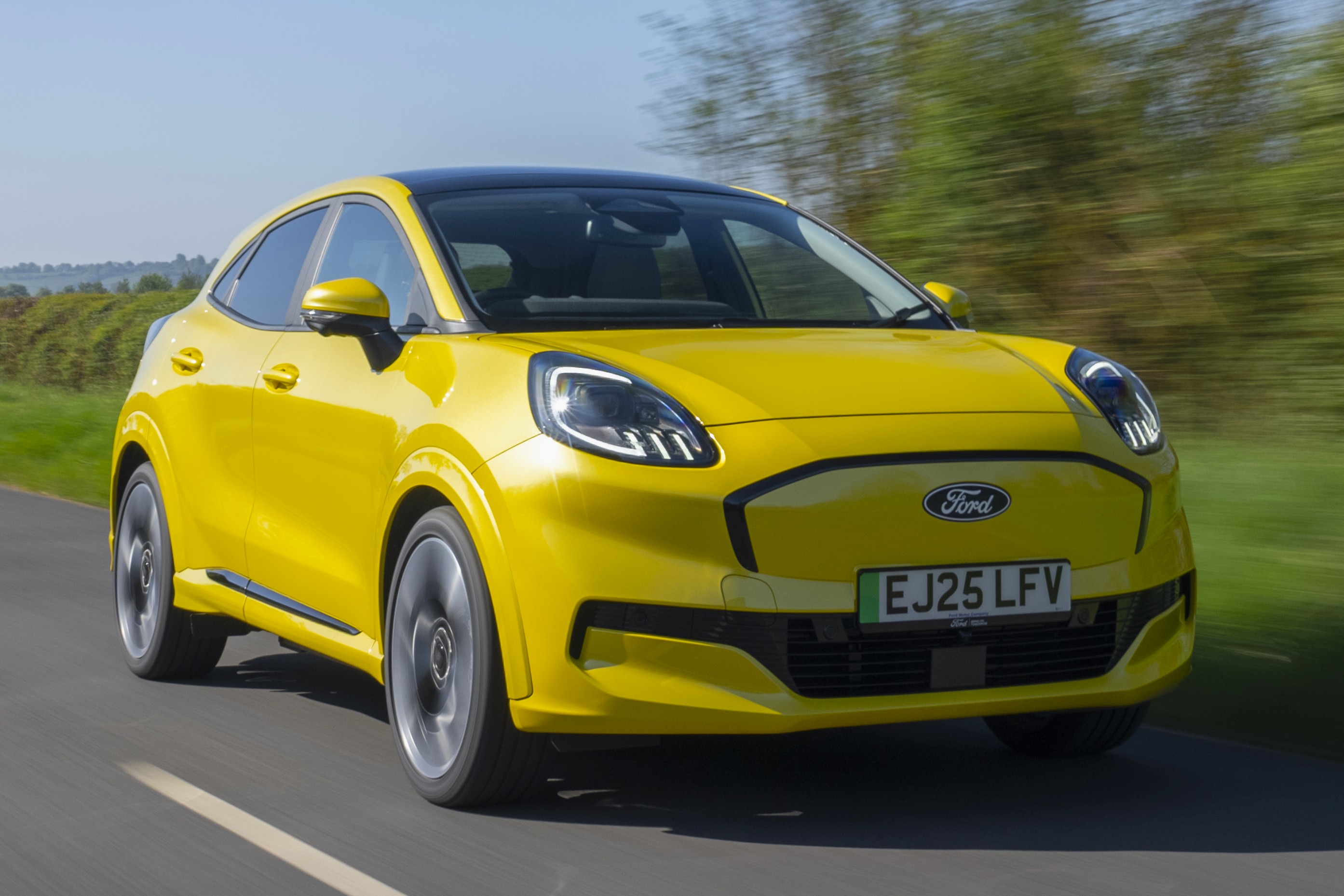
While we enjoy what the petrol-powered Ford Puma feels like to drive, it’s important to recognise that it’s platform is a modified version of that used by the discontinued Ford Fiesta. As such, it wasn’t designed with the intention of being electrically powered, so the conversion to create the Ford Puma Gen-E is somewhat compromised in terms of installing the battery.
As a result, the Puma Gen-E’s battery has a useable capacity of 46.8kWh – the lower the capacity, the shorter the distance the car can drive before needing plugging in again. Ford’s official claim is 259 miles, which is likely to be more than ample for most buyers and reflects how well its engineering team and eked out the Gen-E’s efficiency. Public DC charging is capped at just 100kW, but as the battery isn’t the largest a 10-80% top-up takes 26 minutes.
Because the Puma Gen-E wasn’t designed from the outset as an EV, there’s less interior space than comparable models which were, including the Renault 4 E-Tech and Skoda Epiq. That’s particularly true for those at in the back – realistically, it will only accommodate two adults or a pair of bulky Isofix child seats. Conversely, the Gen-E’s boot is bigger than the combustion-engined version, with 574 litres available, inclusive of the waterproof, 145-litre GigaBox below the boot floor, perfect for wet and muddy sports gear or wellies, thanks to its drain hole. There’s also an extra 43 litres below the bonnet, so you can keep your charging cables tidy.
Equipment levels are generous, meaning we advise sticking with the entry-level Select trim for reasons beyond its ride quality being superior thanks to riding on smaller, 17-inch alloy wheels. No amount of standard features or display screen real estate will distract you from the plasticky nature of the Ford’s interior fixtures and fittings, which are disappointingly downmarket. Not that the Ford Puma Gen-E is exactly cheap, though – even with the government’s electric car discount subtracted, it’s still pricier than its Renault and Skoda rivals.
Ford Explorer
Launched in: 2024
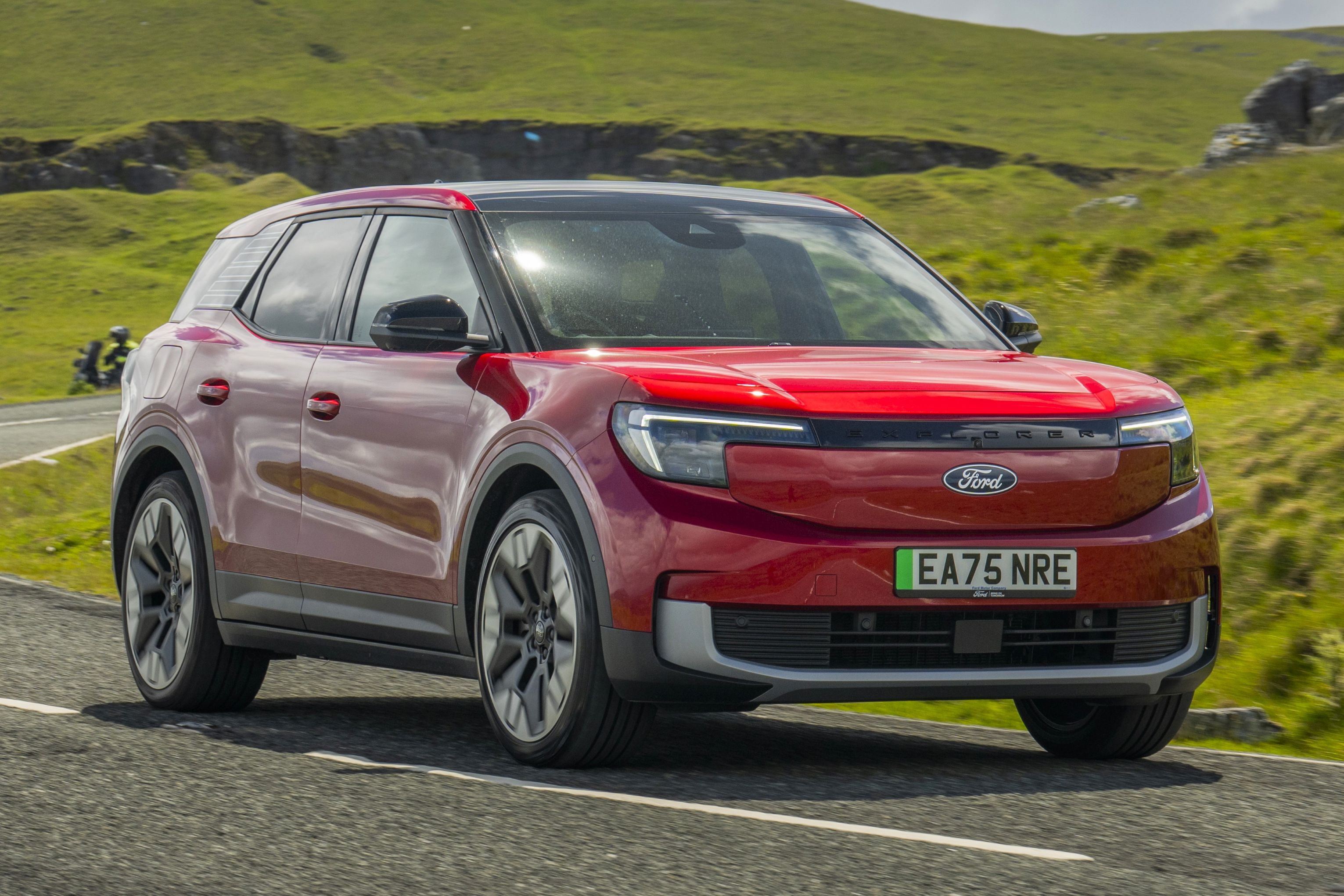
Choosing a name from its back catalogue seems to be the way the company goes about doing things lately, even if the newcomer bares little to no relation to its forebears. It seems less of an issue with the Ford Explorer given few will remember the original SUV sold here from the late-1990s.
Last time around the Explorer was a large, American model, powered exclusively by a 4.0-litre V6 petrol engine, so bringing the name back on a smaller-yet-roomier family-sized EV is indicative of the brand’s transition. Kinda. Beneath the Explorer’s smooth bodywork is a platform and a choice of batteries and electric motors supplied by VW, albeit with modifications by Ford’s engineers, particularly to the suspension and steering. As a result it feels similar to the Volkswagen ID.4 in many respects, but with a hint of the handling finesse which used to be a Ford hallmark.
Inside, the Explorer’s roomy front and rear, although again feels dour with so much dark plastic everywhere. The keen-eyed will also spot of smattering of components that feature on the ID.4 and Skoda Elroq. At 470 litres, the Ford’s boot is also smaller than those rivals, but it’s still a useful size, while in the passenger compartment there’s a remarkable 48 litres of storage dotted around, including 17 litres beneath the front armrest and a multimedia touchscreen which slides back and forth to hide smaller items away behind.
There are three battery size and motor power combinations for the Explorer – 58kWh and 190PS, 79kWh and 286PS or 77kWh and 340PS. It’s the Extended Range middle option that’s the one to go for in Select specification, meaning you’re entitled to a £1500 ECG discount bringing the price down to £39,615. Select nets you a heated steering wheel and front seats, a wireless smartphone charging pad and an electric tailgate over the entry-level Style grade, while the 77kWh battery serves a claimed driving range of 374 miles.
While the smaller battery is limited to just 105kW recharging speeds compared with 183kW for the 79kWh pack and 185kWh with the 77kWh, increasing the energy levels from, 10-80% can take as little as 26 minutes.
Ford Capri
Launched in: 2024
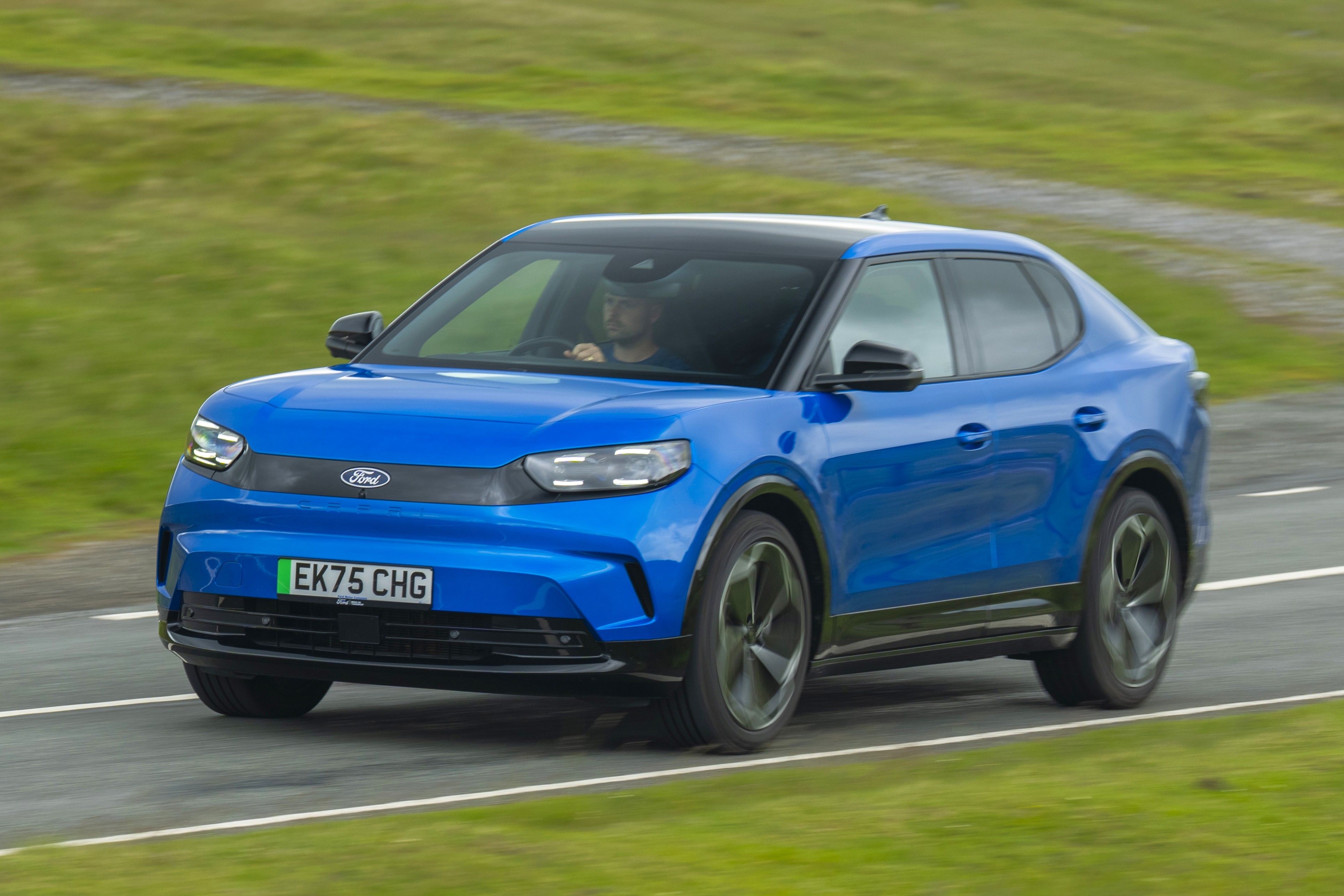
Another retired name was dusted off, but this time to something of a furore – at least among those fond of earlier, sportier iterations. Yes, it appears that the Ford Capri name is held in very high regard among people of a certain age, but the fact it’s a coupe version of the Explorer doesn’t wash with them.
Quite what people who don’t remember Capris of old make of the newcomer is debateable, but given they’re seldom seen compared with Explorers, suggests there’s little about its styling which is winning people over, regardless of what it’s called.
In most regards, the Capri is very like the Explorer in most regards, with identical interiors save for slightly reduced rear seat headroom, although most adults will still be fine back there. Although its shape prevents tall items from being stood up in the boot, there’s up to 102 litres of extra space back there overall at 572 litres, so it’s not without practicality. To drive it feels that bit more engaging than the comparable Volkswagen ID.5, but ultimately the Ford Capri’s a family car that looks a bit sporty rather than something which prioritises driver satisfaction over other concerns.
Only the entry-level Capril Style 58kWh 190PS receives the government’s ECG discount, but we’d forego that to plump for the Select 79kWh 286PS at £43,285 thanks to its claimed driving range of 389 miles instead of 286. That’s also 15 miles further than the comparable Explorer will travel. You can recharge the 79kWh battery at speeds of up to 183kW, zapping it from a 10-80% state of charge in 29 minutes.
Ford Mustang Mach-E
Launched in: 2020
.jpg)
Spend a few minutes wandering around the Ford Mustang Mach-E and you’d be forgiven for not even realising it was a Ford at all. You’ll struggle to find a blue oval badge anywhere because almost all of the branding relates to the Mustang’s galloping pony emblem.
Given how closely the V8-engined Ford Mustang is held to the hearts of Americana enthusiasts, you can understand the company’s reinforcement that the Mach-E is an electric SUV to complement its sports car namesakes, not replace them. The Mustang link – however tenuous it is – also enables Ford to charge for it accordingly, with prices ranging from just shy of £51,000 to approaching £75,000.
Thankfully, the Mustang Mach-E’s interior decor feels just about appropriate for the price – certainly at the lower end of the scale – and there’s a generous amount of room inside its large body for five people. Shame that its boot space is so compromised, though – at 402 litres it’s less accommodating than the smaller models it shares showroom space with.
It does, at least, feel rather entertaining to drive, being far nimbler and more responsive than a car of this size typically would be. Its ride quality is fine at higher speeds and where the road surface is glass-smooth, but around town over substandard asphalt the Mach-E has a tendency to jiffle and fidget.
Unless you regularly need to cover long distances without recharging, stick with the Mustang Mach-E Select Standard Range – its claimed range is 292 miles compared with the Premium Extended Range’s 382 miles. It’s also £9500 cheaper, yet the only significant equipment shortfalls are adaptive headlights which turn the beam as you steer and electrically adjustable front seats.
High-speed recharging is capped at 150kW but connected to a charger capable of that rate of energy flow a 10-80% top up takes 33 minutes.
Ford E-Tourneo Courier
Launched in: 2023
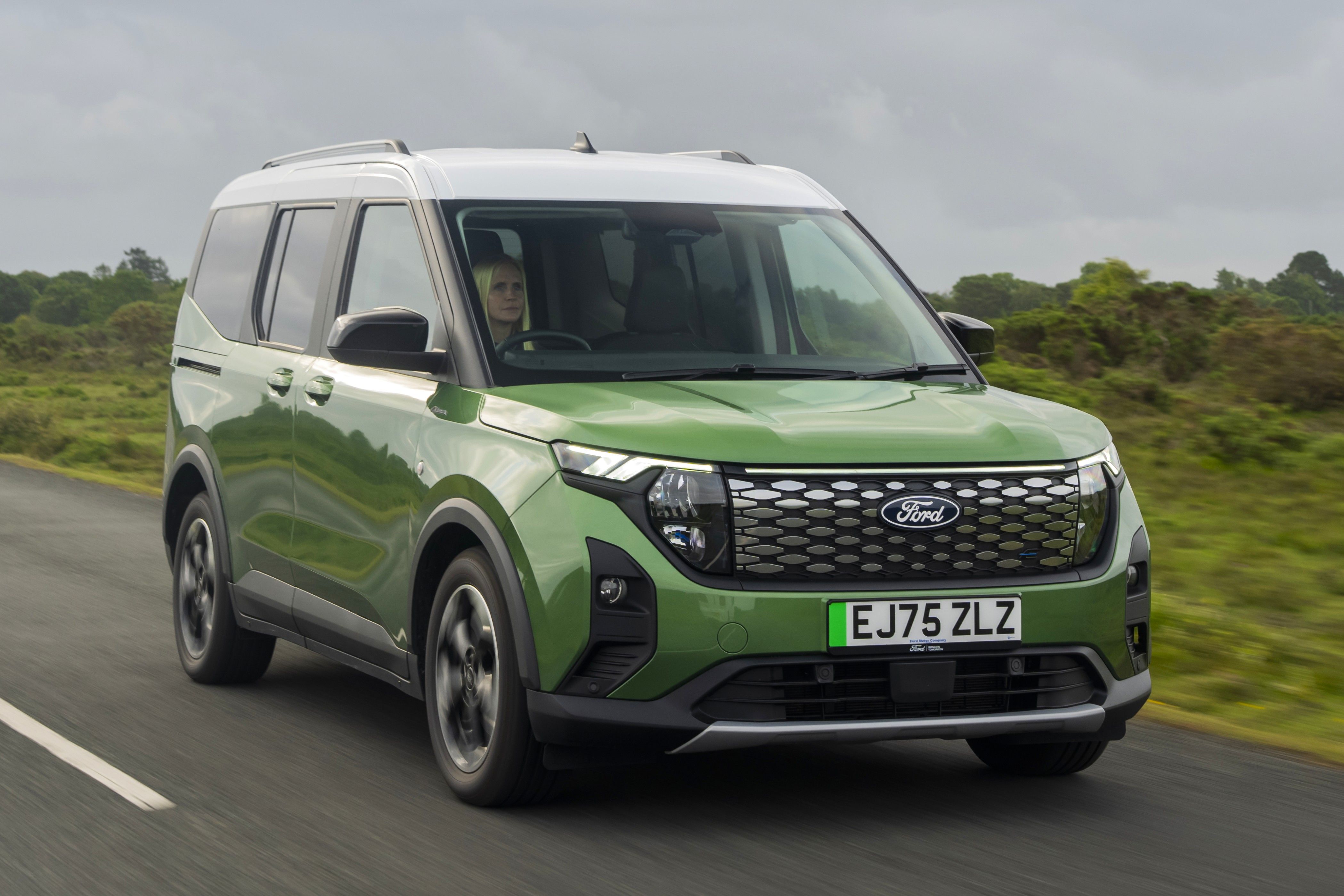
While it’s unlikely to surprise you to learn that the Ford E-Tourneo Courier is a five-seater car derived from the E-Transit Courier van, what might pique your interest is that it shares much of its underpinnings with the Ford Puma Gen-E, albeit only with 136PS of power to play with.
That lack of performance isn’t of great importance, because the E-Tourneo Courier is designed to be an efficient, super-practical yet compact family car first and foremost – and it excels in those regards – yet the Puma link also ensures it’s more fun to drive than it has any real right to be.
Its tall bodywork and perpendicular tail ensure that there’s ample room aboard for five people – with the added convenience of sliding doors to get into the back, reducing the chances of car park dings caused by enthusiastic door swinging – plus masses of space in the boot for carrying all manner of family detritus.
Unfortunately, those upright lines also mean the Ford lacks aerodynamic grace, with a low driving range from its 46kWh battery being the penalty – officially, the E-Tourneo Courier will achieve an average of 198 miles at best. When connected to a 100kW public charger you can zap the battery from 10-80% charge in 26 minutes.
While it’s hampered for longer runs, it works very well the rest of the time and if you go for the Ford E-Tourneo Courier Active and specify a contrasting white or black roof, it could even pass for a miniature Land Rover Defender. If you half-close your eyes.
Inclusive of the ECG discount, prices for the entry-level Titanium grade start at £29,940, while the Active is £1200 more.
Ford E-Tourneo Custom
Launched in: 2023
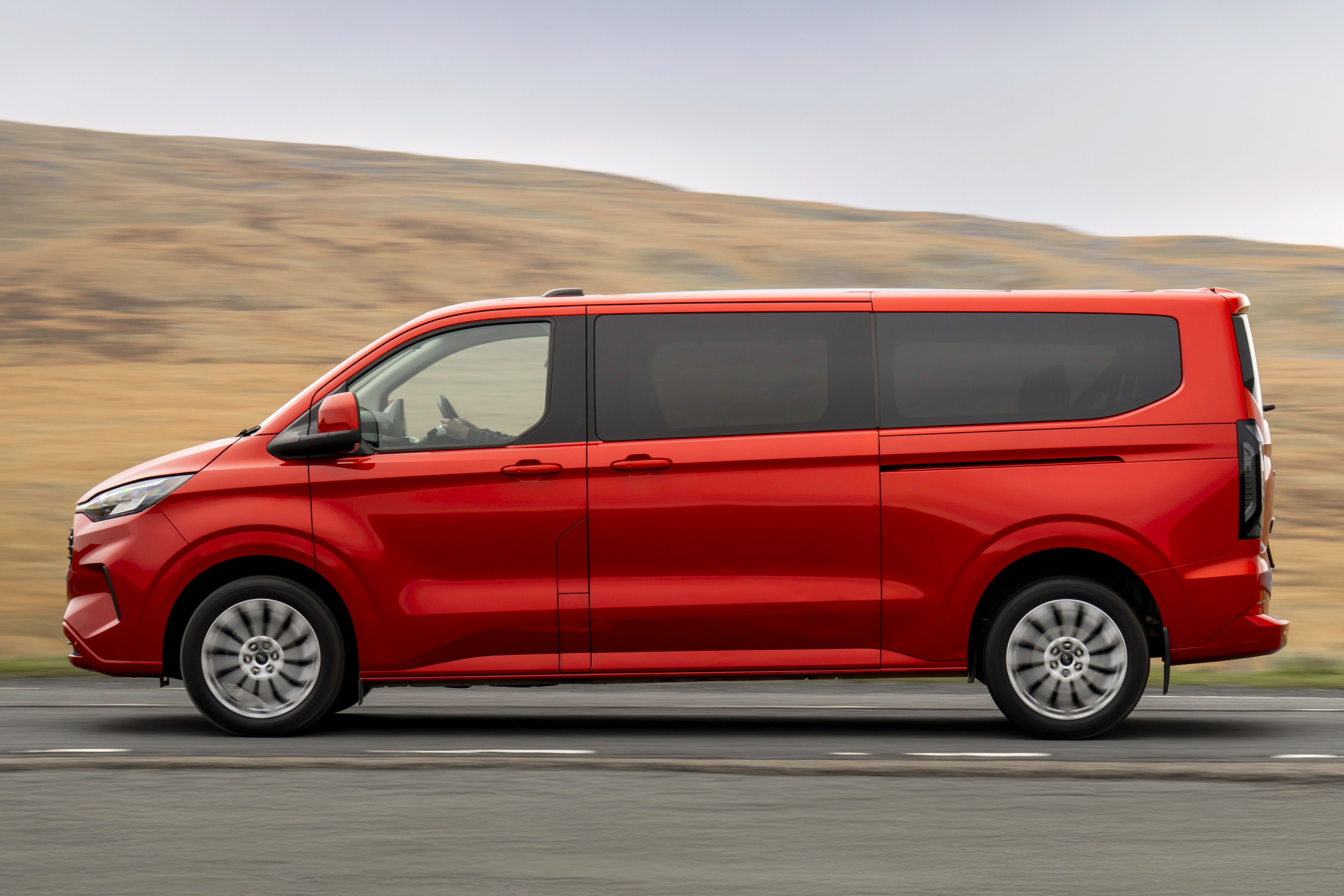
Yes, you guessed it – the Ford E-Tourneo Custom is the MPV version of the electric E-Transit Custom panel van, with space aboard for six, seven, eight or nine passengers depending upon how you choose to specify it.
Reminiscent of how most Ford model line-ups used to be, the assortment of E-Tourneo Customs available is particularly complex, with seven trim levels and two body lengths. We would advise sticking with the shorter body in Zetec specification with nine seats if you’re seeking value and Titanium X Luxe with six individual chairs if you’re craving something plusher.
Dig deep because prices start at a smidgen over £57k. Yes, start. Should you feel so inclined, that can go as high as £78,587 without even troubling the vast array of extra-cost options.
At the top of the range is the body-kitted E-Tourneo Custom MS-RT, available in an array of garish colours. While it has the same 71kWh battery fitted to all models, its power output has been ramped up to 285PS from the others’ 218PS maximum, to the detriment of claimed driving range. While the most efficient can just stretch it to 210 miles, that drops to a worst of 168 miles for the MS-RT.
Driving the E-Tourneo Custom isn’t that far removed from the impressions given by the Puma Gen-E, albeit on a far larger scale and a comfier ride quality on larger alloy wheel sizes. There’s masses of space for adult-sized passengers wherever they’re sat, with up to 999 litres of boot space behind the third-row seats in the longest versions.
If the idea of the E-Tourneo Custom appeals to you but the Ford badge is a tad too blue collar for your liking, it’s essentially the same vehicle sold with a few styling differences as the Volkswagen e-Transporter Shuttle.
Although Ford was late to making a serious effort in selling electric cars, it has dabbled in the past. In 1967 it revealed the two-seater Ford Comuta electric city car and ran a small number of them in the UK for trials, but the 37-mile-range model was never sold to the public.
Few will remember it – and even fewer bought one – but between 2013 and 2017 the company did sell the Ford Focus Electric.
Based on the third-generation Focus hatchback, there was a single, nameless, but high-specification trim level featuring goodies such as keyless entry, climate control, a reversing camera, an auto-dimming interior rear-view mirror and LED ambient lighting.
Slotted underneath was a 23kWh battery pack which gave the Focus Electric a potential driving range of up to 100 miles. Good grief. Still, because the power pack was so small, a flat-to-full recharge using a 7.4kW domestic wallbox could take as little as four hours.
How much? Erm… Well, after the £5000 government plug-in car grant had been removed, it chimed in at launch at £28,580 in September 2013. That might not sound unreasonable in 2026, but for reference, the 250PS Ford Focus ST-3 Estate was only £26,595 at the time. Ouch. Now you know why Ford didn’t sell many Focus EVs.
That situation’s become rather fluid in recent times, with Ford stepping away from its previous suggestions that it would be EV-only by 2030.
It’s already committed to producing at least a couple of new family sized SUV models with plug-in hybrid drive systems as well as electric-only power from 2028, which may remain on sale until such propulsion methods are banned from new sale in 2035.
Well, no names have yet been confirmed, but given Ford's penchant for reusing its former model names, there's a strong likelihood that the Fiesta name might make a comeback in 2028 on a small electric car. Unless it opts to go with Anglia or Prefect, of course.
The 'new Fiesta' will be an EV and based heavily on the Renault 5 E-Tech's platform. What's not yet known is how much – if at all – it will look like the donor car. Using the electric Nissan Micra as an example, its bodywork is almost entirely different from the R5's, but because the structyre its attached to is unchanged, its overall shape is very similar.
This depends on many factors, not least the battery capacity and how powerful the charger is that's plugged into it.
Broadly speak, when using public chargers, Ford's EVs can typically increase from a 10-80% state of charge in 25-35 minutes. When using a 7kW domestic wallbox charger, a 0-100% recharge will take anywhere between 10 and 16 hours.
Find an electric Ford for sale
- Images coming soon!0
Ford Mustang Mach-E197kW Select 72kWh RWD 5dr Auto
20262,066 milesElectric£30,678
NP194SL Ford Tourneo Custom160kW 65kWh H1 Titanium X 8 seater Auto
20263,125 milesElectric£34,000
NP194SL- Images coming soon!0
Ford Puma123kW Select 43kWh 5dr Auto
Electric£29,995
B57AZ Ford Tourneo Courier100kW Titanium 46kWh 5dr Auto
Electric£33,882
GL25YBFord Capri210kW Premium 79kWh 5dr Auto
Electric£43,799
GL25YBFord Capri210kW Premium 77kWh 5dr Auto
20251,998 milesElectric£30,500
PR22YQFord Puma124kW Premium 47kWh 5dr Auto
Electric£27,668
B57AZFord Puma124kW Premium 47kWh 5dr Auto
Electric£26,568
B57AZ
More electric car guides
From choosing the right EV to understanding charging, running costs and more, our guides can help.